
Open this photo in gallery:
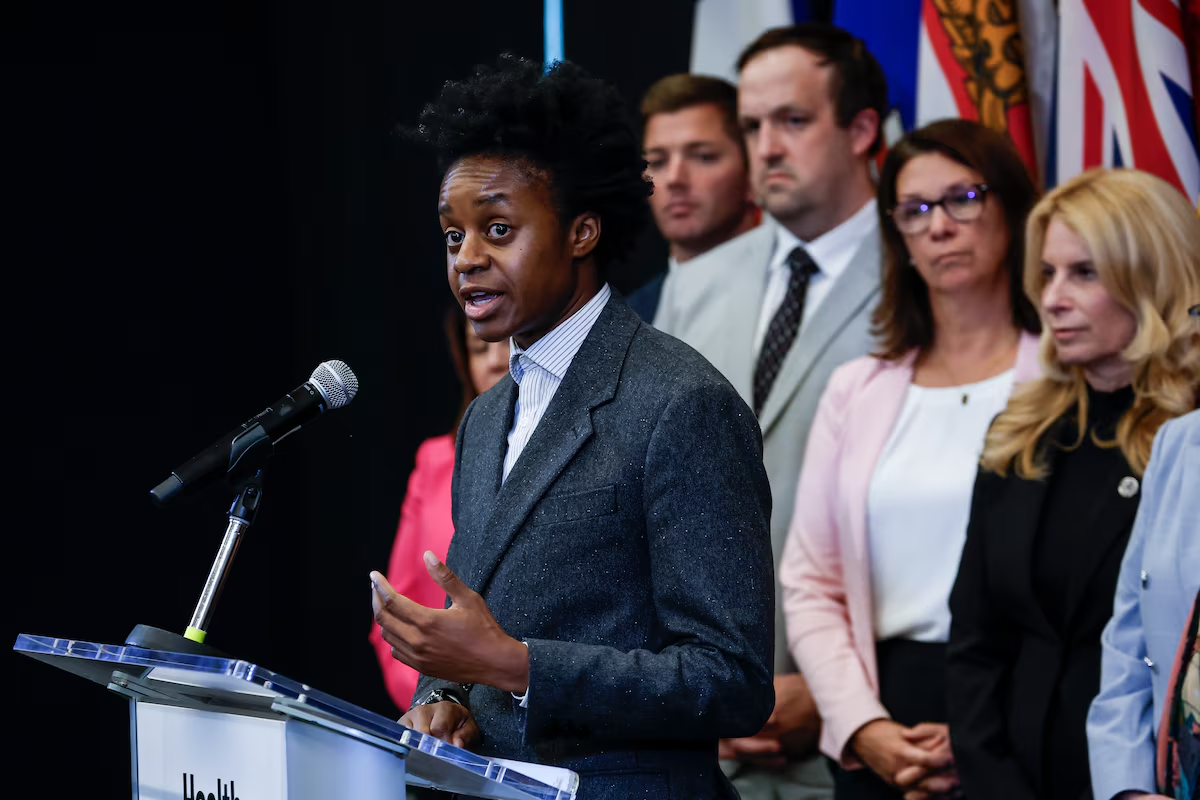
Uzoma Asagwara, Manitoba’s health minister, speaks during the Provincial-Territorial Health Ministers Meeting news conference in Winnipeg, on Thursday.John Woods/The Canadian Press
Canada’s provincial and territorial health ministers say Ottawa’s one-year extension of funding for mental health, addiction treatment and home care is not enough, and that federal plans would amount to a spending cut that is “the largest in a generation.”
The ministers made the comments on Thursday at the end of their first day of discussions in Winnipeg, where they are meeting this week during a particularly strained period for hospitals and medical facilities across the country.
Late on Wednesday evening, federal Health Minister Marjorie Michel announced on social media that Ottawa plans to extend for a year programs that were set to expire in 2027, which she said would represent $1.2-billion in funding. But her territorial and provincial counterparts said that change is inadequate and comes at the last minute.
“We welcome the important first step from Minister Michel,” said Uzoma Asagwara, Manitoba’s health minister, speaking alongside officials from all 13 provinces and territories.
“However, it is a first step. We are unified in stating very clearly that we need to go much further than that.”
Mx. Asagwara said the ministers are pushing for longer-term commitments on bilateral agreements. Health ministers want the Canada Health Transfer, the federal government’s main funding vehicle for provincial health care, to grow at a minimum of 5 per cent a year, rather than the 3-per-cent growth rate it is expected to reach in 2028, they said.
As part of the Canada Health Act, jurisdictions in the country must be made federal transfer payments on a per-capita basis.
“How do we work with patients and clients and families and communities? How do you plan when you do not know what the federal government’s plans are for – again – what would potentially be the largest cut to health care in a generation?” Mx. Asagwara said.
Open this photo in gallery:
Ontario Health Minister Sylvia Jones says many funding streams in the province would have to be cut in half without federal support.John Woods/The Canadian Press
Ontario Health Minister Sylvia Jones added that Ottawa’s temporary commitment “does not fill us with a lot of joy.”
She said discussions with Ms. Michel, who is expected to meet with provincial and territorial ministers Friday, will focus on these issues.
“We all have different programs that we have started in our jurisdictions,” Ms. Jones told reporters, adding that many funding streams in Ontario would have to be cut in half without federal support.
The federal budget is expected to be tabled in the House of Commons this fall, though a date has not yet been announced.
Ms. Michel made no further comments on the matter on Thursday. In her announcement, she said she looks forward to Friday’s meeting.
In an interview, Bolu Ogunyemi, president of the Canadian Medical Association, said physicians agree with the provincial and territorial health ministers. He described Ms. Michel’s announcement as “insufficient from a planning perspective.”
“Certainly, we need longer-term, sustainable funding to allow for stability and certainty,” Dr. Ogunyemi said in Winnipeg. “The demographics in our all cities and jurisdictions are changing, and the federal government needs to support that for us to deliver appropriate care.”
The Canadian Federation of Nurses Unions echoed Dr. Ogunyemi’s calls.
MP Gord Johns, health critic for the federal NDP, said he expects more from Ottawa.
In a statement, he said Ms. Michel must apply 6-per-cent annual increases to the Canada Health Transfer, while covering 35 per cent of provincial and territorial health care costs.