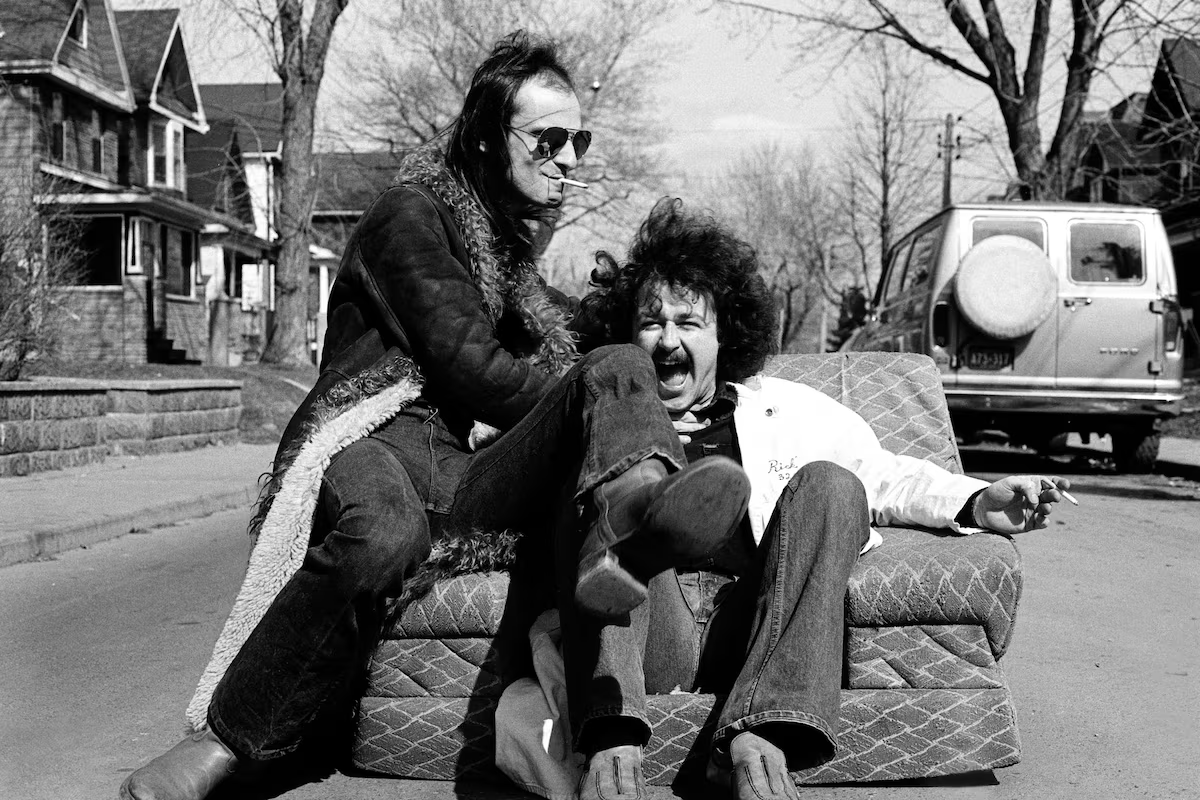

Open this photo in gallery:
Kim Mitchell, left, and Pye Dubois on the street in front of the band’s house in Toronto.Patrick Harbron/Supplied
On June 9, 1977, Max Webster, a band not a man, topped the bill at the city’s venerable Massey Hall for the first time. The stylish Toronto rockers opened the concert with Oh War!, a progressive-rock protest song.
“So, so long, soldier, wash your socks and guns,” frontman Kim Mitchell sang. “And just remember if you don’t see a profit, sell your stocks and run.”
Reviews of the show that ended with three encore sets were universally ecstatic. Trade magazine RPM Weekly, for one, wrote that the band “held the audience on the edge of their seats with a very tight set, both musically and stage-wise.”
Bob Mackowycz of Q107 (CILQ-FM) was particularly impressed with the lyrics: “They’re written by some bizarre character named Dubois. … He writes these surreal crazy songs about things like driving to the moon drunk or meeting a groupie in the washroom. They’re surreal, but the words really express Max Webster’s vision, which I guess is best summed up by the word ‘absurd.’”
The bizarre character was Pye Dubois, the band’s lyricist and non-performing fifth member. He made a rare public appearance at Massey Hall, briefly popping on stage and waving to the audience before Toronto Tontos, a song with bilingual lyrics: “Nous sommes fous/ Put down a little life from a morning cosmic.”
Mr. Dubois was born Paul Woods. (“Dubois” translates to “from the woods.”)
If nothing else, the sighting dispelled any rumours that the invisible songwriter may have been a fanciful creation cooked up by the band’s publicity people and record label. It was, after all, the seventies, a decade in which the mysterious Canadian band Klaatu was initially thought to be the Beatles undercover.
He had a big head of curls and an unapologetic mustache − a stockier Kurt Vonnegut. At Massey Hall, the man wore a white lab coat. Which was appropriate enough for the lyrical mad scientist of Canadian rock ’n’ roll.
Mr. Dubois died on Sept. 15. He was 77 and had been living in London, Ont. No details of his death were provided by the family in the death notice.
He was the chief word supplier for Max Webster, whose eclectic music was once described by Mr. Mitchell as “high-class curiosity rock.” Mr. Dubois wrote obsessively, supplying countless sheets of paper full of poetry and far-out ideas he called “flourishes” that could be edited into singable songs.
“For me, Pye was the most important part of the band,” said Martin Popoff, author of A Million Vacations: The Max Webster Story.
“He was a full creative partner,” author and musician Dave Bidini said. “The band counted on him.”
Mr. Dubois’s death is one of several in the Max Webster world this year. The band’s drummer Gary McCracken and keyboardists Terry Watkinson and Jim Bruton all died in 2026, as did Kim Mitchell’s drummer, Chris (Suds) Sutherland, and songwriting collaborator, Jim Chevalier.
Both Mr. Dubois and Mr. Mitchell hailed from Sarnia, Ont. Their songwriting relationship continued post-Max Webster into Mr. Mitchell’s more commercially successful solo career. Royalties from the co-written mid-eighties hits Go for Soda and Patio Lanterns helped sustain him.
He also contributed to four songs recorded by legendary Canadian prog-rock trio Rush: Force Ten, Between Sun and Moon, Test for Echo and Tom Sawyer. The latter was one of the band’s most enduring hits.
“In my company, Pye was always very friendly and upbeat but remained a rather private person when it came to his life outside music. His background was more of a matter of speculation than fact for those of us outside their band,” Rush singer-bassist Geddy Lee told The Globe. “Adding his voice to our songs gave it a different twist, and twists and turns in our music were what Rush was all about.”
Mr. Dubois was inducted into the Canadian Songwriters Hall of Fame in 2021 with songwriting partner Mr. Mitchell but never picked up his trophy. “I still have it,” Mr. Popoff said. “Pye was a little bit of an enigma. Some people described him as reclusive, but I would characterize him as secretive.”
Mr. Dubois held down a job for years at Toronto’s Clarke Institute of Psychiatry (now part of the Centre for Addiction and Mental Health).
He was a fan of Frank Zappa, Joni Mitchell, Kate Bush and fellow inscrutable persona Captain Beefheart, and was among a unique class of non-performing rock lyricists associated with a particular band: Pete Brown with Cream; Keith Reid with Procol Harum; Robert Hunter and John Perry Barlow with the Grateful Dead.
Despite not being a musician, Mr. Dubois toured with Max Webster, living and documenting the rock ‘n’ roll dream like a war correspondent embedded with troops.
“If I’m not on the road with those guys, songs like The Party and Oh War! and America’s Veins don’t happen,” he once said.
From his spot backstage, he observed the interaction between fans and musicians. On The Party, for example: “We’re all here for a celebration, the madcap scene and the max machine.” The 1979 single Paradise Skies poetically captured the thrill and mystique of live music:
Tonight, inaugurates rock and roll wings
Tonight, we’ll turn the world around
And we’ll hover and we’ll leave the ground
And the magic we need frees the dancer we wanna be
Open this photo in gallery:
Dave Myles, Pye Dubois, Kim Mitchell and Gary McCracken in front of the band’s Toronto home in March, 1978.Patrick harbron/Supplied
Mr. Mitchell’s 1989 double-Platinum solo album Rockland was co-written with his wordsmith wingman. The biggest hits were Rocklandwonderland and Rock N Roll Duty. The latter song took just a half-hour to come together.
“I had the riff and Pye came over and I started to sing nonsense to the changes, and he just went for writing lines down,” Mr. Mitchell said. “Thirty minutes later it was finished. [It’s] the only song that went that fast.”
The last of Mr. Mitchell’s albums the pair wrote together was 1994’s Itch. “I’m sure they had a complicated relationship,” Mr. Wegner said. “They were making music intensely together for 20 years.”
Though Mr. Dubois’s lyrics could be abstract and free-form, he did consider who would be singing his words. “I remember him telling me that he liked the way “r” sounded on Kim’s voice. So, sometimes to that end he would favour one word over another in a lyric,” said Todd Booth, who also collaborated with Mr. Mitchell.
Mr. Dubois’s last songwriting co-credit was for Rush’s Test for Echo, a biting critique of modern media and the American justice system, which reached the top of Billboard’s mainstream rock airplay chart in 1996. “What a show,” the chorus went. “Vertigo.”
Paul Phillip Woods was born on Oct. 6, 1948. His parents were Sam Woods and Noreen Woods. Part of his upbringing was portrayed in Mr. Mitchell’s 1986 hit Patio Lanterns, a hummable, nostalgic and autobiographical song about middle-schoolers drinking lemonade, listening to Bobby Vinton’s Blue on Blue and working up the nerve to ask for a dance at a patio party in the early 1960s.
Growing up, Sarnia native Mary Ellen Wigle lived behind the Woods family’s house. Because she was years younger than Mr. Dubois and his friends, she could only watch the parties from her bedroom window.
“I vividly remember the backyard with a big tree and the patio lanterns that were there every summer,” she said. “Patio Lanterns paints a picture of an idyllic time. You’re young, you’re shy and you’re just beginning to have feelings for the opposite sex.”
Mr. Dubois’s upbringing, however, was not altogether idyllic. While attending St. Clair Secondary School (since renamed Great Lakes Secondary School) he left home to stay with a friend’s family.
“I didn’t like my parents and they didn’t like me, so I thought I’d try to survive adolescence on my own,” he said in a 1979 Toronto Sun interview.
He began writing lyrics at the age of 13. Though Mr. Dubois and Mr. Mitchell did not attend the same high schools, they shared the directionless glory of coming of age in small-city Ontario.
“We’d walk the streets and we’d skip high school and be smoking cigarettes out the back,” Mr. Dubois told biographer Mr. Popoff. “I can remember a couple basements we used to go to. The parents would let us go and we’d listen to Zappa’s 200 Motels or something. Someone usually had a joint.”
While enrolled at Lakehead University in Thunder Bay, Mr. Dubois split for Greece, where Mr. Mitchell had landed a steady gig with a crooner. The guitarist recalled the incident in a 1982 interview with Music Express magazine.
“I’m living on one of the Greek islands, no one knows where, and Pye decides to visit me. He flies to Greece, gets a boat to the right island − all of this on instinct − takes a cab to the town and stopped in front of three or four apartment buildings. He picks the one that hasn’t been finished, walks up to the third floor, down the corridor and opens the door to my room, where I’m sleeping. I mean, the guy’s a bit … psychic, I think. Too many things like that have happened.”
The pair would collaborate on all five Max Webster albums, beginning with the band’s 1976 self-titled debut. Their songwriting on Mr. Mitchell’s solo efforts produced the enduring summer rock anthems I Am a Wild Party and Lager & Ale.
“My favourite is Go for Soda, with the line, ‘Might as well go for a soda, nobody drowns and nobody dies,’” said singer-songwriter and Sarnia native Donovan Woods. “It always makes me think of kids jumping off the base of the Blue Water Bridge outside of Sarnia and letting the current haul you down the St. Clair River, which people, including me, often did drunk. Some drowned.”
Though not specifically about the perils of drinking and driving, Go for Soda was adopted as an anthem by Mothers Against Drunk Driving.
“That type of slogan songwriting is kind of amazing,” Mr. Woods said. “When you read the titles, it seems like they’d all run the risk of turning schlockey, but they don’t. There are lots of ideas in all of them.”
Mr. Dubois’s lyrics were typically evocative, whether their meaning was vague or more straightforward. He told the Toronto Sun in 1979 that his function as a lyricist was to show people aspects of reality: “I could never do something as pretentious as persuade them.”
His songwriting partner appreciated Mr. Dubois’s gift for metaphor and symbolism rather than clean narratives. “He built pictures in your mind and images, and that’s what I loved about his stuff,” Mr. Mitchell told The Toronto Star’s Nick Krewen in 2021.
If his lyrics were hard to pin down, so was Mr. Dubois. He kept a low profile after he stopped working with Mr. Mitchell. In Toronto he could be found at the Detroit Eatery, a neighbourhood institution on Toronto’s Danforth Avenue destroyed by fire in 2019. In retirement he divided his time between Florida and Ontario.
“He battled himself a little bit,” Mr. Bidini said. “He would come to see our band, Rheostatics, but then leave before we got on stage. He was a little ghostly in that way. He was there, and then he wasn’t.”
Mr. Dubois leaves his brothers, Dave Woods and Rob Woods.
You can find more obituaries from The Globe and Mail here.
To submit a memory about someone we have recently profiled on the Obituaries page, e-mail us at obit@globeandmail.com.