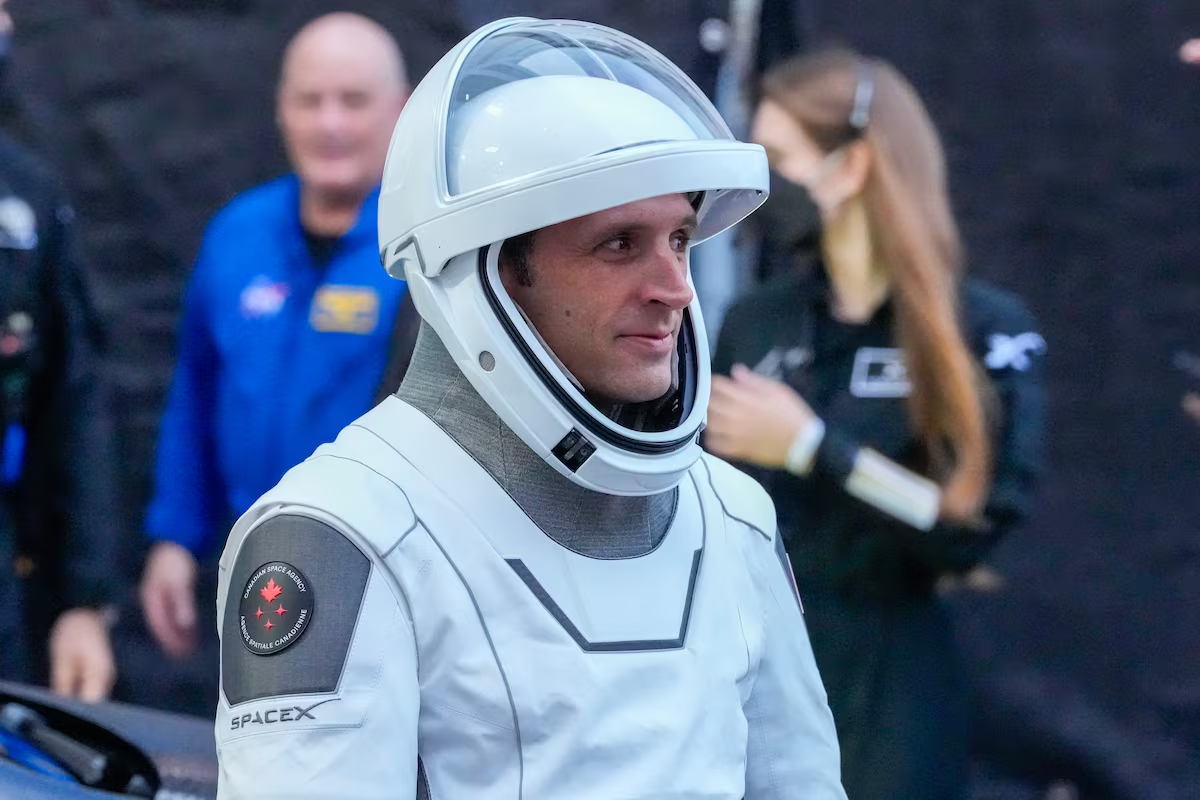

Open this photo in gallery:
Canadian astronaut Joshua Kutryk leaves the Operations and Checkout Building at the Kennedy Space Center in Cape Canaveral, Fla., earlier this month.John Raoux/The Canadian Press
Canada’s latest space traveller, Joshua Kutryk, may be far from home, but home is rarely out of sight, the astronaut said in his first conversation with reporters since arriving at the International Space Station.
“We’re actually over Canada right now,” he said during a live press briefing from space that was held on Tuesday. “We’re about to cross over Vancouver, and then we’ll be coming down over the top of Quebec and right over Sept-Îles about the time this interview is wrapping up. So, I do get to see the country a lot from here.”
Col. Kutryk, a native of Fort Saskatchewan, Alta., and three crewmates blasted off for the station on Oct. 1. Following a crew switchover that was completed a few days later, he is one of seven astronauts on board the orbiting laboratory.
Canadian astronaut Joshua Kutryk says he’s having a blast on the International Space Station but the mission also shows how Canada can contribute to the leading edge of space flight. Kutryk is on a six-month mission to the ISS.
The Canadian Press
A former test pilot with the Royal Canadian Air Force, Col. Kutryk described the sensation of riding into space in a capsule atop a SpaceX Falcon 9 rocket as “exhilarating,” “spectacular,” “powerful” and “violent.”
“Your mind is alive, trying to bring in all these new experiences and feelings and sensations – things you’ve trained for, but never really felt for real.”
He added that once all the procedures and checks were completed after the launch, he was able to unclip his seatbelt and work his way to a window to look out at Earth spinning below. At that moment, he said, “your mind doesn’t know what to do.”
Col. Kutryk is the first Canadian to spend time on the ISS since Montreal businessman-philanthropist Mark Pathy made a self-funded visit in April, 2022, and the first to be on a long-duration mission at the space station since astronaut David Saint-Jacques returned from a six-month stint in June, 2019.
During the media briefing, which was conducted by video link, Col. Kutryk said he was just beginning to get down to the work of conducting the many science experiments on his to-do list, including several developed by Canadian researchers.
Open this photo in gallery:
A SpaceX Falcon 9 rocket carrying the company’s Dragon spacecraft is launched on NASA’s SpaceX Crew-13 mission to the International Space Station.Joel Kowsky/The Canadian Press
Among them are some that focus on mitigating the effects of microgravity on the human body, including bone and muscle loss.
Col. Kutryk noted that he had weighed himself after his first week in orbit and was down about five pounds.
He also showed that he was wearing a special sensor shirt associated with a Canadian-led experiment called AstroFit. The shirt is designed to provide 48 hours of continuous monitoring of heart rate, respiration and oxygen levels. It also features a built-in accelerometer that measures the wearer’s activity level, including when using an exercise device called a cycle ergometer.
Based on studies done with subjects under continuous bed rest on Earth, the experiment is designed to test the effectiveness of a fitness protocol that breaks up prolonged inactivity with exercise during three separate times in an astronaut’s day.
“We can track changes in his physical fitness by monitoring heart rate while he does the same session on the cycle ergometer early in flight, the mid-point of the flight and again in the final few weeks of the flight,” said Richard Hughson, a professor emeritus at the University of Waterloo and principal investigator for AstroFit.
Open this photo in gallery:
NASA’s SpaceX Crew-13 crew members (left to right) Canadian Space Agency astronaut Joshua Kutryk, NASA astronauts Luke Delaney and Jessica Watkins, and Roscosmos cosmonaut Sergey Teteryatnikov walk out of the Neil A. Armstrong Operations and Checkout Building ahead of the launch in Florida.Justin Sullivan/Getty Images
Col. Kutryk said that, for him, the biggest challenges related to life in space involve having to figure out how to do basic things like eating and sleeping.
“You have to sort of learn to do everything again, almost like you’re a child,” he said.
The payoff, he added, was experiencing the novel environment of the ISS and seeing one amazing sight after another, including a brilliant display of Northern Lights, which the crew observed over the weekend.
“To see the whole Earth – the curvature of the Earth – just embraced by this blanket of dancing fluorescent oranges and yellows and pinks is magical,” he said.