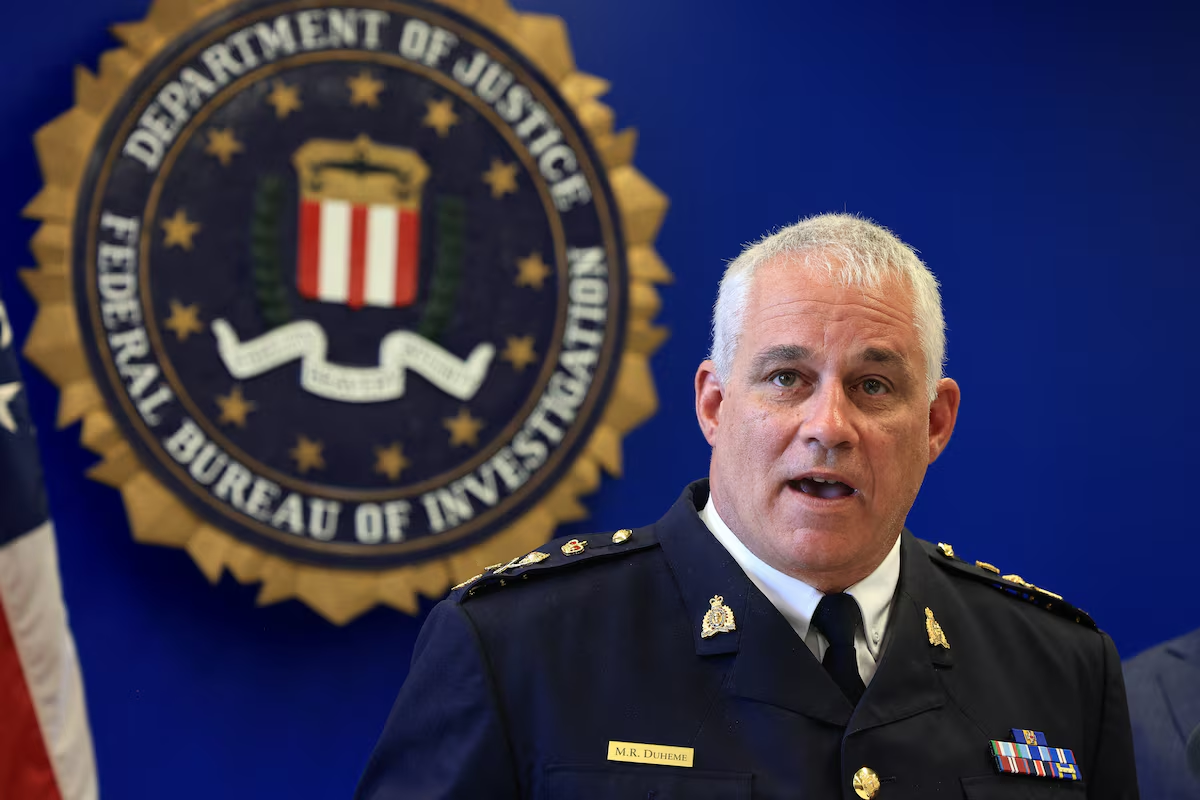

Open this photo in gallery:
RCMP Commissioner Mike Duheme speaks as U.S. and Canadian law enforcement officials announce federal charges and arrests of alleged members of a transnational organized crime group, in Los Angeles, on July 7.David Swanson/Reuters
Canada’s national police force says it will continue to strengthen ties with the U.S. Federal Bureau of Investigation, even as experts warn against deepening the relationship at a time of growing divergence between the neighbouring countries.
This year, RCMP-FBI co-operation has been credited for dismantling gangs such as Ryan Wedding’s alleged drug-trafficking organization, with Mountie Commissioner Mike Duheme appearing alongside Trump administration officials to announce these takedowns.
“Given the shared border between Canada and the United States, the RCMP works closely with U.S. law enforcement partners,” RCMP spokeswoman Jessica Kingsbury said in an e-mail to The Globe and Mail, adding that “expanded operational collaboration with U.S. agencies has enhanced threat identification, information sharing, and contributed to high-profile arrests.”
However, in a new book, Kent Roach, a law professor at the University of Toronto who chaired the RCMP’s management advisory board in 2023, argues that the Mounties have grown too dependent on the FBI.
Prof. Roach writes that the Mounties have relied on the bureau’s tips to learn about impending terrorist attacks and other national-security threats to Canada, and they are also embracing FBI-led partnerships to put some of Canada’s most wanted criminals before U.S. courts. He argues, however, that this is not addressing the obstacles in the Canadian criminal-justice system against tackling complex crime and also exposes Canadian police to U.S. administrations who are being accused of politicizing policing.
FBI charges alleged Bishnoi gang member in California over threats against B.C. victim, RCMP say
“We have to imagine a world where the Americans, and specifically the FBI, may be less reliable partners,” Prof. Roach said in an interview. “We need to be able to do these complex national security, and also financial crime and organized crime prosecutions, as part of our sovereignty.”
In Prof. Roach’s book, Red Alert, he says U.S. law enforcement agencies are being politicized. He adds that Canada’s federal government has yet to address longstanding calls for structural RCMP reform, which has left the FBI filling gaps in Canadian law enforcement. A 2023 report from a committee of parliamentarians said the Canadian government might need to strike up a new national police force entirely, if it could not better enable the RCMP to tackle transnational crime.
Prof. Roach also criticizes the response of former prime minister Justin Trudeau to U.S. President Donald Trump, who imposed emergency tariffs on Canada in 2025 over concerns that fentanyl was flooding from this country into the U.S. (A Globe investigation found Mr. Trump was using misleading data about drug seizures at the border to justify the tariffs.)
Mr. Trudeau promised to be a better security partner to the United States, with his government pledging hundreds of millions in new funds to hire more Mounties and also leasing Blackhawk helicopters to patrol the border.
“I think Trudeau was panicking over Trump,” Prof. Roach said in an interview.
RCMP bill for chartering Black Hawk helicopters to patrol border set to top $50-million
Over the past two years, the RCMP has unveiled operational partnerships with the California FBI that are now being credited for taking down transnational gangs.
Mr. Wedding, a former Canadian Olympic snowboarder, was among the FBI’s most-wanted fugitives when he was arrested in Mexico in January on multiple charges of drug trafficking and murder conspiracy. He had spent more than a decade on the run and is now set to stand trial in Los Angeles, where he has pleaded not guilty.
About 30 individuals tied to his gang have been arrested under U.S. laws, according to indictments filed in California. At least 12 of those accused have been arrested by police in Canada and most are fighting extradition.
Canada’s top police official was in California as FBI Director Kash Patel escorted a shackled Mr. Wedding off a U.S. plane after he was apprehended in Mexico. “This is a great day for public safety in Canada,” Commissioner Duheme said in January, adding the RCMP supplied crucial information to the FBI to help dismantle the gang.
Court documents filed in California allege Mr. Wedding and his Canadian co-conspirators trafficked tonnes of cocaine by truck and hired gunmen to kill Canadian citizens.
In another operational partnership announced in July, the California FBI and RCMP highlighted U.S. charges against 37 people allegedly tied to gangs – including ones connected to India’s most notorious crime lord, Lawrence Bishnoi.
Bishnoi gang leader charged in connection with slaying of Nijjar
The U.S. Department of Justice now alleges Mr. Bishnoi personally directed political assassinations, murders and shootings, including the slaying of Hardeep Singh Nijjar, a Canadian citizen shot dead in Surrey in 2023.
Commissioner Duheme was quoted in the U.S. DOJ statement announcing the arrests, saying that “together, we disrupted the operations of organized criminals.”
The close ties have persisted despite an apparent threat from Mr. Patel on X in late August to withdraw from the FBI’s relationship with Canada. The threat was over an internal CBC/Radio-Canada guideline about removing the word “terrorism” from coverage of the 25th anniversary of Sept. 11. It prompted the RCMP to make inquiries about whether the U.S. agency had halted intelligence sharing.
Three national-security sources with direct knowledge of the probe previously told The Globe and Mail that the RCMP had not found any indication that intelligence sharing from the FBI had been interrupted. The Globe did not name the sources because they were not authorized to speak publicly about the probe. (The public broadcaster subsequently reversed the policy.)
In late September, the FBI and the Mounties held a joint press conference in Los Angeles to announce a US$1-million reward for information leading to the arrest of an Indian gangster allegedly tied to the assassination of Mr. Nijjar. And on Oct. 6, representatives from the B.C. RCMP were present with FBI officials in Seattle to announce the arrest of a 30-year-old in Washington State who authorities allege provided advice, money and technical assistance to the teenager who perpetrated the mass shooting in Tumbler Ridge, B.C., earlier this year.
Cases such as these show Canadian police are getting better at leveraging vital U.S. relationships, said Peter German, a retired former RCMP deputy commissioner.
“The United States is 10 times larger than us, it has a 10 times larger law enforcement footprint around the world,” Mr. German said. He added that U.S. laws make it easier for the FBI to obtain evidence and prosecute complex transnational crime cases. “The U.S. is much more agile at conducting a criminal investigation than we are in Canada.”
However, RCMP critics are wary of the close relationship.
“The FBI has bailed out the RCMP many times,” Mr. Roach writes in Red Alert, noting that FBI intelligence tips have kickstarted several of Canada’s most urgent national security investigations.
Prominent Sikh separatist says RCMP, FBI have warned him of new threat on his life
Ms. Kingsbury, the RCMP’s spokeswoman, said the Mounties maintain “full independence” while accepting tips about threats from foreign agencies.
Such exchanges, she said, have saved Canadian lives. “There is no doubt that the RCMP benefits from its international partnerships, including those in the United States,” she said. “The RCMP rejects the suggestion that it was ‘bailed out.’”
Other observers, however, say the Trump administration is changing U.S. law enforcement in ways which may make close Canadian partnerships fraught.
Wesley Wark, a Canadian security expert at the Centre for International Governance Innovation, agrees that the Mounties may need to be rapidly bolstered. “Acceptance of a significant degree of dependency and reliance by the RCMP on intelligence flows from the FBI now looks untenable,” he said.
Canadian police cannot be “subcontracting out our criminal prosecutions to a foreign jurisdiction,” said Paul Cavalluzzo, a Toronto lawyer. “If you become reliant on Big Brother, so to speak, you do not hone your own skills.”
Police arrest two teens in Nova Scotia, Manitoba accused of planning co-ordinated school attacks
After 9/11, Mr. Cavalluzzo served as commission counsel on the Arar commission, a judicial inquiry that unearthed how RCMP intelligence exchanges with more aggressive U.S. security agencies led to several innocent Arab Canadian citizens being secretly flown to Middle East jails where they were imprisoned and tortured by foreign agencies backed by the CIA.
Several strictures guide the RCMP’s security partnerships with international partners, said Ms. Kingsbury. The Mountie spokeswoman said the RCMP regularly runs risk assessments and also abides by the Avoiding Complicity in Mistreatment by Foreign Entities Act.
That federal law, she said, precludes Canadian officials from exchanging any information where “doing so would create a substantial risk of mistreatment abroad, including circumstances involving capital punishment.”
However, Prof. Roach, who has contributed research to most major Canadian judicial inquiries into policing failures over the past 25 years, says such guardrails may now be insufficient.
“The Trump administration loves the death penalty,” he said. He argued that Mr. Wedding’s apprehension circumvented international extradition norms, leaving the Canadian citizen exposed to potential capital punishment if convicted in California.
Mr. Roach says what Canada needs now is a radically reformed national police force better able to push its own complex cases through Canada’s courts. “We should be able to prosecute these cases,” he said.