
Open this photo in gallery:
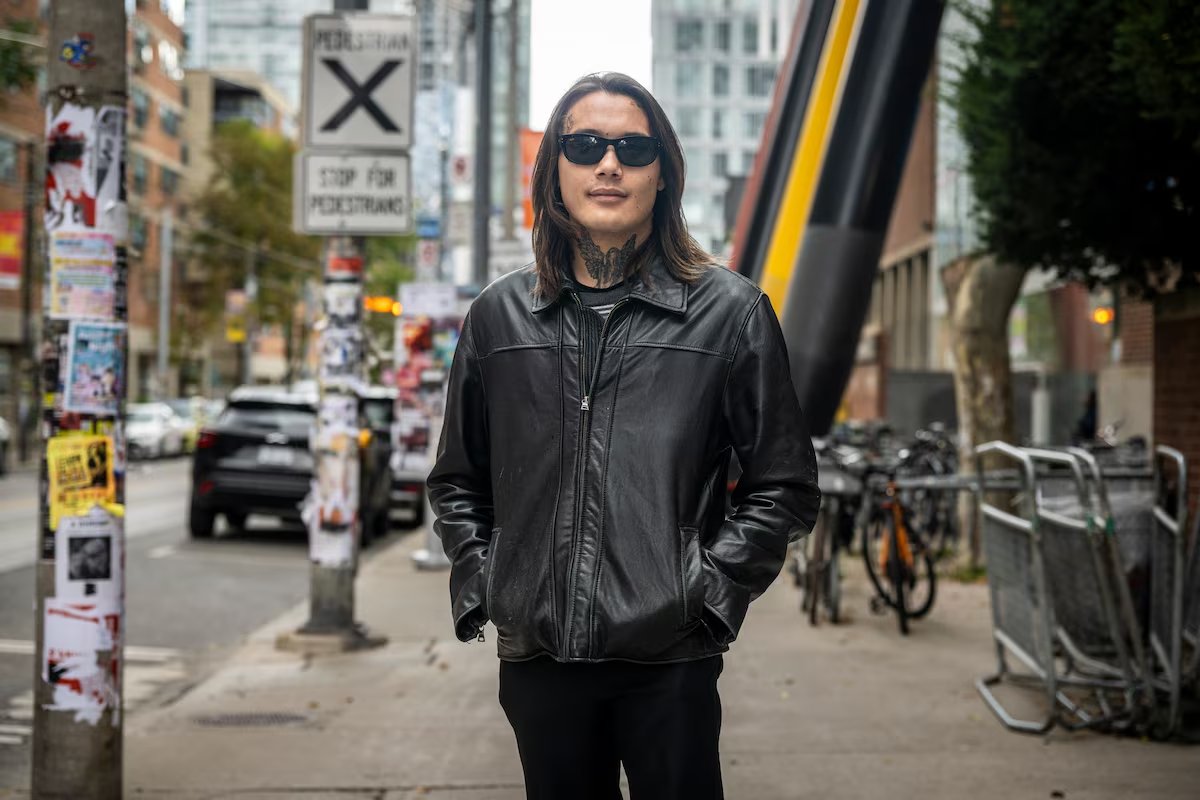
Toronto mayoral candidate Braeden Chow, Oct. 8. Political scientists say his presence on the ballot could cause voter confusion and prove consequential for Mayor Olivia Chow in a tight race.EDUARDO LIMA/The Globe and Mail
In his promotional photos, Braeden Chow dons mayoral chic: button-down shirt and loose tie. On this day, with a Globe photographer present, he opts for black Ray-Bans, a black leather jacket and black pants. He’s become the Toronto election’s man of mystery. Why not embrace the part?
With the Toronto mayoral race tightening in recent days, neither of the front-runners can afford miscast ballots. That scrutiny has wrenched Mr. Chow’s candidacy out of obscurity. He shares a last name with the incumbent, Mayor Olivia Chow, and appears immediately above her on the ballot, creating the real possibility of Ms. Chow losing voters to Mr. Chow, political scientists told The Globe.
“It’s a serious issue,” said York University politics professor Dennis Pilon. “If the numbers even up, then suddenly a candidate that surprisingly gets a few thousand votes could be decisive.”
But who is the unknown Chow?
His was a inconspicuous candidacy until Ms. Chow emerged from early voting on Tuesday to speak with reporters. They wanted to ask about Chris Alexander, the former federal candidate who had dropped out of the race that morning. She had something else on her mind.
“I just noticed there is two Chows on the ballot and there is one before me,” she said, admitting she’d nearly voted for the wrong person.
Toronto’s budget hole looms over mayoral race
Her campaign followed up with a social media post and a statement reminding voters to mark the right Chow on their ballots. Reddit commenters soon labelled him a decoy candidate, a plant and a spoiler – someone whose last name alone could siphon enough votes away from Ms. Chow to allow her main challenger, Brad Bradford, to win an ever-tightening contest.
“I’d feel bad for sure if that happened,” said Mr. Chow, who insisted nobody recruited him to the race while sitting on a bench outside the Art Gallery of Ontario and sipping a double-double. “But I’d also say Olivia could join forces with me. If I win, she’s on my team for sure.”
That’s a stretch – for a few reasons. His support has failed to register in polling.
What’s more, they have incompatible political philosophies (he wants to fund city services through donations from the rich and train 100 police to be Navy Seals, “like GI Joe and GI Jane,” he said).
And then there’s the family matter.
He insists he’s the mayor’s second cousin.
But, according to the mayor’s campaign team, that’s simply not true.
“We can confirm that Braeden Chow is not related to Olivia Chow,” said campaign spokesman Zeus Eden in a statement to The Globe. “We have no idea where he comes from. Our campaign is encouraging all voters to look to Olivia Chow, who is number 9 on the ballot.”
No hard feelings. He says he endorses Ms. Chow all the same and hopes she wins. It’s an unconventional campaign.
She could use the support. Ms. Chow’s odds of winning appeared to narrow this week, with Mainstreet Research releasing a poll on Friday showing she leads Mr. Bradford by just 2.9 points among decided and leaning voters. The poll of 1,000 people carries a margin of error of 3.1 per cent 19 times out of 20 and was conducted Oct. 6 and 7, after Mr. Alexander had withdrawn.
Researchers have found that minor candidates can pick up as much as two-tenths of a per cent if they appear next to a major candidate, said Charles Tessier, expert in citizen behavior at TACT, a Quebec-based public affairs firm and a ballot-order researcher.
Chris Alexander drops out of Toronto mayoral race
Fifty-three candidates are vying to be Toronto’s chief magistrate. That’s down considerably from the 102 who ran in 2023, but far greater than other Canadian cities. The upcoming Vancouver election has eight mayoral candidates while Winnipeg has 12.
“The decision in Toronto is more prone to that kind of mistake because there are so many candidates,” he said. “If the election is decided by a few votes, it could have an effect.”
Some jurisdictions put candidate names in random order to avoid side-by-side name duplication. Others place pictures next to the candidates. Still others place high fees and endorsement requirements on anyone applying to be a candidate. In Toronto, mayoral aspirants need endorsements from 25 people and a $200 filing fee to enter the race.
Mr. Chow said he got 25 names when he filed his candidacy in May, but some endorsers messed up the form. He had to ask strangers outside City Hall to complete the list.
Since then, he hasn’t done much campaigning. He says he was homeless for about a week last month, showering at GoodLife Fitness. He’s also been taking care of a friend’s cats and working on registering a charity, the Nora Foundation, which will provide free groceries, laundry, transportation to those in need, according to a website he registered in June. He isn’t certain yet how it will accomplish those lofty goals.
“Honestly, that’s a ChatGPT site,” he said. “But I had the homeless week, and the taking care of cats and I’m landscaping in the summer. I haven’t had time to open a location and all that. But soon.”