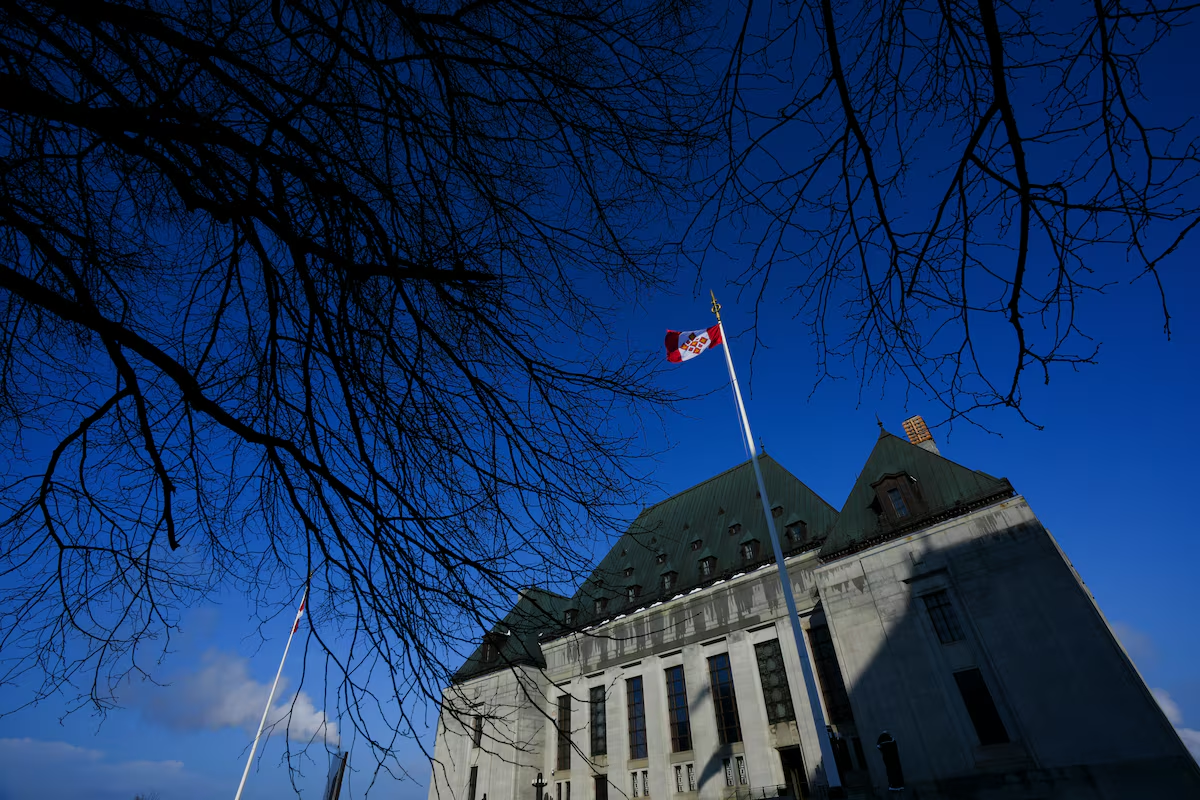

Open this photo in gallery:
The Supreme Court panel of nine judges considered how sentencing provisions in the Criminal Code related to addressing the issues of the overrepresentation of Indigenous people in prisons and the vulnerabilities of Indigenous women to intimate partner violence.Sean Kilpatrick/The Canadian Press
The Supreme Court of Canada has clarified how courts should appropriately sentence offenders in cases of intimate partner violence when both the accused and victim are Indigenous.
The 5-4 decision released Friday upholds the reduced three-year sentence of a Mi’kmaq man and provides new guidance on what the Supreme Court has called the “twin crises” of violence against Indigenous women and the overincarceration of Indigenous people.
The tight vote demonstrated how difficult it is for judges to rule on cases that have seemingly conflicting sentencing provisions for Indigenous offenders while protecting Indigenous victims.
The Supreme Court panel of nine judges, which included majority-voting Indigenous Justice Michelle O’Bonsawin, considered how sentencing provisions in the Criminal Code related to addressing the issues of the overrepresentation of Indigenous people in prisons and the vulnerabilities of Indigenous women to intimate partner violence. The court concluded they have to be considered together. The case was heard last December.
Opinion: Supreme Court clarifies, rather than cancels, Gladue sentencing in vulnerable victim cases
In its decision, the majority said courts have to take Indigenous perspectives and the voices of Indigenous victims seriously, particularly in sentencing circles.
“This means treating that circle as a bridge between the criminal justice system and Indigenous models of justice, not an exercise in performative tokenism, which will only erode trust, set back reconciliation and exacerbate the challenges Indigenous people face with the criminal justice system,” the decision states.
Courts aren’t bound by sentencing circle recommendations and rulings are at the discretion of each judge.
The court heard the notion that courts must choose between supporting Indigenous women victims of crime or addressing the mass incarceration of Indigenous people is a false dichotomy, a position argued in submissions by the accused and interveners, including Aboriginal Legal Services (ALS) from Toronto, where lawyer Christa Big Canoe is based.
It’s not an either-or, Ms. Big Canoe told the Globe.
“We think this is a clear instruction to all other courts that when you have an Indigenous offender, an Indigenous woman victim, that you have to balance and that you should be taking into consideration the Indigenous community justice processes that have occurred,” she said.
Ms. Big Canoe said the original trial judge failed to properly consider the sentencing circle that was held for the accused (the victim did not participate) and conducted by two Mi’kmaw lawyers who didn’t recommend further incarceration because of the accused’s history of mental health illness.
As one of 21 interveners, Ms. Big Canoe said the position of the ALS was that prison sentences don’t make communities safer.
“People come out worse off and much more violent. It hasn’t been working for decades and generations now,” she said.
Justice O’Bonsawin wrote in the majority decision that sentencing judges must follow three specific steps in such cases.
First, the judge must weigh the gravity of the offence and the degree of responsibility of the offender in the context of the Indigenous identities and backgrounds of the parties.
Second, the judge must sensitively identify the relevant criminal sentencing objectives, prioritizing denunciation and deterrence.
Lastly, the judge must choose the proportionate and just sentence within the context of the Indigenous parties, given that Parliament has expressly directed sentencing judges to consider all available sanctions other than imprisonment.
In Depth: How human traffickers are establishing corridors to move Indigenous victims between Canadian cities
The top court added that the sentencing circle process can be relevant to understanding the availability of alternative sentencing options in the community, as well as the community’s perspective on the sentence that would best achieve the objectives.
The ruling comes in the case of Harry Arthur Cope, a Mi’kmaq man with severe mental health challenges who was sentenced to five years in prison after pleading guilty in 2022 to aggravated assault against his partner, a Mi’kmaq woman.
The Nova Scotia Court of Appeal reduced the sentence to three years.
The Supreme Court ruled Friday the three-year sentence should stand.
The top court found the sentencing judge did not recognize that the offender’s mental illness contributed to the commission of the aggravated assault and did not consider the effect of that illness on the relevant sentencing objectives.
The sentencing judge would have settled on a shorter prison term had she properly considered the offender’s significant mental health issues, particularly when viewed in light of a sentencing circle’s recommendations in the case, the Supreme Court said.
The four dissenting Supreme Court judges argued that the Crown’s appeal should be allowed and the original sentence imposed by the sentencing judge restored.
They said the majority’s sentencing framework fails to reflect Parliament’s direction to sentencing judges to prioritize denunciation and deterrence, and to generally impose harsher sentences for the abuse of vulnerable victims, including Indigenous women and girls.
The majority found the original trial judge made two errors in her sentencing, including failing to consider how a longer prison sentence could aggravate the accused’s severe mental health illness, ultimately decreasing chances of rehabilitation.
Gladue principles, derived from a case decided by the Supreme Court of Canada in 1999, require courts to consider an Indigenous offender’s life experience and history as they relate to systemic impacts stemming from colonization (such as residential schools) through presentencing written reports.
More recent provisions were added to the Criminal Code following the national inquiry report on missing and murdered Indigenous women and girls, recognizing those groups as vulnerable individuals facing disproportionate violence, and that such increased vulnerability can weigh in favour of a more severe sentence (whether the accused is Indigenous or not).