
Open this photo in gallery:
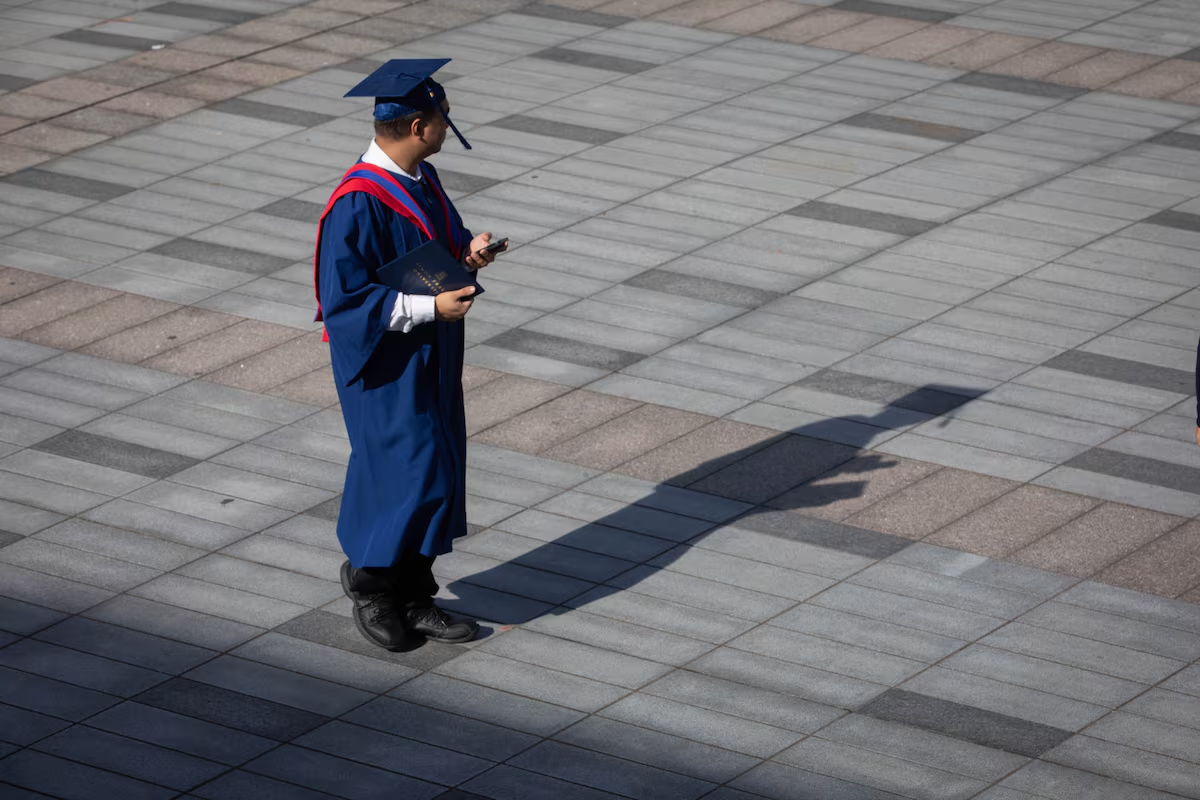
A graduate walks on the Simon Fraser University campus in Burnaby, B.C. Postsecondary schools across the province have been forced to make tough budgetary choices ever since Ottawa began curtailing international enrolment.Justine Beaulieu-Poudrier/The Globe and Mail
Carissa Wilson felt blindsided when she learned that the cabinetmaking certificate program she was supposed to start at North Island College this fall had been suspended.
Ms. Wilson, 46, was a mature student seeking a fresh start as her youngest son headed off to college. She was already looking for places to live in Port Alberni, the Vancouver Island city that was home to North Island’s 10-month furniture design and joinery program until the college’s board voted to pause it and 14 other programs last February.
“I was gutted,” she said.
The news landed like a blade to the abdomen for Ms. Wilson because she figured skilled trades programs – currently the darlings of Canadian politicians everywhere – would be spared as North Island worked to balance its books without millions in international student revenue.
But not even trades courses were safe from the financial reckoning for postsecondary institutions in British Columbia, the province that relied more on foreign student fees than any jurisdiction except Ontario.
Colleges and universities across B.C. have been forced to make tough budgetary choices ever since the federal government began curtailing the international student program in early 2024.
The abrupt loss of revenue prompted Premier David Eby’s NDP government to order an independent review of the sector late last year. Reviewer Don Avison, a former board chair of Emily Carr University of Art + Design, submitted his findings to the government last spring, but his report has yet to be released. The snap election call further delayed it.
B.C.’s universities and colleges are now stuck in limbo. Most continue to make or contemplate cuts while hoping their woes will attract the attention of political leaders before the Oct. 24 provincial vote.
“There are a number of postsecondary institutions right now in the province who are very close to the edge of sustainability, and that is of deep concern,” said Joy Johnson, the president and vice-chancellor of Simon Fraser University, which lost nearly $80-million in revenue when the international student boom went bust.
The Burnaby research university, like most of its counterparts, has already sliced away the fat and muscle in its budget. “The question I have for SFU is, ‘how close to the bone are we right now?’” Dr. Johnson said. “I think we’re pretty close.”
If the next B.C. government doesn’t lift a long-standing 2-per-cent annual cap on domestic tuition fee increases or provide more public funding to the sector, Dr. Johnson foresees more pain ahead. “Hard choices are going to have to be made,” she said.
Open this photo in gallery:
SFU President and Vice-Chancellor Joy Johnson, shown in her office this week, said a number of B.C. schools ‘are very close to the edge of sustainability.’Justine Beaulieu-Poudrier/The Globe and Mail
Mr. Eby told The Globe and Mail’s editorial board on Friday that a re-elected NDP government would keep the tuition limit in place. He promised to release the Avison report in full. He touted his government’s investments in new postsecondary spaces for trades and health workers.
He also emphasized that postsecondary institutions have an obligation to control costs and to “ensure that they are living within the budgets that they have.”
That’s no surprise, considering the province is grappling with a monster deficit and the terms of reference for Mr. Avison’s review stipulated that “a large injection of permanent, net new funding for the sector is not expected given the fiscal reality.”
B.C. Conservative MLA Peter Milobar told The Globe in an interview that his party would release the Avison report and examine its conclusions before making any promises. The Green Party didn’t respond to a request for comment.
Where does that leave B.C.’s colleges and universities? Matt Milovick, the vice-president of administration and finance at Thompson Rivers University in Kamloops, is blunt in his assessment.
“I don’t think for a moment we should assume there’s any new resources that that are going to be recommended through the Avison report to help us with the current situation,” he said. “This is our problem to solve.”
Drop in international students stings
Prior to the federal about-face in 2024, fees from international students accounted for about 18 per cent of total revenues for B.C.’s public colleges and universities. At some schools, the share was as high as 40 per cent.
By the time Mr. Eby’s government appointed Mr. Avison last November, 19 of B.C.’s 25 publicly funded postsecondary institutions were forecasting at least one annual deficit in the next three years, and nine were in an accumulated operating deficit position. That was despite many having already slashed faculty, staff and programs to save money.
The B.C. Federation of Students, which has been tracking the provincewide cuts through board documents and union communications, says more than 200 programs have been cut or paused, and nearly 1,400 faculty and staff laid off in recent years.
“Students are experiencing these cuts through fewer course sections, long wait lists and reduced services like counselling, academic advising [and] library hours – these have real consequences,” said Debi Herrera Lira, chairperson of the federation.
To take one example of a school hit hard by the loss of international student revenue, consider Kwantlen Polytechnic University, whose main campus is in Surrey in Metro Vancouver.
In 2023-2024, international tuition and fees accounted for $129-million, or 41 per cent, of Kwantlen’s $312-million budget. There were 7,398 foreign students enrolled at the university that year.
By 2025-2026, the number of international students had dropped to 2,976. This year, international student revenue is projected to account for $46-million, or 18 per cent, of its $250-million budget.
To balance its budget, Kwantlen has had to cut 175 full-time equivalent roles since 2024, cease operations at its Civic Plaza campus in Surrey and suspend six programs, including a Bachelor of Arts major in policy studies and a diploma of technology in environmental protection.
“It’s had a devastating effect on the institution,” Diane Purvey, president and vice-chancellor of Kwantlen, said.
Dr. Purvey believes the institution will be able to retrench and thrive by leaning into its status as a polytechnic – a degree-granting institution with a heavy emphasis on practical job training. Kwantlen also has the advantage of operating campuses in Surrey, Richmond and Langley, some of B.C.’s largest cities.
University of Toronto launching $100-million scholarship fund to attract PhD students
Colleges and universities in more remote parts of B.C. don’t have the same pool of potential local applicants to draw upon.
Small rural campuses are generally expensive to operate because they can’t achieve the economies of scale available to their big-city peers. Yet they are essential guarantors of access to higher education, especially in a province where the next nearest campus might be hours and a mountain pass away.
Thompson Rivers University, whose main campus is in Kamloops, about four hours northeast of Vancouver, caused a minor stir earlier this year when it floated the possibility of closing a satellite campus in Williams Lake by 2028.
Surinderpal Rathor, the mayor of Williams Lake, a city of about 12,000 in the Cariboo Chilcotin region of interior B.C., told local media he was shocked at the prospect of losing the educational lifeline. He and city council vowed to fight it.
In May, Thompson Rivers and the city of Williams Lake signed a letter of understanding binding them to maintain postsecondary education access in the region, while publicly consulting and “reimagining” where courses might be offered.
Open this photo in gallery:
Walkers exercise on the running track on the Thompson Rivers University campus in Kamloops.Jeff McIntosh/The Canadian Press
Currently, the university runs the satellite campus in an old high school that is too big for its needs, Mr. Milovick said – especially now that the student head count at Williams Lake has dropped to 256, down from 391 in 2024-2025.
“We are committed through and through to postsecondary education in Williams Lake, and the region,” said Dr. Airini, the president and vice-chancellor of TRU, who goes by one name. “The question now really is how our university can best deliver education sustainably into the future.”
Finding the funding formula
The same question applies at other colleges and universities around B.C.
To Jasmine Nicholsfigueiredo, president of the Federation of Post-Secondary Educators of British Columbia, the answer is obvious: more public funding.
The federation was among the groups that sponsored a report from the think tank B.C. Policy Solutions that recommended a substantial increase in government operating funding, while maintaining the 2-per-cent tuition increase cap that has been in place since 2005.
“If you want to increase your economy, grow your communities, build your businesses, you have to invest in the infrastructure,” Dr. Nicholsfigueiredo said. “And sorry – that’s postsecondary education. It’s not the pipeline. It’s not the LNG. It’s the people.”
Dr. Nicholsfigueiredo and her faculty and student association colleagues are frustrated that the government instructed Mr. Avison not to consider new public funding.
Mr. Avison is the second former deputy minister and university leader named Don tasked with reviewing B.C.’s higher education sector in less than five years.
In 2022, then-premier John Horgan appointed Don Wright, a former president of the British Columbia Institute of Technology, to examine the provincial funding formula for colleges and universities.
While Mr. Wright was collecting feedback, Mr. Horgan stepped down, Mr. Eby took over and the review was shelved before Mr. Wright could complete his work.
The B.C. Federation of Students obtained through a freedom-of-information request a draft slide deck that Mr. Wright submitted in January of 2023.
A slide titled “Current Formula” opened with the bullet point, “Punchline: ‘there is no funding formula.’” It went on to explain that most public funding was distributed as block grants with no rewards for schools that hit their enrolment targets or consequences for those that didn’t.
“20 years of this zero-consequence funding approach has resulted in a management culture within many [postsecondary institutions] of ‘don’t manage, rather complain about inadequate funding,’” the presentation deck said.
However, it also mentioned that if the government was open to a material increase in postsecondary funding, it would require about $200-million more a year, over and above increases for collective bargaining compensation.
Eby’s election promise to tax unsold condos in B.C. draws industry criticism
In an interview with The Globe this week, Mr. Wright said nobody in government told him explicitly why his review was paused. He figures Mr. Eby had other priorities.
Mr. Wright said he hopes that at some point soon, a B.C. government takes a serious look at putting in the right formulas and incentives to make colleges and universities financially stable.
One option could be lifting B.C.’s tuition-increase cap, he added, as long as it’s done carefully and grandfathers in existing students. B.C. has the fifth-lowest average undergraduate tuition fees in Canada, after Newfoundland and Labrador, Quebec, Manitoba and Yukon.
“I’ll get in trouble with the students’ associations here, but low tuition is such an ineffective way to improve access to postsecondary education,” Mr. Wright said. “You get much better value for money if you target it and you have needs-based financial aid.”
For now, postsecondary institutions in B.C. have little choice but to keep scouring their operations for savings, as North Island College did last February when it suspended 15 programs, including the furniture design and joinery program Ms. Wilson hoped to take.
Enrolment in the program had declined to single-digit students in the last three years, according to an analysis of the program presented to the North Island board of governors. Cabinet-making wasn’t as aligned with local labour-market needs as other trades; as a result, the program tended to attract “hobbyists and retirement learners.”
While Ms. Wilson bemoans the suspensions and service cuts she has witnessed as executive director of the North Island Students’ Union – including the closing of campus bookstores – she found another path to her fresh start.
She switched to North Island’s Campbell River campus, where she is happily studying to be a welder.