
Open this photo in gallery:
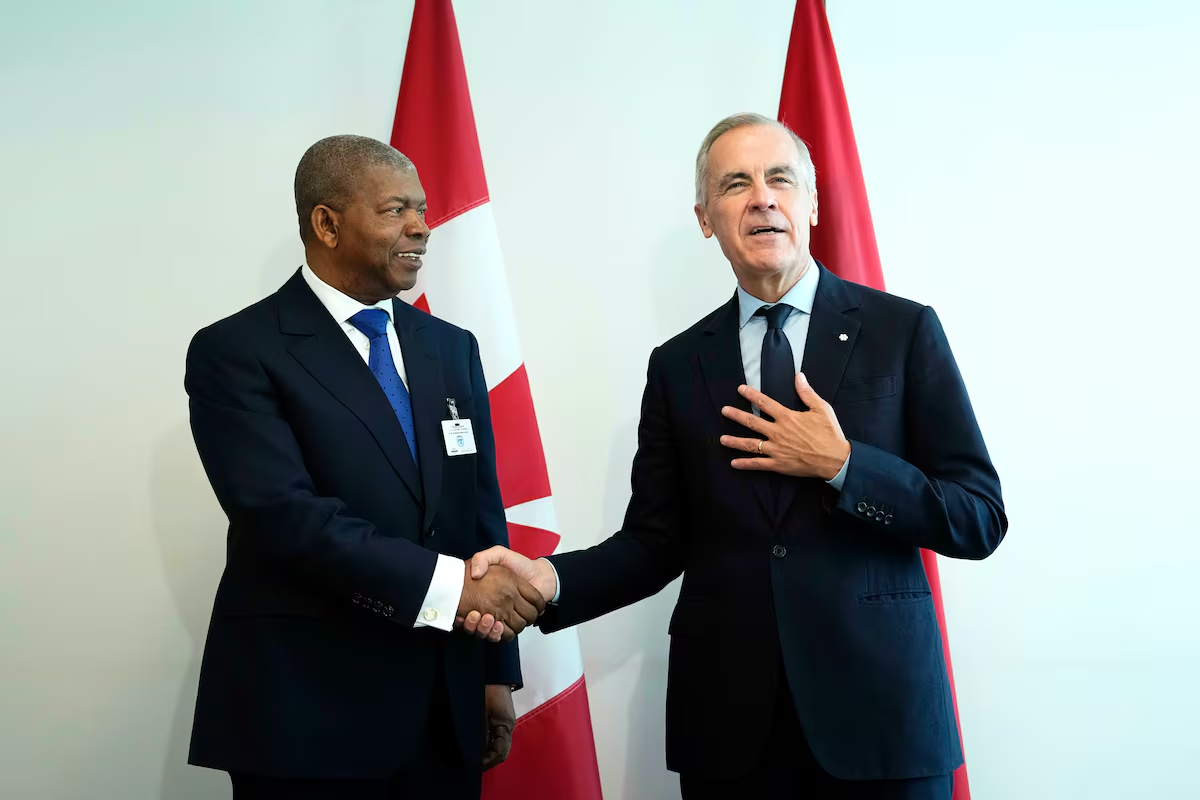
Prime Minister Mark Carney, right, and President of Angola João Lourenco participate in a bilateral meeting on the sidelines of the United Nations General Assembly at the UN headquarters, on Sept. 22.Justin Tang/The Canadian Press
Canadian mining companies could be among the beneficiaries of the Carney government’s push for an economic agreement with resource-rich Angola, one of the first African targets in Ottawa’s global trade diversification campaign.
Prime Minister Mark Carney met last month with Angolan President João Lourenco, inviting him to Canada and announcing progress in their economic negotiations. Deeper collaboration in mining and critical minerals is a top priority for both countries, his office said after the meeting.
The two leaders, who met on the sidelines of the United Nations General Assembly, discussed an economic co-operation agreement and “agreed to work toward its conclusion,” Mr. Carney’s office said in a statement.
The agreement would be a memorandum of understanding – a broad framework for talks on future deals – rather than a detailed blueprint. But it could put Angola ahead of most other African countries, which have not received the same level of attention from the Carney government since the beginning of its trade diversification efforts.
Its oil wealth has placed Angola in the ranks of Africa’s six biggest economies, but its mineral deposits are emerging as a new focus for investment. The country is considered to be underexplored – especially in comparison with neighbouring Zambia, where Canadian companies are major investors in the copper sector.
Opinion: Carney is pushing hard to diversify trade. But will businesses leap into foreign markets?
“Angola has the resources and is actively trying to broaden its mining investor base, and Canada has the companies, capital markets, technical expertise and mining-services ecosystem, so there is a fairly natural complementarity,” said Marisa Lourenço, a Johannesburg-based regional analyst.
She predicted that mining will be central to the Canada-Angola economic deal and will be the “most obvious anchor” in their emerging relationship.
“Angola has been trying for years to reduce its dependence on oil, and the government is increasingly pitching minerals such as copper, lithium, niobium and rare earths as part of that diversification strategy,” she told The Globe and Mail.
Canadian officials, including Foreign Affairs Minister Anita Anand, have held several meetings with top Angolan officials over the past year, with mining usually on their agenda. The two countries are also negotiating a second deal: a Foreign Investment Promotion and Protection Agreement.
“Canada has historically been relatively underengaged commercially in Africa, particularly compared with some of its G7 peers,” Ms. Lourenço said. “It wants to move from a relatively cautious and fragmented commercial presence in Africa towards a more deliberate economic strategy.”
Carney to visit Turkey this month, sources say, as he seeks to diversify trade ties
Until recently, Angola did not appear to be a top Canadian priority. Canada does not have a full embassy in Angola, covering it instead from its high commission in Mozambique, another former Portuguese colony.
Canada imported $16-billion in oil from Angola in the years before 2015, but trade between the two countries has been relatively small since then. There was an uptick in trade last year, however, when Angola imported about $200-million in goods from Canada – mainly in the aircraft sector – up from $85-million in the previous year.
Angola has strategic importance to the mining sector because its Atlantic Ocean port of Lobito is the terminus of the multibillion-dollar Lobito Corridor. The railway, supported by the United States and Europe, is expected to boost exports from the copper and cobalt region of the Democratic Republic of the Congo, the eastern end of the railway.
Stronger collaboration on the Lobito Corridor was one of the subjects of discussion when Ms. Anand met her Angolan counterpart, Tete António, in June.
Vancouver-based Ivanhoe Mines Ltd. IVN-T, which has a copper project in Congo, has been among the early beneficiaries of the Lobito Corridor, although the railway needs upgrading and is not yet operating at full capacity. Ivanhoe is also exploring for copper in Angola.
Opinion: Brazil’s presidential election risks complicating Canada’s plans for trade diversification
Global Affairs Canada has not provided any specifics on what the Angola economic co-operation agreement could include. “While mining and critical minerals are among potential sectors of mutual economic interest, work is continuing on the details of the proposed MOU,” department spokesperson Aditee Kissoon said in response to questions.
An assistant deputy minister in the Global Affairs department, Cheryl Urban, met the Angolan secretary of state for mineral resources, Jânio Correia Victor, in the Angola capital, Luanda, in February. They discussed “how to identify and promote new investment opportunities in the mining and energy sectors,” the Angolan government said in a statement after the meeting.
This meeting, along with earlier talks at an Africa mining conference in Cape Town in February, helped to lay the groundwork for the current economic negotiations, Ms. Lourenço said.
Chris Roberts, an Africa specialist at the University of Calgary, says Canada is “finally playing catch-up” to the investments that other Western countries – along with China and Gulf states – have been pouring into Angola in recent years. “Canada-Angola relations are significantly underdeveloped,” he told The Globe.
He noted that Canada’s new Africa Strategy, released last year, contains multiple references to critical minerals as a priority. Ottawa is working with other Western countries to diversify the global supply chain of critical minerals, and the Lobito Corridor is part of that strategy, he said.