
Open this photo in gallery:
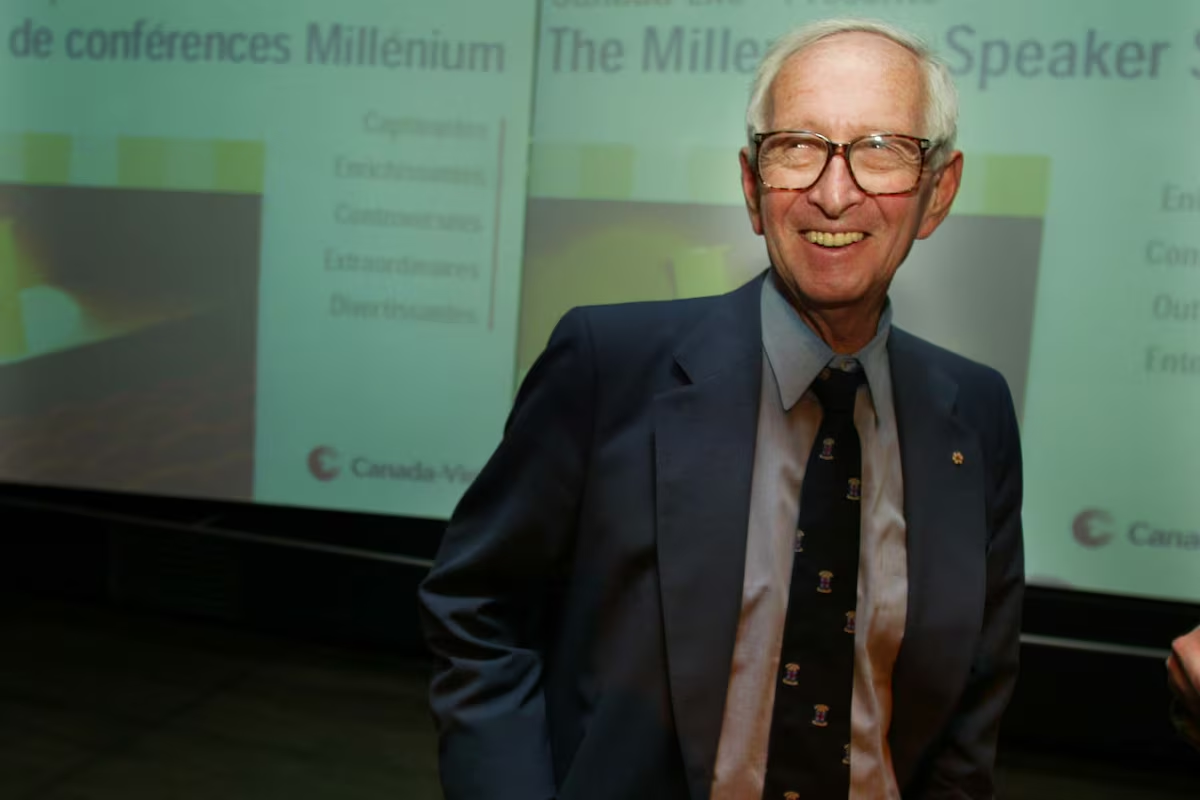
Stephen Jarislowsky in Montreal in 2002. The investor, entrepreneur and philanthropist died on Thursday at the age of 101, his family said in a statement.Andre Forget
As a young counterintelligence officer with the United States Army stationed in postwar Japan, Stephen Jarislowsky honed his investigative skills hunting black marketeers and rooting out Nazis from among the Germans living in the country.
The posting also gave him his first exposure to the concept of governance. One day his unit picked up rumours that the wife of U.S. General Douglas MacArthur was attempting to influence the outcome of postwar reconstruction contracts. Chasing down that lead resulted in Mr. Jarislowsky’s unit being temporarily suspended.
Years later, according to his 2005 book, The Investment Zoo, Mr. Jarislowsky would draw heavily on those early experiences as he built a small securities research firm into one of Canada’s most powerful institutional money managers.
In the process, the former chairman of Jarislowsky Fraser Ltd. emerged as a crusader for shareholder rights and a sharp-tongued critic of underperforming or inept corporate executives and the board of directors who blindly supported them.
An investor, entrepreneur and philanthropist, Mr. Jarislowsky died on Thursday in Montreal at the age of 101, his family said in a statement.
Stephen Jarislowsky, businessman who championed corporate governance, dies at 101
At its peak, Jarislowsky Fraser was a powerhouse in the world of institutional investing. In 2007, the firm oversaw roughly $60-billion in assets for pension funds, foundations, corporations and high-net-worth individuals from its Montreal head office.
During the prior four decades, Mr. Jarislowsky had repeatedly deployed his growing clout to cross swords with a who’s who of Canadian corporate titans, including the Billes family behind Canadian Tire, Montreal’s powerful Bronfman clan, the former media mogul Conrad Black and auto parts magnate Frank Stronach.
Though the circumstances were different in each case, he took up the fight against transactions and deals he saw as manipulative and abusive toward minority shareholders, doggedly battling his opponents with biting language that earned him a reputation for being quick to temper – and made him a favourite source for multiple generations of business journalists.
Open this photo in gallery:
Mr. Jarislowsky in 1988.John McNeill/The Globe and Mail
When the Billes family in 1986 attempted to sell its voting-class shares to Canadian Tire dealers in a transaction that disadvantaged investors with non-voting shares, he publicly derided the deal as “crap” and “grossly abusive” while successfully convincing regulators and courts to block it. Likewise, he clashed repeatedly with Mr. Black over the latter’s management fees at Southam Inc. and later his attempt to take Hollinger Inc. private, describing his former friend as a “bully” and demanding regulators take action.
Mr. Jarislowsky also frequently used his pulpit to lambaste other targets: boards of directors for being “puppets of management”; lax regulators for allowing white-collar crime in Canada to become “a pretty good bet – almost as good as the house in Las Vegas”; and successive governments that “placed self-perpetuation through massive vote buying policies ahead of long-term economic progress.”
Mr. Jarislowsky was born in Berlin on Sept. 9, 1925, to accomplished parents, both Jews. His father was an industrialist and a merchant banker, his mother, a lawyer. When Mr. Jarislowsky was 4, his father died from scarlet fever, and he and his siblings were sent to live near relatives in Amsterdam.
It was the first of several challenges the family would endure. When the Nazis rose to power, the businesses his father had built were seized (then later nationalized by East Germany’s Communist government in 1947). The family moved to Paris, where Mr. Jarislowsky studied and became fluent in French and English. But when his stepfather’s work helping refugees escape German-occupied France for the U.S. was uncovered by the Gestapo, the family too had to flee, again, arriving in New York in 1941.
Open this photo in gallery:
Forbes last estimated Mr. Jarislowsky’s net worth at US$3.9-billion.HO/The Canadian Press
After he graduated from Cornell University with a mechanical engineering degree, Mr. Jarislowsky was drafted into the U.S. Army, becoming a U.S. citizen in the process. Upon his return to America from his posting in Asia, he delved back into education, completing a degree in Far Eastern Studies at the University of Chicago before enrolling in the Harvard Business School where he got his first taste of investing.
Harvard led to a stint at Alcan Aluminum Ltd. and to Montreal, the city where he would eventually settle permanently with his first wife, with whom he had two sons.
As a hobby in 1955 he developed an “experimental” statistical service, crunching balance sheets, income statements and valuation ratios on roughly 200 Canadian companies. After teaming up with Scott Fraser, a junior broker at the time, Jarislowsky Fraser was born, selling subscriptions to its statistical review before branching into field research through interviews with company executives. Soon, firms in Chicago, New York and London were turning to the fledgling outfit for investment counselling services. (Mr. Fraser left the firm roughly 20 years later.)
By the 1970s and 80s, Mr. Jarislowsky was regularly at the centre of corporate battles as foreign companies sought to take their publicly-traded Canadian subsidiaries private, often at opportunistic valuations. It was shareholder activism before most people had ever heard the term.
The success Mr. Jarislowky was having for his investor clients translated into a windfall for himself that eventually grew into one of Canada’s largest personal fortunes. Though he made regular appearances on various rich lists – Forbes last estimated his net worth at US$3.9-billion – he lived a relatively modest life with his second wife Gail, who he married in 1968. (The couple had two more children, daughters. One of Mr. Jarislowsky’s sons from his first marriage died in 2014 after an illness.)
Open this photo in gallery:
Mr. Jarislowsky during the Millenium Speaker Series in Montreal in 2002.Andre Forget/The Globe and Mail
Mr. Jarislowsky didn’t own yachts or luxury vehicles, though he was an avid collector of Chinese jade and art, particularly works by Canadian artists and French impressionists. The couple still lived in the same Westmount home they bought in 1972.
That said, he recognized the value of wealth, writing: “Money doesn’t mean reckless spending, but it does mean freedom.”
Similar to his investment strategy, he applied a studied approach to his philanthropic giving. In 1993, he established the Jarislowsky Foundation, which oversees assets worth more than $386-million and donated millions annually to hospitals, universities, nature trusts, cultural institutions and organizations that promote democracy and foster political leadership training.
“Charity should be effective, should achieve measurable goals, should be implemented by people with integrity, should be fully researched so you know that your gifts will not end up in the wrong pockets,” he wrote. “You should not give sentimentally, but insist on regular reviews of stewardship, throughout the process.”
Mr. Jarislowky’s other legacy is a heightened awareness in Canada about the importance of corporate governance. Whereas in the 1980s he guided an informal network of institutional money managers who together accounted for roughly 60 per cent of stock market trades and used that clout to influence recalcitrant boards of directors, he formalized that approach amid accounting scandals in the early 2000s at the likes of Worldcom, Enron and Nortel.
In 2002, he co-founded the Canadian Coalition for Good Governance, made up of powerful institutional investors to press for improved board oversight of public companies, and in 2005 he helped establish the Institute for Governance of Private and Public Organizations, a think tank to research and recommend ways to improve governance.
Opinion: Stephen Jarislowsky was a patriot and the Leonardo da Vinci of Canadian business
In 2008, Mr. Jarislowsky was named a companion of the Order of Canada, with the official citation highlighting his advocacy for shareholder rights; he has also received honorary degrees from 20 Canadian universities.
But Mr. Jarislowsky and his firm faced stumbles, too. In the late 1990s, as dot-com mania gripped investors’ psyche and quaint concepts such as value and fundamentals fell out of favour, he faced a drumbeat of complaints from clients unhappy with the lagging returns generated by the Old Economy stocks he kept their money in. His response: “Then take your money and gamble with it if you want,” he told this reporter, while explaining his deep skepticism for tech stocks. “Technology is just about new ways to communicate, nothing else. People still eat. They still drive cars. They still fornicate. What’s new?”
His stubbornness was eventually rewarded. By 2001, the narrative turned after the internet stock frenzy collapsed in spectacular fashion and investors chased the safety of dividend-paying stocks and disciplined portfolio management.
However, other headwinds were building. The emergence of lower cost passive investment products and increased competition from Canada’s big banks and hedge funds for institutional clients put pressure on the company, which saw its assets under management fall 40 per cent between 2007 and 2012 to $37-billion.
Open this photo in gallery:
Mr. Jarislowsky speaks to a reporter after the Canfor Annual General Meeting in Vancouver in 2007.Lyle Stafford/Reuters
At the same time as money was leaving the firm, so too were staff and high-level executives who departed to launch their own money management firms.
The upheaval prompted a leadership shake-up. For more than two decades, questions swirled about Mr. Jarislowsky’s eventual retirement – one 1995 feature in The Globe and Mail on the then-69-year-old began, “As he slips quietly into retirement …” – but this time he stepped back as chief executive officer for real, allowing a management committee to take over.
Even so, when Mr. Jarislowsky struck a deal in 2018 to sell the investment management company to Bank of Nova Scotia for $950-million, he was still handling accounts for 200 personal clients at the age of 92.
Despite having been born to Jewish parents and educated by Calvinists, Jesuits and Episcopalians, Mr. Jarislowsky wrote that he eschewed traditional religious doctrine and considered himself “basically agnostic.”
“I can’t see myself sitting silently and quietly on top of a cloud for the next million years. That would be awfully dull. Those ideas are the inventions of humans,” he wrote. “But that doesn’t mean that ethics and behaving responsibly don’t have a place in the universe. To me, the ethics of Aristotle is religion.”
You can find more obituaries from The Globe and Mail here.
To submit a memory about someone we have recently profiled on the Obituaries page, e-mail us at obit@globeandmail.com.