
Open this photo in gallery:
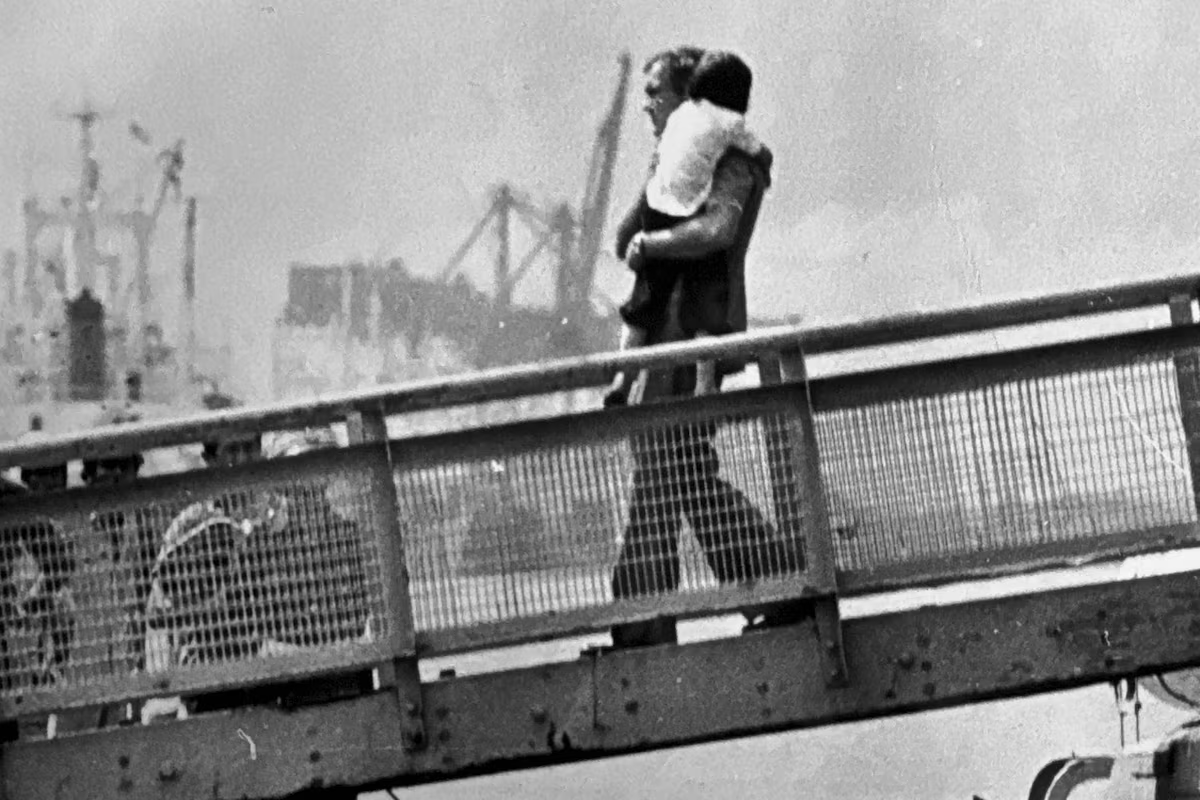
Ian Hamilton, with a child, disembarking from a Malaysian naval vessel to which the Hai Hong escapees had been transferred. Hamilton and his crew interviewed and accepted as many as 356 refugees in a single day in an era when the standard was 12 interviews a day.Courtesy of Ian Hamilton, donated to the Canadian Immigration Historical Society
It was an image that caught the world’s attention: A rusty freighter, the Hai Hong, appeared off Port Klang on the coast of Malaysia in early November 1978, its filthy decks teeming with 2,500 refugees from Vietnam.
It had been three years since the fall of Saigon and the collapse of the South Vietnamese regime to the communist forces. There had been an initial outflow of refugees fleeing the country but by 1978 that stream had turned into a torrent, creating what became known as the “boat people” crisis, as tens of thousands of Vietnamese boarded any watercraft, no matter how flimsy, to escape their homeland, heading out across the South China Sea. They were joined by victims of repression in Cambodia and Laos.
Open this photo in gallery:
Ian Hamilton retired in the early 1990s, spending lots of time in nature.Courtesy of family
Malaysia, already overwhelmed by the influx of refugees, wanted nothing to do with the Hai Hong’s human cargo and threatened to tow the ship and its desperate passengers out to sea. The country’s Malay majority was hostile to the ethnic Chinese people on board. And Malaysian authorities claimed the passengers weren’t real refugees because they had paid for their passage.
As international pressure grew for wealthy countries to do something, the Canadian government decided to act. Immigration minister Bud Cullen announced that Canada would take 600 of the ship’s refugees for resettlement.
The officer in charge of Canada’s tiny immigration office in Singapore was Ian Hamilton, a seasoned 42-year-old official, who was sent to Kuala Lumpur to lead what became a heroic operation that saved thousands over the coming months. Tall, charming and rugged-looking with an infectious sense of humour, Mr. Hamilton, who died in Ottawa on Sept. 15 at the age of 89, was also determined and dedicated to the task at hand.
Malaysian officials wanted the Hai Hong and its passengers to leave their country’s waters, but nonetheless threw roadblocks in front of Mr. Hamilton’s small team. They wouldn’t allow the freighter to dock or permit the Canadians to board it. But, according to the 2017 book Running on Empty: Canada and the Indochinese Refugees, 1975-80, Mr. Hamilton persuaded the officials to allow him to set up shop on a Malaysian minesweeper, anchored near the Hai Hong, to conduct his screening.
Armed Malaysian police escorted small contingents of the refugees to the deck of the naval ship where the immigration officers, plus a doctor and an interpreter, assembled a rudimentary office consisting of two wooden tables and a few chairs under a tarpaulin to protect them from the scorching tropical sun. The refugees were short of food and traumatized by their days at sea, with the Hai Hong refused entry by neighbouring countries.
“It was an appalling situation, probably the greatest human tragedy of our time,” Mr. Hamilton told a CBC film crew.
“The pressure of saying yes and no just squashes you,” Mr. Hamilton said 10 years later in an interview with The Ottawa Citizen, recalling how frail and terrified the refugees were. “You’re doing the best job that you can and you’re just being eaten up by the decision-making process. You want to say yes, but obviously you can’t.”
He did what he could, sometimes bending the rules to save lives. Dick Martin, who was No. 2 in the Singapore immigration office, remembers an incident where a woman slipped and fell to her death on the Hai Hong. The next day, her son, who was seven or eight and now an orphan, appeared before the Canadian immigration officers with a group of other refugees. Alone.
“I told Ian the story and he was overcome. He already had in front of him a young family, a mother, father and two children,” Mr. Martin recalled in an interview with The Globe. “Ian looks at them and says, ‘are you taking your nephew with you?’” Perplexed, the father initially said he didn’t have a nephew, but Mr. Hamilton insisted, gesturing to the little boy in the queue. The man relented, and his new-found nephew was on his way to life in Canada.
Despite the awful conditions, Mr. Hamilton and his crew interviewed and accepted as many as 356 refugees on a single day in an era when the standard was 12 interviews a day. By the end of November, the first Boeing 707 full of refugees from the Hai Hong arrived in Montreal. Three more flights followed. In all, 604 Vietnamese from the Hai Hong restarted their lives in Canada. The remaining refugees were taken by the U.S., France, Germany, Belgium and Switzerland.
Over the next two years, Canada welcomed 60,000 Southeast Asian refugees, many of them under the pioneering private sponsorship program, where church and other groups got together to support newcomers as they adapted to Canadian life. After the Hai Hong, Mr. Hamilton travelled throughout the region processing thousands of refugees at wretched refugee camps, renting fishing boats and leaning on reluctant bureaucrats to facilitate his work, armed with nothing more than a stack of Maple Leaf pins, which he distributed widely.
“He was a real leader, a mentor, the kind of guy who set an example,” said Scott Mullin, who as a 21-year-old junior immigration officer in Hong Kong, was assigned to work with Mr. Hamilton. “He was a superb guy. I loved working with him,” added Florent Fortin, who represented the Quebec government, which had recently signed an immigration agreement with Ottawa, and was part of the team.
“They were young and they were tough,” said Mike Molloy, a senior Immigration official at the time who worked on co-ordinating the refugee influx from Ottawa and co-wrote Running on Empty.
“Ian was a really compassionate person,” Mr. Molloy told The Globe. “There are people who are really good and Ian was one of those people, in terms of being compassionate and caring about people.”
Ian Stewart Hamilton was born on Sept. 23, 1936 in Ottawa, the eldest of three children of John Hamilton, a vice-president of the E.B. Eddy forest products company, and his wife, the former Shirley Stewart. Ian grew up in Aylmer, Que., and attended boarding school in Ontario, winding up at Valley Forge Military Academy in Pennsylvania, where he completed high school.
He earned a degree in psychology at Curry College, a small liberal-arts institution near Boston and began work as a psychologist for Corrections Canada. After two years, he joined Canada’s foreign service as an immigration officer, posted successively to Cologne, Stockholm, Sydney and Madrid before moving to Singapore in 1977. By that time, he was married and had three sons.
After the Hai Hong, Mr. Hamilton continued his resettlement work in refugee camps along the Malaysian coast, gaining considerable media attention for his work. “Hamilton has waded out to tossing boats carrying dead and dying in his arms,” read one account in The Toronto Sun. “There are lines of fatigue around his eyes where the laugh lines were once etched. It comes from tropical diseases, from endless days of interviewing in the filth and heat of a refugee camp.”
By the summer of 1979, the ceaseless work proved too much. Mr. Hamilton had contracted hepatitis. “It was hard on him physically. It was hard on him emotionally,” his eldest son, Shawn, said. Mr. Hamilton and his family moved back to Canada. Soon after, he and his wife separated.
Mr. Hamilton was honoured with a Public Service Award in 1979 but remained in Ottawa for the rest of his career, working in immigration and consular affairs, never venturing out on another foreign assignment.
“He did not want to travel again. It was a purposeful choice,” Shawn said. “He was done. He just wanted to find peace and tranquillity.” Mr. Hamilton retired in the early 1990s, spending lots of time in nature, on extended camping trips in Quebec’s La Verendrye Park and salmon fishing on the Miramichi River.
He seldom talked about his time in Southeast Asia, only opening up as he aged. Shawn says he discovered 80 per cent of what he knows about that crucial period of his father’s life in the last two or three years. “The veil lifted.”
Mr. Hamilton’s role wasn’t forgotten by the people most important to him, members of Canada’s Vietnamese community, who would send him greeting cards on his birthday and Christmas. He befriended Can Le, a retired Ottawa economist and a leader of the Vietnamese-Canadian community who has been working for years to erect a Boat People Museum in Ottawa.
Last March, Mr. Le invited Mr. Hamilton to a fundraising event for the project in Ottawa. “He gave a very eloquent and moving speech,” Mr. Le said. Mr. Hamilton recalled how he was haunted by the awful things he had seen in the refugee camps after he returned to Canada decades ago. Distraught, he would walk through Ottawa’s Chinatown neighbourhood and found solace in seeing how the newly arrived refugees were adapting well to their new home.
“I love you all dearly,” Mr. Hamilton told the crowd. “I’m proud of what I did. And you are the ones who are building our country.” The crowd gave him a standing ovation.
Mr. Hamilton leaves his sons, Shawn, Matthew and Nicholas; five grandchildren; and his sister, Susan. Bonnie Boyle, his wife of 41 years, died in 2013. His first marriage ended in divorce.
Mr. Molloy said he recalled that Mr. Hamilton was once asked how he decided on whether a displaced family should be accepted for resettlement or not. “He replied, ‘by the light of their children’s eyes.’”
You can find more obituaries from The Globe and Mail here.
To submit a memory about someone we have recently profiled on the Obituaries page, e-mail us at obit@globeandmail.com.