About this series
The Globe is reporting from cities and towns in Ontario, Manitoba and British Columbia to hear from residents about the issues affecting their communities and their votes in the municipal elections.
The Pete Palangio Arena in North Bay has all the shabby charm of 100 other arenas in 100 other Canadian towns, right down to the olfactory bouquet of rubber mats and foot sweat.
But on this busy Thursday night, there’s a key difference here: tranquility.
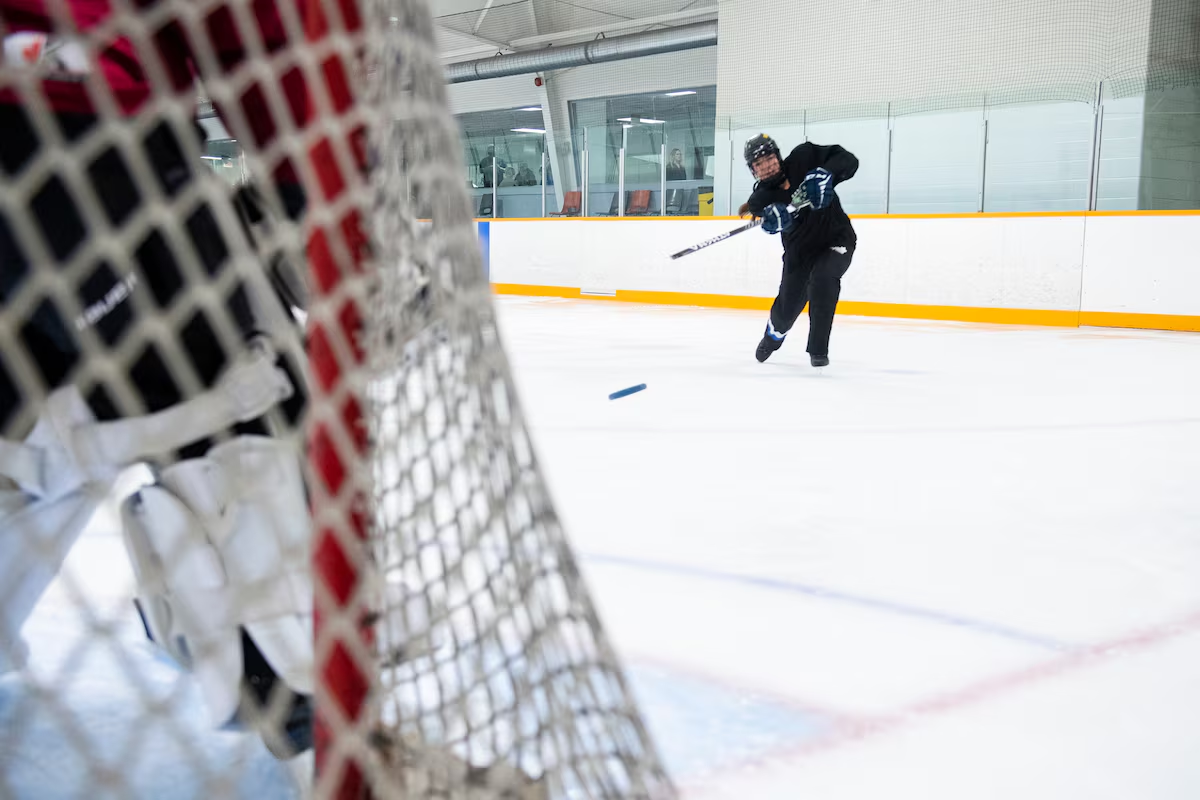
As a dozen high-school-age members of the West Ferris 63s hustle up and down the ice, they swish a blue rubber ring from stick to stick. There’s no rifle-crack of pucks, no barking coaches, no bodies crashing against the boards. “It’s nothing like hockey,” says Steve Hamilton, a long-time ringette referee and coach keeping a close eye on the scrimmage. “It’s got a real strategy to it. It’s like a combination of basketball and lacrosse on ice.”
North Bay is the home of ringette, a variation of floor hockey with rubber rings in lieu of pucks.
Ringette is North Bay’s gift to the world. Invented in 1963 in this northeastern Ontario city of roughly 60,000 people, its popularity stalled in the 1990s, when the arrival of women’s Olympic hockey began drawing girls away from the sport and created uncertainty around ringette’s future. Now, the sport is slated to lose a piece of its storied past.
On the other side of North Bay from Pete Palangio, the arena considered the place where ringette was born is slated for possible demolition. Some residents have vowed to make the preservation of that building, the now-shuttered West Ferris Centennial Community Centre, an issue in coming municipal elections.
Rinks form the social backbone of countless Canadian towns and cities, yet half of all single-pad arenas need urgent refurbishment, according to Statistics Canada. Those costs often stretch cash-strapped municipalities, leaving few options aside from demolition.
“We can’t keep tearing down our history,” said Bill Antler, who’s leading a local charge to save the rink. “That’s the birthplace of ringette. That’s the history of North Bay. That’s women’s sports history. You can’t do that.”
Bill Antler supports keeping the West Ferris Centennial Community Centre, and believes its problems – such as cracks in the walls – are not beyond repair.

With West Ferris closed, North Bay residents still have five rinks to choose from. Pete Palangio Arena is one of them: Today, the West Ferris 63s ringette team is practising here.
The origins of ringette can be traced to the Great Depression, when a director at Toronto’s West End YMCA, Sam Jacks, developed rules for floor hockey, then played with broomsticks and a felt ring.
Almost 30 years later, in 1963, recreation directors in Northern Ontario wanted to come up with a no-contact sport for girls that would break up the male domination of ice sports in the region. By then, Mr. Jacks was North Bay’s head of parks and recreation. He suggested a version of his ring-based floor hockey game – but played on ice.
There was just one problem. Hockey ruled North Bay. Team managers and local bureaucrats had no interest in giving up ice time to an experimental girls’ sport. The first games had to be played 200 kilometres away, in Espanola, fuelling perpetual arguments over the game’s true birthplace.
Open this photo in gallery:Open this photo in gallery:
West Ferris was built in 1967, but the local ringette association gets its team name, the 63s, from the year of the sport’s birth. Erin Johns, with daughter Adrie, is the association’s current president.
When West Ferris opened in 1967, its manager, Don Pecore, battled hockey leagues and municipal politicians to secure three hours of ice a week for ringette, according to his memoir.
Karen Cook recalls sitting in grade school when someone came to recruit players. “They said all we needed was our mother’s broom handle, skates and a helmet,” she recalled.
She played her first season outdoors before moving into West Ferris. “That rink was the centre of the universe – for us, if not for the entire sport,” she said.
By the 1980s, there were 50,000 players across the country, with sizable involvement in Finland, Sweden and the U.S. Big games featured prominently on CBC and TSN. Ms. Cook led efforts to erect a highway sign declaring North Bay the birthplace of ringette in 2005. A few years later, the sport got its own postage stamp.
But much of the 2000s marked a period of stagnation. Registration plateaued at around 30,000 players as women’s hockey boomed from 8,000 players in 1990 to 120,000 today.
The highway sign is gone now, and city staff say the arena has reached its end. Inspections have found cracks in the rink walls and foundation. The brine piping system needs a $2-million replacement, and the heaters have been defunct for years. A full renovation would likely cost upward of $12.4-million, the price Orillia recently paid to upgrade Brian Orser Arena.
Open this photo in gallery:
Participation in women’s hockey has been growing in North Bay over the decades, but ringette is in decline, according to reports commissioned by the city.
With the recent completion of a $63-million twin-pad facility, North Bay has five rinks without West Ferris, enough to meet demand in an environment where boys’ hockey and ringette participation are both declining, according to reports commissioned by the city.
In May, the infrastructure committee voted to demolish the 59-year-old rink. Council later punted the decision back to committee, effectively delaying any decision on the rink’s fate until after the Oct. 26 municipal election.
Mayor Peter Chirico, who is not running for re-election, cast the lone vote against a delay, saying the millions of dollars required to renovate a surplus rink would be wasteful.
The council vote came after a presentation from Mr. Antler, a self-described rink rat who spent much of his youth in the arena.
He said none of the publicly shared reports show fatal flaws in the structure and that rink participation studies are inaccurate.
“I wouldn’t be surprised to see it become one of the major issues in the election,” he said.
Open this photo in gallery:
It’s up to the next city council to decide whether to renovate West Ferris, as Mr. Antler hopes, or demolish it as originally planned.
Mr. Antler co-chairs a golf tournament that has raised hundreds of thousands of dollars for the Nipissing Association for Disabled Youth and attracts the likes of retired NHLers Doug Gilmour and Wendel Clark. He has offered to help raise money for rink repairs.
Not everyone is convinced.
“For us, the rink means a lot,” said West Ferris Ringette Association president Erin Johns. “It was our home arena. It was the birthplace of ringette. But change is inevitable. We have to embrace the new.”
Ms. Cook said she’ll understand if the building must come down for engineering reasons, but she won’t like it. She hopes the city will work to recognize ringette and the Jacks family in the new arena.
“We’re all going to cry our eyes out if it’s knocked down,” she said.