
Open this photo in gallery:
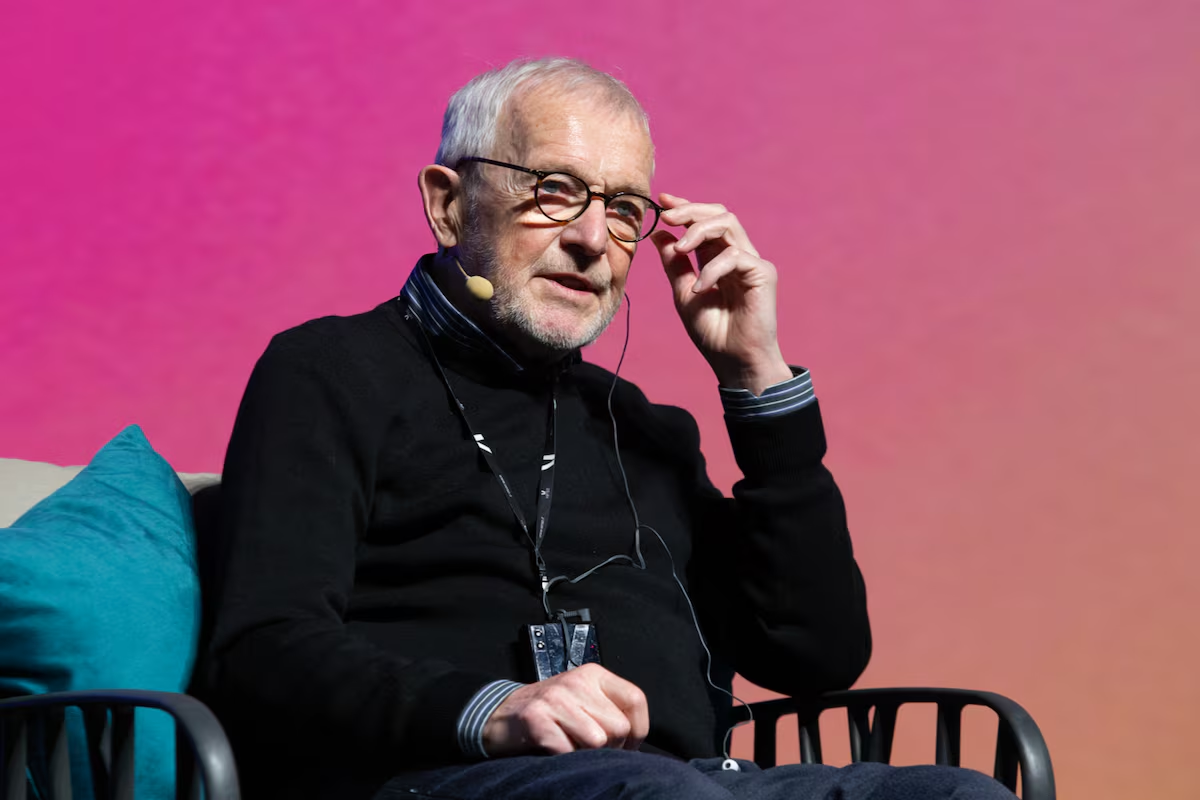
Physicist Francis Halzen speaks during a presentation on the IceCube Neutrino Observatory at the Bergamo Scienza science festival in Italy, Sunday.Laura Pietra/Bergamo Scienza 2026/via The Associated Press
Francis Halzen, a University of Wisconsin-Madison professor who pioneered the detection of ghostly particles from outer space, has been awarded the Nobel Prize in Physics.
On Tuesday, members of the Royal Swedish Academy of Sciences named Dr. Halzen the sole winner of this year’s physics prize.
Dr. Halzen is best known for his work establishing the IceCube Neutrino Observatory at the South Pole. Using a one cubic kilometre volume of the Antarctic ice sheet as its detection medium, the experiment can spot flashes of light that occur when high-energy neutrinos from the distant universe occasionally collide with atoms in the ice.
Completed in 2011, the experiment ushered in a new era of particle astrophysics.
Winning the Nobel “was a great surprise,” said Dr. Halzen when reached by phone during the announcement.
“When I reflect on this moment I have to emphasize how lucky I was because when we started this project, everybody realized this was maybe a good idea but very few thought it would work, including myself.”
Born in Belgium in 1944, Dr. Halzen received his PhD from KU Leuven university in 1969. In 1971, he began his research career in Wisconsin where he continues to lead the IceCube project.
The goal of IceCube is to detect neutrinos, particles that interact so infrequently with other forms of matter that they can easily pass through miles of solid lead as though through thin air.
Starting in the 1960s, experimental physicists began devising experiments to spot neutrinos produced by nuclear reactions in the sun’s core. Such experiments are typically located underground because the surrounding rock is invisible to neutrinos but screens out cosmic rays – electrically charged atomic fragments that are constantly raining down to Earth from collisions in the upper atmosphere.
Open this photo in gallery:
Eva Olsson, Ellen Moons, and Mark Pearce announce Francis Halzen as the recipient of the 2026 Nobel Prize in Physics at the Royal Swedish Academy of Sciences in Stockholm, Sweden, Tuesday.Christine Olsson/TT/Reuters
In 2015, Canadian physicist Arthur McDonald shared the Nobel Prize for leading a solar neutrino experiment built in a mine in Sudbury, Ont., which in the early 2000s helped to establish that neutrinos have mass.
Meanwhile, Dr. Halzen sought to extend the reach of neutrino detectors into the larger universe beyond our solar system.
His goal was to spot high-energy neutrinos that are produced in extreme environments, including massive stellar explosions and jets of material accelerated by the powerful magnetic fields that surround supermassive black holes.
High-energy neutrinos are far more rare than those from the sun and so require a much larger detector than can be installed in a mine. Dr. Halzen realized that clear, solid ice, like that atop the South Pole, would be an ideal place to build a detector.
His initial effort was called AMANDA, for Antarctic Muon and Neutrino Detector Array. Built between 1995 and 2000 it used hundreds of optical detectors that were lowered into bore holes melted into the ice and then allowed to refreeze. Passing neutrinos interacting with atomic nuclei in the ice generated telltale flashes of light that the detector could spot.
While cosmic rays drowned out the neutrino signal from above, Dr. Halzen and his colleagues only paid attention to particles moving upward from below, effectively using the bulk of Earth as a filter through which they could view neutrinos arriving from the northern sky.
AMANADA showed the approach could work, paving the way for IceCube, a much larger version of the experiment.
Physicists want to catch neutrinos in the sea. Step 1: Make sure their machinery won’t drown
Over the years that it has been operating, IceCube has confirmed the existence of neutrinos arriving from distant galaxies and provided new information about high-energy events in the cosmos. It has also helped to pin down key properties of neutrinos themselves.
As leader of IceCube, Dr. Halzen has also helped to set a course for parallel efforts to spot high-energy neutrinos, including P-ONE, an underwater experiment in development off the coast of Vancouver Island.
Jodi Cooley, a particle astrophysicist and director of SNOLAB, the successor to Dr. McDonald’s facility in Sudbury, said she considered Dr. Halzen one of her research mentors.
“I cannot express how delighted I am,” she said after learning of Dr. Halzen’s Nobel win, adding that his vision and enthusiasm for discovery “inspired generations of scientists to pursue the bold idea that neutrinos could reveal a previously hidden universe.”
With Tuesday’s announcement, the physics prize has been awarded 120 times to 230 individuals since it was established in 1901.
The most recent Canadian winner was Geoffrey Hinton, a University of Toronto professor and pioneer of artificial intelligence who was awarded the physics Nobel in 2024 for is work on neural networks.