
Open this photo in gallery:
Photo Courtesy of CHUM Ltd.
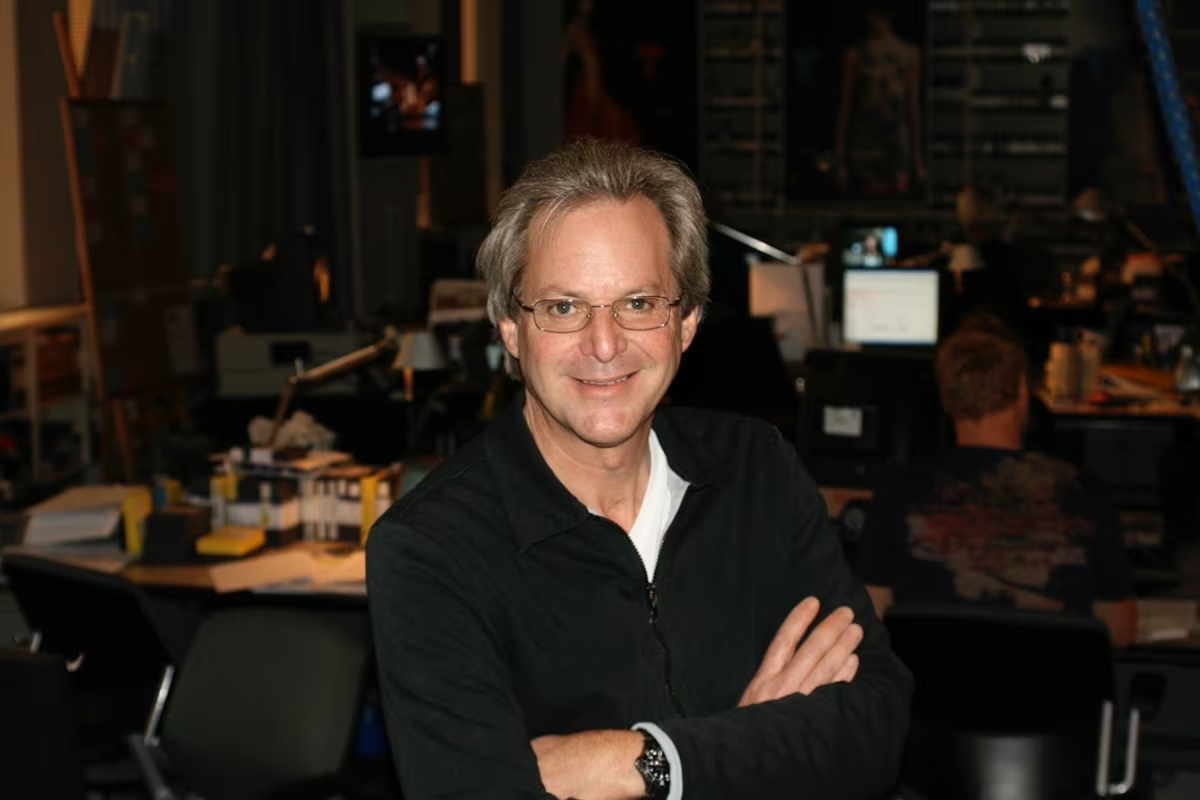
Television producer Jay Levine knew little about clothing or designers when he changed both broadcasting and the fashion world with the launch of the first Fashion Television (FT) broadcasts in 1985. He was creator and founding producer of the show, which ran for 27 years, went into global syndication and spawned a magazine and a 24-hour specialty channel.
“We were strangers in a strange land,” said Jeanne Beker, the former host of FT, of the early days of the show. “I didn’t know much about fashion and neither did Jay. He wasn’t Mr. Fashionista, but he did understand what would be compelling to watch.”
When it launched, the only other mainstream fashion-related television program on air was CNN’s staid Style With Elsa Klensch. FT differentiated itself by focusing on lively storytelling; the approach had many imitators.
“One of the keys to success of the show is it never discussed hemlines or colours or trends or anything insipid like that. It was about people – the arbiters of style around the world. FT felt elevated compared to its competition,” said Tyler Levine, Mr. Levine’s half-brother, who worked on FT with him for many years.
Jay Levine, 69, died on Sept. 1 of complications related to lung cancer.
Ms. Beker and others say he set high standards for the show.
“A show about fashion could have been this trivial, superficial show. But he was always encouraging us to dig deeper,” recalled Howard Brull, who worked on FT for its entire run, starting as an editor and later senior producer. He said the team pushed themselves every day to do better, often to impress Mr. Levine. “He brought a certain level of excellence and professionalism.”
Open this photo in gallery:
Ms. Beker said his innovative ideas for segments meant that she, Mr. Levine and crew members would visit the world’s fashion capitals but also went to Japan in 1986 to cover the fashion scene, visited Russia after the Berlin Wall came down and did a one-hour special on Israeli design. “I’m always coming across pictures of Jay and I in the trenches in Milan or other places,” she said.
The show’s early years coincided with the ascendance of runway fashion and supermodels in pop culture, and FT capitalized on the trend, garnering interest from around the world – it was syndicated in as many as 140 countries.
FT was nominated repeatedly for Gemini Awards (which merged with the Genie Awards and are now called the Canadian Screen Awards) but the show never won; Tyler said Jay did not care. Mr. Levine’s documentary Naked in the House: A Photographic Competition, which he produced under the FT brand, won a Gemini in 2002 for best editing. (The Globe and Mail called it an “amazing, different hour of television.”)
FT used pop music to back its runway footage and featured enticing – and often skin-revealing – visuals; its tagline was “sexy, stylish and spectacular.” It proved sexy enough to trigger viewer complaints, but the Canadian Broadcast Standards Council ruled that the show did not breach the broadcast code.
Those who worked for CITY-TV at its Queen Street West location in Toronto recall the early FT era as an exciting time when creative and even rebellious ideas were welcome – and Jay fit right in. “He was naturally a very cool guy,” Tyler said.
Mr. Levine had also studied economics and understood the business side, often going to bat for the show when budget cuts threatened it. “He was very charming. He would talk to the corporate people and he got our shows at least an additional five years,” Mr. Brull said. FT was cancelled in 2012.
Mr. Levine was always reading at his desk, but seldom about fashion, Mr. Brull said. “[In] most of our conversations in the over 25 years we worked together, I don’t think we discussed fashion. We were discussing life.”
He taught Tyler to be well-versed in what was going on in the world in order to make smart television. “His part of being a producer of Fashion Television required reading every newspaper and listening to every interview he could. So I kept up that kind of scouring, just always hunting for a good story.”
Open this photo in gallery:
Photo Courtesy of CHUM Ltd.
Ms. Beker said Mr. Levine served as a mentor to many young people. “I’m now hearing so many stories from people about how when they were newbies, he was very much there to support them,” she said.
Jay Lawrence Levine was born on May 9, 1957, in Toronto. His father, Norman Levine, was an entrepreneur and his mother was Beverley (née White, later Rosen). He had an elder brother, David, and a younger one named Harvey. His parents later divorced; Norm Levine remarried and the union produced a son, Tyler, who is 18 years younger than Jay.
Jay studied economics and film at York University, graduating in 1979. His father was close friends with director and producer Perry Rosemond, who died in August, and he helped Jay get his start in television. That included serving in junior roles on the CTV sketch show Bizarre.
Tyler said Jay drove a taxi early in his career and, one day, Moses Znaimer, then head of CITY-TV, got into his cab; by the end of the ride the media executive offered him a job.
Mr. Levine wrote in The Canadian Jewish News in 2022 that he had pitched a review show about theatre to CITY-TV, which he described as “the channel where I always wanted to work.” Instead, Mr. Znaimer asked him to produce the 10 p.m. newscast. “And that was the CITY-TV aesthetic: Getting someone who knew nothing about news to do the news. It was enough to assure me a few years later that I could make a show about fashion,” Mr. Levine wrote.
It was through his extensive reading that Mr. Levine hit on the idea: He found out that Paris designers were filming their collections for American buyers who could not attend the fashion shows in person. “I figured if we could get our hands on that footage, we could make a show about that.”
Mr. Levine’s first concept was tentatively titled Vogue on Video, but that morphed into FT, Tyler recalled. Ms. Beker, who was working on The New Music and wanted a change, advocated to become the host.
Fashion Television started in 1985 as 15-minute segments and launched as a half-hour show a year later. It quickly found viewers and Mr. Levine, Ms. Beker and their camera operators were soon travelling the world, asking fashion icons what it was it like having their names on people’s underwear and who their favourite architect was.
The show, “created a world appetite for television fashion programs …and inspired others to try to imitate its style and content,” an article on the History of Canadian Broadcasting website said. This even led to a copyright infringement lawsuit, a case FT lost.
In 2001, CHUM Limited, which owned CITY-TV, launched Fashion Television Channel, a 24-hour station. It aired a full slate of fashion and art-related content in its early years. It stopped operations in 2021.
Meanwhile, in 2004, the team at FT launched a magazine with Ms. Beker at the helm.
While working at FT and after the show ended, Mr. Levine took on other projects as well, such as the two-season talk show Spectacle: Elvis Costello with…, which launched in 2008, and a series about architecture. Outside of television, he developed digital content for the Andy Warhol Museum, in Pittsburgh, in 2013.
When he became ill, Mr. Levine was working on a project about music managers who were pivotal to the career of their artists and the music scene. “I was excited to see what he was going to come up with. I knew he was capable of doing anything,” Mr. Brull said.
Mr. Levine is remembered as a great friend, a talented television producer and a cool and funny guy who could talk intelligently and wittily about any topic. “He was hilarious and he was brilliant,” Mr. Brull said.
Mr. Levine leaves his brothers and their families.
You can find more obituaries from The Globe and Mail here.
To submit a memory about someone we have recently profiled on the Obituaries page, e-mail us at obit@globeandmail.com.