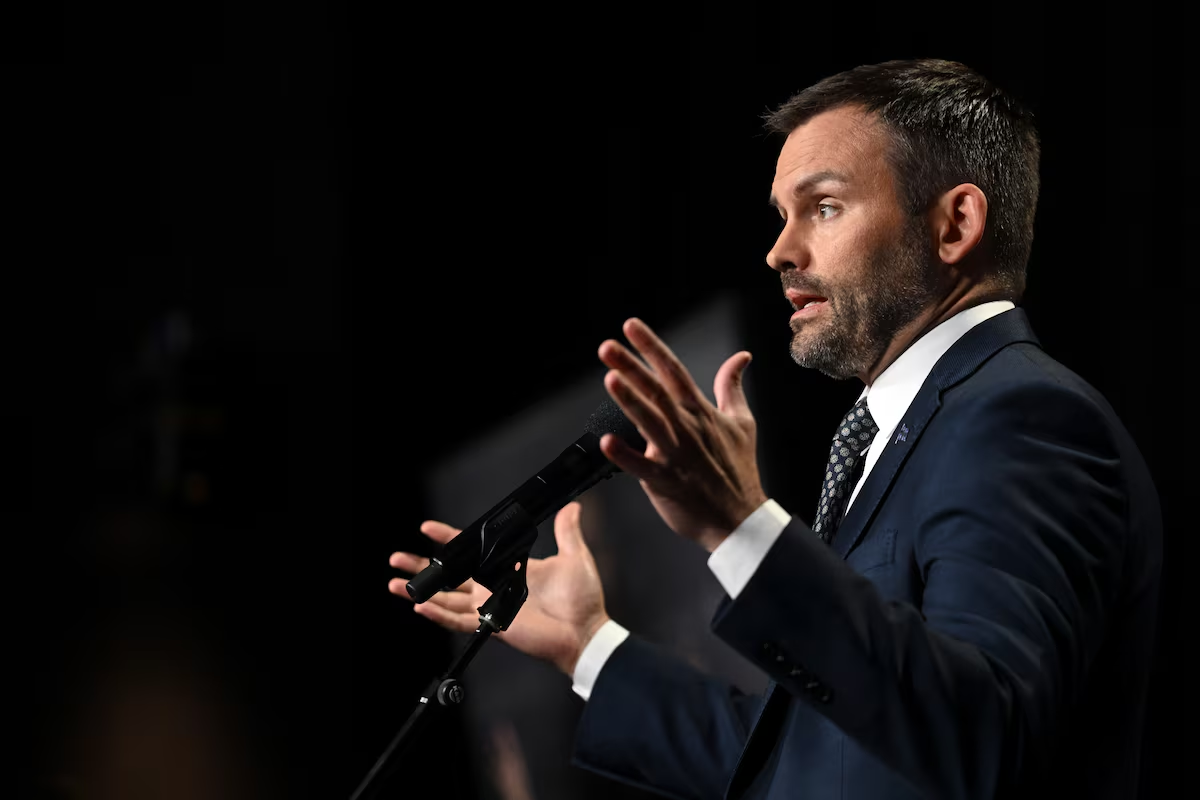

Open this photo in gallery:
Parti Québécois Leader Paul St-Pierre Plamondon said this week that it’s ‘unacceptable’ for a representative of the British Crown to have a role in Quebec’s Parliament.Graham Hughes/The Canadian Press
The leader of the Parti Québécois says he will break with the monarchy in Quebec if he becomes premier, invoking the spectre of a constitutional battle that critics say could help him drum up support for an unpopular referendum on independence.
Paul St-Pierre Plamondon said this week that it’s “unacceptable” for a representative of the British Crown to have a role in Quebec’s Parliament. If the PQ wins the provincial election on Oct. 5, he said his government will pass a law eliminating the role of lieutenant-governor.
Quebec has for decades taken steps to reduce the visibility of the monarchy in its legislature, including when the Coalition Avenir Québec government scrapped a mandatory oath of allegiance to the Crown four years ago – a change that was also driven by the PQ Leader.
But experts say a move to unilaterally abolish the function of lieutenant- governor is transparently unconstitutional and would inevitably wind up in court.
“It’s almost being done intentionally just to cause a constitutional crisis that then bolsters the impetus for a referendum,” said Lawrence David, who teaches constitutional law at the University of Ottawa.
The PQ is widely expected to win Monday’s election and could claim a majority of the seats in the province’s National Assembly. Mr. St-Pierre Plamondon has promised to hold the province’s third sovereignty referendum by 2030, even though support for independence in Quebec is currently below 30 per cent.
Liberals struggle to gain traction in Quebec election even in historically red Eastern Townships
On Tuesday, the PQ Leader said that it’s “not normal” for a representative of King Charles III to “tell us what to do.” Lieutenant-governors swear in premiers and cabinet ministers, open legislative sessions and grant royal assent to bills passed by provincial legislatures.
“There is nothing preventing the National Assembly from acting as a sovereign legislature and passing a law that abolishes the lieutenant-governor’s duties and stops allocating funds to this charade, which wastes money that could be put to better use,” he told reporters.
He said he would redirect the provincial government’s contribution to the lieutenant-governor’s office – about $1.3-million in the 2026-27 fiscal year – to fighting homelessness. The lieutenant-governor’s salary and pension are paid by the federal government, while the province covers a portion of office expenses.
But Mr. David said any such constitutional amendment would require the unanimous consent of the federal Parliament and every provincial legislature, and cannot be carried out unilaterally.
“Mr. St-Pierre Plamondon knows that there is no way to argue that it’s not manifestly unconstitutional,” he said. If a court struck down the Quebec law, he added, Mr. St-Pierre Plamondon could argue that the only way to rid Quebec of the monarchy is through separation.
Speaking to reporters Thursday, the PQ Leader denied that he’s spoiling for a fight with Ottawa ahead of a referendum, which he has said would not take place until U.S. President Donald Trump leaves the White House in 2029.
“I am preparing Quebeckers for three years of true democracy, with my sole loyalty being to the interests of Quebeckers,” he said.
Patrick Taillon, a professor of constitutional law at Laval University, said Quebec has a long history of taking steps to make the monarchy “invisible” in the province without abolishing it outright.
In Ottawa, the governor-general typically delivers the Speech from the Throne to open sessions of Parliament. After Mark Carney became Prime Minister last year, the King delivered the speech himself during a visit to Canada.
Quebec election 2026: What to know about the major parties, their platforms and where to vote
But in Quebec, the lieutenant-governor since 1973 has given only a short inaugural address. The opening speech is then delivered by the Premier.
Prof. Taillon pointed out that Quebec has also replaced the word “Crown” with “state” in provincial laws, and earlier this year announced that it would remove the British crown from the province’s official coat of arms.
On Tuesday, Mr. St-Pierre Plamondon said he would ask the province’s lieutenant-governor, Manon Jeannotte, not to attend the opening speech at the National Assembly if the PQ forms government. His caucus has previously boycotted the lieutenant-governor’s address.
Such cosmetic changes have a low chance of provoking constitutional challenges, Prof. Taillon said. But scrapping the role entirely would have a “high risk of being challenged.”
Mr. St-Pierre Plamondon has for years called for the monarchy to be excised from Quebec. In 2021, the new PQ Leader published a sardonic video in which he listed several reasons to “love the monarchy,” including that it “reminds us of our colonial heritage.” He then called on the legislature to abolish the office of lieutenant-governor.
After he was elected to the National Assembly in 2022, he and his caucus members were denied entry to the legislature after they refused to swear allegiance to the King.
The move propelled the CAQ government to pass a law stating that only an oath of allegiance to the Quebec people would henceforth be required. Mr. David is now challenging that law in court.
With reports from The Canadian Press