WARNING: This story contains details of experiences at residential schools.
A new art exhibit at Gore Park asks passersby to reflect on the legacy of Canada’s first prime minister and repossesses the space where his statue once stood in Hamilton.
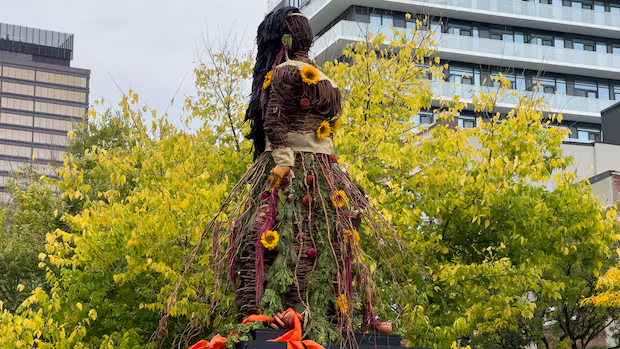
In honour of the National Day for Truth and Reconciliation, Indigenous production company Bawaadan Collective installed Right to Repossess, a piece that includes a representation of Mother Earth standing atop Sir John A. Macdonald’s old pedestal.
In August 2021, protesters toppled the statue of Macdonald in Gore Park. Macdonald’s legacy was under growing public scrutiny for his part in founding Canada’s residential school system, which some 150,000 Indigenous children were forced to leave their families to attend.
Just over five years after the statue’s removal, artists in the collective and members of the public attended an event Wednesday afternoon that was promoted by the City of Hamilton. Local Indigenous advocate Jordan Carrier said the approximate start time of the event, 2:15 p.m., was in reference to the discovery of potential unmarked graves at the site of the former Kamloops Indian Residential School in 2021.
“It doesn’t matter if it was one or a million,” Carrier said. “There shouldn’t have been any.”
 Shyann Jenkins, centre, said her dance was to help heal people. (Justin Chandler/CBC)
Shyann Jenkins, who grew up in Hamilton and lives in St. Catharines, Ont., performed a jingle dress dance.
Jenkins said she was in Gore Park for the “ground-shaking moment” when the Macdonald statue came down.
The dancer said her twirling moves heal by collecting sickness and trauma.
After the dance, Carrier handed out orange paper hearts on which attendees could write their commitments to residential school survivors and Indigenous communities. She then strung them around the pedestal of the statue.
 Orange hearts strung around the base of the statue contain messages about truth and reconciliation, including one about solidarity between Indigenous and Latin American people. (Justin Chandler/CBC)
Bawaadan member Yuma Hester told CBC Hamilton Right to Repossess is the group’s first public art installation. Hester said the collective is grateful to anyone who engages with the work and that each artist likely has their own perspective on the piece.
“We’re all on our healing journeys,” Hester said, adding for him, the piece is about how nature “holds the dominion over all civilizations.”
Other members of the collective spoke with CBC Hamilton about what the installation and the event meant to them.
Katsitiaráse (Joni) Squire-Hill said the piece is made with all natural materials including willow, cedar pine and corn husk — medicines that help people with grief. “We’re hoping it can help us grow as Onkwehón:we people to go forward.”
 Around 50 people gathered at Gore Park Sept. 30 to mark the National Day for Truth and Reconciliation and the unveiling of Right to Repossess. (Justin Chandler/CBC)
Working from scans of the Macdonald statue, Jessica Laight used clay to reconstruct the statue’s face and hands, which are visible within the figure of Mother Earth. The Six Nations resident grew up in Hamilton and said it’s meaningful to raise awareness about residential schools, noting her grandmother went to one.
Luke Jeffries, who helped build the figure’s internal structure, said he was happy to support the Hamilton community, even though he’s skeptical of the national day. “It’s lip service on the side of Canada to [absolve] themselves of guilt and shame when really there’s no actual justice being laid out on the ground.”
Collective member Teyonehrahtawénrye Ashley Maracle said she met many of the people involved in Right to Repossess at her son’s school Everlasting Tree in Six Nations. “To me that speaks really highly of the knowledge that they carry and the knowledge we want our kids to be able to learn.”
Maracle said it’s important to keep in mind that healing isn’t just for Indigenous people and everyone has to work on it, even if it’s uncomfortable.
Exhibit asks people to consider their views on Macdonald
Signs at the Right to Repossess site include an artist’s statement, information about Macdonald originally published by Parks Canada, and ask people to consider how their views on the man might have changed after viewing the installation.
Hester said the installation will come down on Saturday and that Bawaadan is hoping it will find a new home within the city.
Government or church-run residential schools operated from 1857 to 1996. The Truth and Reconciliation Commission’s years-long study of residential schools revealed the devastating impact they had on Indigenous communities. They were characterized by widespread abuse and neglect, and led to as many as 6,000 deaths, mostly from malnutrition or disease.
The TRC report made 94 calls to action. Eleven years later, 15 have been implemented, according to CBC tracker Beyond 94.
 Collective member Katsitiaráse said the piece is made with all natural materials including willow, cedar pine and corn husk — medicines that help people with grief. (Justin Chandler/CBC)
Macdonald statue remains in storage
After the Macdonald statue’s toppling in 2021, the City of Hamilton began a review of its landmarks and monuments “to address Indigenous and historical landmarks and determine opportunities to honour the Indigenous community in line with the City’s Urban Indigenous Strategy,” city spokesperson James Berry said in an email Wednesday.
No decision has been made yet regarding the future of the monument, he said, adding the monument will be addressed “in a future phase of the Indigenous Landmarks and Monuments Review project, after dedicated engagement with Indigenous communities and the broader public.”
Berry said the statue is in storage and noted an assessment found it to be extensively damaged.
Right to Repossess received funding through a city grant program.
Bawaadan Collective members and their collaborators who worked on Right to Repossess include:
- Teyonehrahtawénrye Ashley Maracle, Mohawk/Irish (Hamilton-based).
- Yuma Dean Hester, Anishinaabee/Cree (Hamilton-based).
- Tyorhén:se Waaseyaa Hester, Mohawk/Irish/Anishinaabee/Cree (Hamilton-based).
- Yetistohkwarókwas Hester, Mohawk/Irish/Anishinaabee/Cree (Hamilton-based).
- Tehohsén:nake Luke Jeffries, Tyendinaga.
- Marjan Verstappen.
- Rose Hopkins.
- Allison Cooley.
- Katsitiaráse Joni Squire-Hill, Six Nations.
- Diwęhso’ Jonathan, Six Nations.
- Jessa Laight, Six Nations.
- Samantha Miller, Six Nations.
The event at Gore Park was one of several events marking National Day for Truth and Reconciliation in the Hamilton area, and across Canada.
Earlier in the day, the city’s Indigenous Relations team hosted a sunrise ceremony, followed by a program at West Harbour plaza, where around 200 people gathered next to the All Our Relations art panels designed by Angela DeMontigny to hear poetry, speeches, drumming and dancing.
 Hamilton’s Indigenous Relations team hosted a sunrise ceremony and National Day for Truth and Reconciliation event at the West Harbour plaza that saw around 200 people attend. (Eva Salinas/CBC)
A national 24-hour Indian Residential School Crisis Line is available at 1-866-925-4419 for emotional and crisis referral services for survivors and those affected.
Mental health counselling and crisis support are also available 24 hours a day, seven days a week through the Hope for Wellness hotline at 1-855-242-3310 or by online chat.