
Open this photo in gallery:
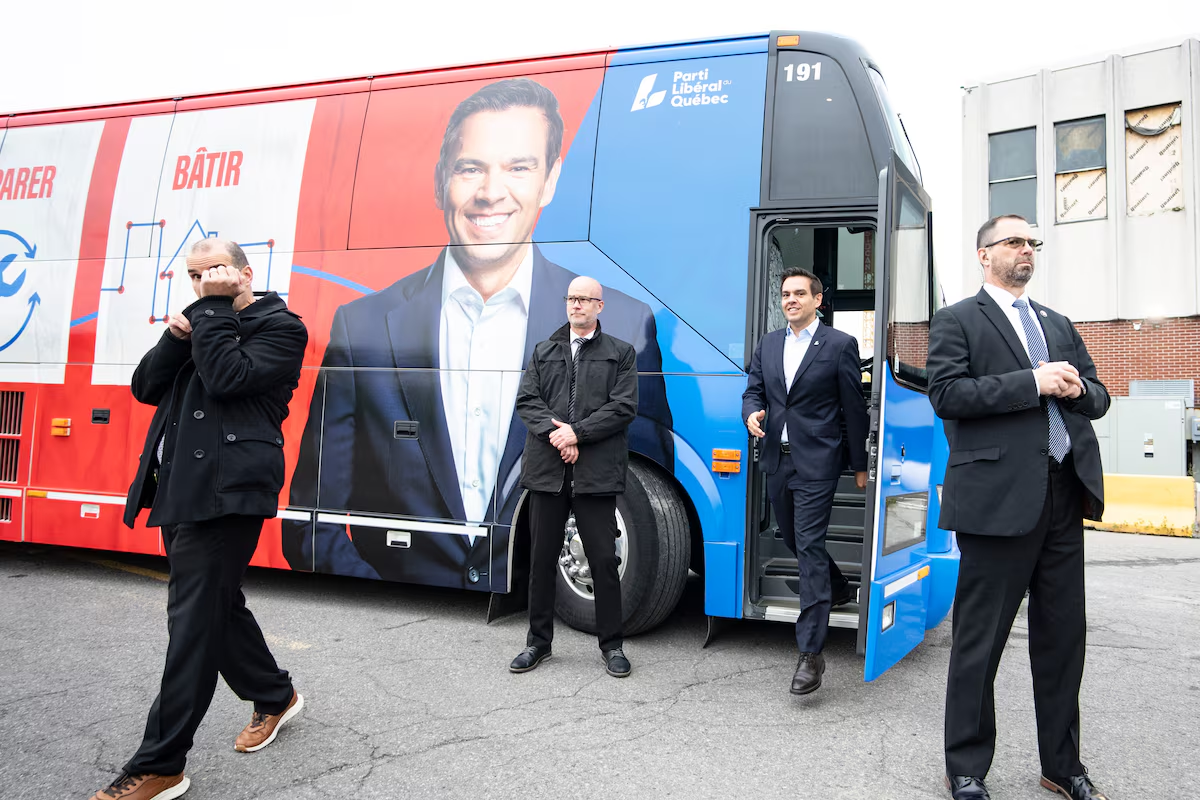
Quebec Liberal Leader Charles Milliard arrives for a campaign stop in Montreal on Tuesday. Quebec votes in a provincial election on Oct. 5.Christinne Muschi/The Canadian Press
Even the leaves were turning Liberal red in Knowlton, Que., on the final week of the provincial election campaign, as Frédéric Beauchemin went door-knocking in his riding.
Good omens seemed to be stacking up for the Quebec Liberal Party candidate in Brome–Missisquoi. This corner of the Eastern Townships is prosperous, fairly anglophone, and historically rouge. Voter after voter told Mr. Beauchemin they were tired of the incumbent Coalition Avenir Québec and totally opposed to the independence referendum promised by the Parti Québécois. He should have been winning by default.
The Quebec Liberals (PLQ) represent change in a change election, federalism in a federalist climate, and economic credentials in an economic crisis.
Yet, despite all their advantages on paper, the PLQ are locked in a close three-way race in Brome–Missisquoi. The venerable old party looks poised to form Opposition again after being stuck in neutral during the campaign for the Oct. 5 election. This week, Mr. Beauchemin was frantically trying to get out the vote with reinforcements from Montreal; another Liberal candidate in the safe seat of D’Arcy-McGee, Elisabeth Prass, drove down to help on Tuesday because “she feels bad for me,” Mr. Beauchemin half-joked. On Thursday, party Leader Charles Milliard came to lend a hand.
Quebec election 2026: What to know about the major parties, their platforms and where to vote
What ails Quebec’s natural governing party has become the subject of a thousand op-eds in the province, but with the separatist PQ likely to form government, the woes of the provincial Liberals have become Canada’s problem, too. The province’s voice for federalism is struggling to be heard.
The pitfalls are commonly dated to the government of Philippe Couillard, a courtly white-haired neurosurgeon who came to power in 2014. He left the province with a budget surplus, but was seen by nationalist voters as too pro-Canadian and multiculturalist, without an aggressive agenda for strengthening the French language.
He was defeated in 2018 by François Legault and the CAQ, who presented themselves as defenders of Quebec identity, passing laws restricting the use of English and banning religious symbols for some public sector workers.
The PLQ opposed both. The party has historically been a defender of minority rights, and its most solid base is among anglophone and immigrant voters in the Montreal region.
But the laws were popular, and the party’s opposition hurt it badly among the French-speaking majority. The most recent Léger poll had the party supported by just 14 per cent of francophones, who naturally decide elections in Quebec.
Parti Québécois could win majority despite low support for sovereignty
“The francophone vote doesn’t recognize itself in the Liberal Party of Quebec, notably because of the question of identity,” said Louis Aucoin, a communications strategist and former Bloc Québécois staffer.
When former federal cabinet minister Pablo Rodriguez became the PLQ leader last year, he had name recognition and experience in his favour. But within six months of assuming the post, he resigned amidst a financing scandal surrounding his leadership campaign. Mr. Rodriguez maintains he did nothing wrong, and the results of multiple provincial investigations are outstanding, but the damage was done. For a party that struggled with allegations of corrupt campaign financing as recently as the premiership of Jean Charest in the 2010s, the optics were especially bad.
“The integrity of the party was put in question,” Mr. Aucoin said.
When Mr. Milliard, a boyish-looking pharmacist and former Uniprix executive, won a hastily assembled leadership race this past February, he was uncontested. The PLQ brand was tarnished, and the new chief would have little time to introduce himself to voters ahead of a fall campaign.
Those circumstances set the Liberals back, but a deeper obstacle was at play as well: what Mr. Aucoin called Quebec’s “deep blue streak,” has lately risen to the surface. The province finds itself in a conservative era, with fears about the future of French – amidst a massive increase in immigration and the overweening presence of English online – leaving many francophones in a defensive mood.
The persistence of Paul St-Pierre Plamondon brings the PQ to a critical point
In this atmosphere, the party of minority rights, public sector reform, business, and federalism has had trouble gaining traction. Although only the PQ and Québec solidaire are arguing for independence, the CAQ and even the once-libertarian Conservative Party of Quebec are making strong nationalist pitches – a veritable sea of ideological blue.
It’s harder to make the federalist case because nationalism is largely based on emotion, André Pratte, president of the PLQ’s National Political Commission, which acts as an internal think tank, said in an interview earlier this year.
“For many Quebeckers, being part of Canada is a rational decision, not so much an emotional decision,” he said.
Adding to this baggage, the Milliard campaign got off to a bumpy start with gaffes that were heavily scrutinized in Quebec’s intense media climate, dominated by the sovereigntist-leaning Québecor empire. The party’s decision not to put the leader’s face on the side of its campaign bus was dissected for days, until Mr. Milliard’s visage finally appeared on the vehicle.
Since then, the party has fared better. Mr. Milliard was thought to have performed well in the debates. The polling collapse of the CAQ in recent days has seemingly directed some anti-referendum voters into the Liberal camp, with the party now sitting at 26 per cent in Léger’s latest survey, behind only the PQ at 30 per cent.
But because of the PLQ vote’s heavy concentration in Montreal, the party is projected to win about 30 fewer seats than the péquistes. Mr. Beauchemin’s move to run in the Townships, rather than in his blood-red former seat in the metropole, was an attempt by the party to strengthen its position in the regions.
CAQ Leader Christine Fréchette’s fresh start withers in the end
It was a risky bet for the fluently bilingual former banker, who comes across as a walking embodiment of his party. With a sheaf of flyers in his hand, he marched up and down the pretty rural roads of Knowlton expounding liberal principles.
“History judges nations harshly that only treat their majorities well … The anglophones don’t have the impression of being treated equally … The role of the government is not to pick winners, it’s to create the winning conditions for everyone to succeed.”
At the doorstep, Mr. Beauchemin got a warm reception; some voters had already cast their ballots for him in advanced polling.
“There’s no question – I don’t want a referendum,” said Josianne Côté, a lifelong Liberal voter.
But the riding-wide polls were still not as kind as the townsfolk of Knowlton, and there was something tense in the candidate’s manner as he hustled down the campaign’s home stretch, trying, like his party, to stave off a PQ victory.
At times, he seemed to see the colours of his adversaries everywhere. Stopped at a peaceful stream on the side of one rural road, Mr. Beauchemin gazed into the water and sighed, “It’s got a bit of blue algae in it.”