
Open this photo in gallery:
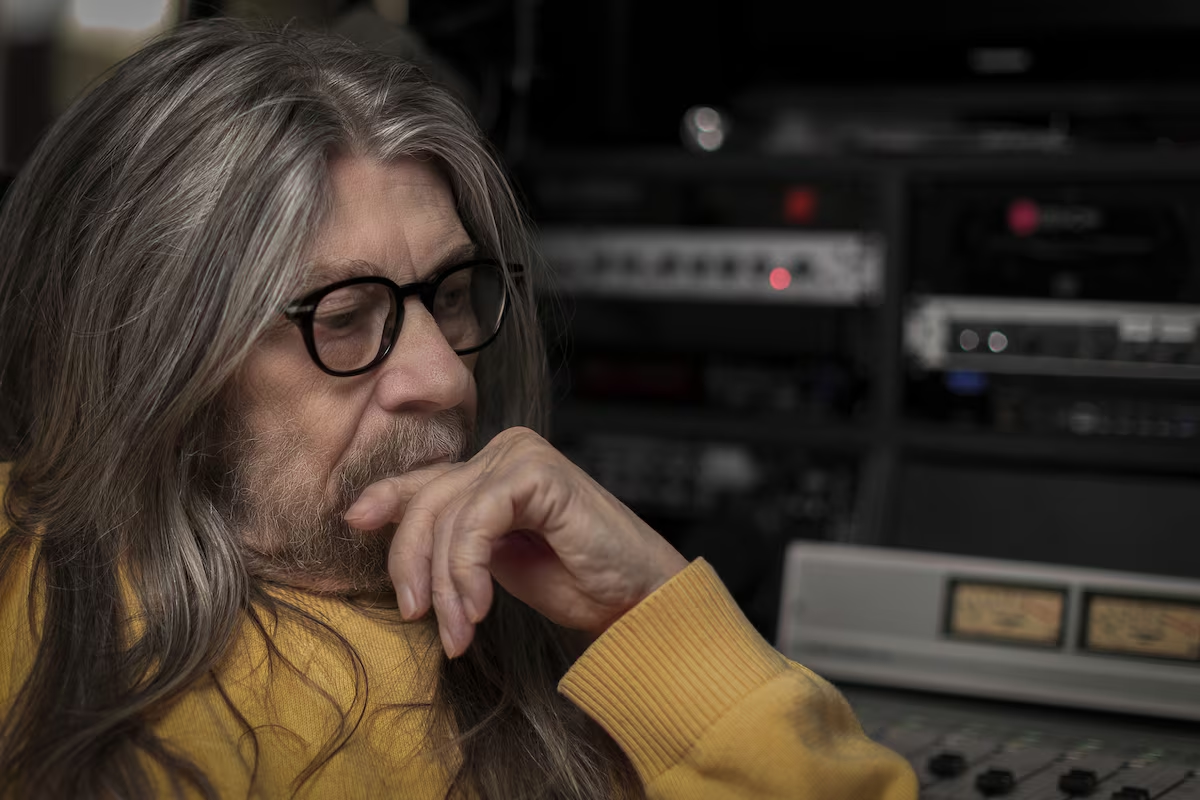
Igor N. Loukine / Sound Transmission Inc./Supplied
Some of the world’s best radio disc jockeys are cultural tastemakers, influencing music and helping to break new genres. Others are colourful personalities who attract ardent listeners with distinctive wit and dazzling delivery.
David Marsden, a Canadian broadcasting legend who died on Sept. 25 at the age of 85, had all that and more.
Over the course of an illustrious 63-year career that took him from AM and FM outlets across Ontario, Quebec and British Columbia to Canada’s first online radio hub, with occasional forays into television, Mr. Marsden stood out as a brave pop visionary and professional shapeshifter, revered by colleagues and admired by everyone from rock heroes Rush to egghead Marshall McLuhan.
His first on-air persona was Dave Mickie, a motor-mouth DJ at Toronto’s CKEY in the early 1960s with an extraordinary 700-words-a-minute delivery that led Mr. McLuhan to devote a full chapter to him in his celebrated book Understanding Media: The Extensions of Man.
The esteemed philosopher transcribed some of Mickie’s frenetic patter (“That’s Patty Baby and that’s the girl with the dancing feet … in the night time ooohbah scubadoo how are you booboo”) and observed that he “alternately soars, groans, swings, sings, solos, intones and scampers, always reacting to his own actions.” Mr. McLuhan concluded that while Mickie’s chatter appeared nonsensical in print, it still functioned as a cohesive, engaging performance on radio.
“The medium was the message and, for a moment, the message was Dave Mickie,” noted broadcaster, musician and impresario Jaymz Bee, in one of many online tributes.
In the 1960s, he transformed from the babbling Dave Mickie to the slow-talking, intimate hipster David Marsden, his most famous persona. The long-haired, openly gay man loved pink Cadillacs and wild promotional schemes attracting new followers with his freeform, eclectic style at several prominent FM outlets. He found perhaps his greatest success at CFNY, in Brampton, Ont., where he served as DJ and program director and created Canada’s first alternative music station.
After hearing what Mr. Marsden imprinted on CFNY, Rush recorded one of its biggest hits, 1980s fan favourite The Spirit of Radio, a gumbo of reggae, pop and metal that drummer and lyricist Neil Peart said he wrote to “represent all that radio should be.” The song’s title was taken from Mr. Marsden’s slogan for the station.
After Mr. Marsden’s death, following complications from a fall, there was an outpouring of accolades on radio and social media. Many came from people who worked with him, praising his love of format-free radio and passion for new music.
Liz Janik, the “friendly voice” cited in the opening of Rush’s song, credits Mr. Marsden with creating more than just a team of DJs at CFNY but a “community of tastemakers, creators, dreamers, free-thinkers and real people who he encouraged to be themselves on air and connect with listeners.”
Ivar Hamilton, now executive producer of CFNY: The Spirit of Radio, one of two recent documentaries in which Mr. Marsden is featured, agrees. “He was a one-of-a-kind, magical personality who inspired creative expression right across the radio landscape,” Mr. Hamilton said. “With David, we weren’t following charts or formats – we were playing music we wanted to play, something he did his whole career.”
Under Mr. Marsden’s leadership, CFNY was among the first commercial stations to introduce U2, Talking Heads, Depeche Mode and the Stranglers, giving the station greater influence than others with similar ratings. And he was unwavering in his support for a wide range of Canadian acts, including Teenage Head, the Payola$, Jane Siberry and Messenjah.
Open this photo in gallery:
According to music journalist and historian Michael Barclay, author of Have Not Been the Same: The CanRock Renaissance 1985-1995, the man sometimes known as Marsbar changed the way people listen. “Marsden believed in the freedom of music,” said Mr. Barclay. “What he created and curated spread far beyond the streets of Toronto. I know stories of people from all corners of North America who would trade cassettes of CFNY shows as a lifeline to underground music at the time.”
“David was there when our first independent vinyl release was played and he never stopped bringing us forward to his listeners,” remembers Mark Gane, partner with Martha Johnson in art-pop pioneers Martha and the Muffins. “His influence cannot be overestimated.”
“He was the one who broke us,” states Carole Pope, of trailblazers Rough Trade. “If it wasn’t for him, there wouldn’t have been much punk or new wave on commercial airwaves. David was an innovator and everyone else a follower.”
Born on March 2, 1941 in Toronto, he was adopted at the age of 5 by a Scottish-Canadian family and raised in Stratford, Ont., as David Michie. Bitten by the music bug after seeing Elvis Presley on television at 14, he upset his strict, conservative parents when they discovered he had rented the local YMCA to DJ dances. Before long he was managing the Revols, a group of Stratford teenagers, including singer-keyboardist Richard Manuel, later a founding member of the Band.
Dreaming of a life in radio, he changed his surname to Mickie and applied to over 30 stations, eventually finding work at CFCO in Chatham, Ont. By 1963, he had landed at CKEY, where his hyperactive style got him dubbed “the most controversial thing on Toronto radio.” Ken Stowar, now program director at Toronto’s CIUT-FM, remembers seeing Dave Mickie at Scarborough’s Cedarbrae Plaza. “There he was in a gold lamé jacket and speaking in his fast, outrageous manner,” Mr. Stowar recalled. “I was hooked.”
Two years later, Mr. Marsden was hosting both CBC-TV’s Music Hop, succeeding Alex Trebek, and his own Mickie a Go Go show on Hamilton’s CHCH-TV. When the Rolling Stones first performed in Toronto, Mr. Marsden was the concert’s emcee and did a TV interview with the band because, as he later explained, “no one else wanted to do it because they said the Stones were dirty and didn’t bathe.” After the show, some of the Stones and opening act the McCoys partied at his home, which Mr. Marsden admitted “got a little out of hand.”
He moved to Montreal in 1967, working at CKGM and later its progressive rock FM sister station CHOM. There, he broadcast for the first time as David Marsden, a variation on Marston, his birth mother Mildred Levie’s married name and the spelling of front man Gerry Marsden, of Merseybeat group Gerry & the Pacemakers. At CHOM, he began experimenting with programming, spinning a mix of blues, rock, folk and jazz recordings that baffled his colleagues. But he found his audience and was soon on air six nights a week, at the very moment stereo FM became the music frequency of choice.
By 1973, Mr. Marsden had returned to Toronto and joined CHUM-FM, where he expanded his mind-bending approach to music programming. There, he was the first DJ to play Rush’s self-titled debut. He persuaded concert promoters to book Pink Floyd at Maple Leaf Gardens and leaked an advance copy of the English band’s Dark Side of the Moon, cheekily playing the album in its entirety in advance of a planned promotional premiere. Mr. Marsden was also the first DJ in North America to play the Genesis album The Lamb Lies Down on Broadway. “David played the whole record,” Mr. Hamilton said, “and liked it so much that he played the album all the way through a second time.”
During his time at CHUM-FM, Mr. Marsden delighted listeners with engagingly fanciful storytelling – what he called his “theatre of the imagination” – as much as his daring music choices. And he invented contests, with unnamed prizes he offered to winning callers in a brown paper bag. Although no one knew what would be in the bag – albums, concert tickets, drugs or a head of lettuce – the mystery worked and another form of Marsden magic became the talk of the town.
The Globe and Mail’s Robert Martin described Mr. Marsden’s on-air personality as that of the “weird but hip music freak who talked in an intimate hush as though whispering in the listener’s ear.” Added Mr. Martin: “The music he played matched that personality, usually on the avant-garde fringes of rock.”
Mr. Marsden quit CHUM-FM the day his boss handed him a playlist. “For four years, I had total freedom to play the music I loved, whatever I wanted,” he recalled. “Total freedom, until it wasn’t.” As part of the team launching CFNY in 1977, Mr. Marsden brought his trippy humour and fully baked freeform programming ideas to the station. After becoming program director, he oversaw a rogue’s gallery of popular DJs including Ms. Janik, Mr. Hamilton, Allnite André, Live Earl Jive, Pete and Geets, James Scott, Brad McNally and Deadly Hedley Jones.
Always thinking big, Mr. Marsden introduced new contests and promotional ventures. With CFNY’s promise never to play the same song twice within 48 hours, he launched “Catch Us If You Can,” where the station would send $102 (CFNY’s broadcast frequency number) to any listener who caught them breaking the rule. More ambitiously, in 1981, Mr. Marsden unveiled the U-Knows, an irreverent alternative to the Junos. By 1985, the show had grown into the CASBY (“Canadian Artists Selected By You”) Awards and for the next three years, was televised on CBC, giving CFNY a profile far beyond its broadcast reach.
One of Canada’s first openly gay media personalities, Mr. Marsden came out on air after the station spoke out against the 1981 Toronto Bathhouse Raids. And he regularly stepped out of the studio to spin music, running his signature “The Mars Bar” at local gay nightclubs.
In 1987, Mr. Marsden took his Spirit of Radio dreams to Vancouver. He created Pilot One, a CBC-TV series that mixed music, comedy and interviews, hiring writers like Chris Houston, of punk rockers the Forgotten Rebels, and sex educator Sue Johanson. He then joined Vancouver’s AM station CKST and oversaw its switch as COAST 800 to a modern rock format. But, ultimately, it failed to match CFNY’s success.
Never resting, Mr. Marsden became a pioneer in streaming radio. He returned to Toronto in 1999 to launch Iceberg Media, a platform with over 100 channels of various genres which Standard Broadcasting later bought and transitioned to satellite radio. He started his final adventure in radio at 73, with the subscription-based internet station NYTheSpirit.com which, following Mr. Marsden’s death, promises to keep its founder’s unique programming style alive.
“There was really no one quite like David,” Ms. Pope concluded, “an outrageous character with a warm, kind and slightly insane personality who just loved music and supporting artists. And in the music business, that is a very rare quality.”
You can find more obituaries from The Globe and Mail here.
To submit a memory about someone we have recently profiled on the Obituaries page, e-mail us at obit@globeandmail.com.