
Open this photo in gallery:
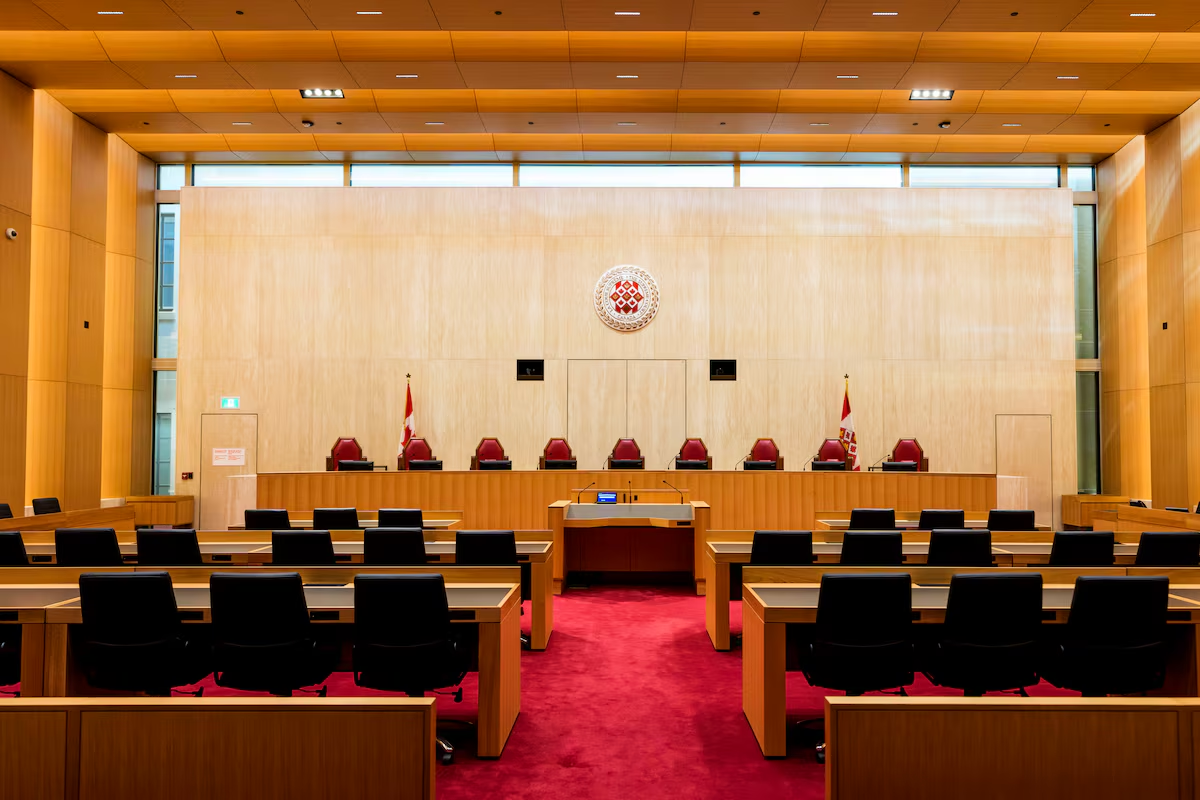
The courtroom of the temporary Supreme Court of Canada in Ottawa. The court has agreed to 13 per cent of appeal applications this year.Justin Tang/The Canadian Press
The Supreme Court of Canada is busier than it has been since the late 2010s, an increased workload that comes after criticism that the top court was not producing enough judgments.
The court each year receives several hundred applications to have cases heard in Ottawa, but in the 2020s the judges have said yes to only 7 per cent of the requests.
This year, however, the court is saying yes much more often. It has agreed to 13 per cent of appeal applications.
Last week, the Supreme Court said yes to two more applications, bringing the number of new cases for 2026 to 41. This is the highest number of new appeals granted since 2018, when the court agreed to hear 42 new cases.
The judges do not reveal why they say yes or no to new cases, but the Supreme Court Act outlines the main two criteria: whether a top court ruling would answer questions of national importance or settle conflicting judgments in the lower courts across the country.
Supreme Court produces fewer rulings than in past years
Concern among lawyers about the number of cases the Supreme Court hears each year centres on worries about the development and clarity of the law across the country. Fewer rulings from the top court means more legal questions are left unresolved.
The Supreme Court aims to hear as many cases as possible, said Daniel Byma, executive legal officer and chief of staff to Chief Justice Richard Wagner.
“The court does not set targets for the number of [appeal] applications it grants in a given year,” Mr. Byma said in response to questions about the court agreeing to more cases than in recent years.
While the court’s workload has increased this year, it remains lower than in the 2010s. The Supreme Court in the 2020s has agreed to hear an annual average of 34 cases – two-thirds the average of 52 in the 2010s.
Chief Justice Wagner, at his annual press conference in June, said the court is projecting its workload to rise back to the levels seen before the COVID-19 pandemic started in 2000.
Justice Mahmud Jamal in February was asked about trends in the court’s workload after a speech about the judges’ collegial decision-making.
“We aren’t looking to take fewer cases,” Justice Jamal said. “Quite the opposite.”
One of Canada’s largest law libraries is on the move along with the court it serves
Questions about the court’s output have spiked at times over the decades. The court heard more than 100 cases a year for most of the 1990s.
That workload was seen as overly heavy, as the judges sometimes struggled to produce timely judgments, but when it dipped in the mid-2000s to around 60 cases a year, some lawyers worried the court was hearing too few cases.
The more recent decline in the 2020s sparked renewed worries that the Supreme Court wasn’t delivering enough judgments on important issues of law across the country.
Lawyer Paul-Erik Veel of Lenczner Slaght LLP in Toronto has tracked trends in the court’s workload in recent years. In a report in June, he highlighted the sudden increase in the percentage of appeal applications the court has agreed to hear.
Mr. Veel, as he has said in the past, argued that a shorter list of Supreme Court cases has real consequences: “It leaves more legal questions left unresolved.”
Mr. Veel’s analysis noted the court is taking on more cases in public law, which involve constitutional questions and other issues, and private law, which include disputes between individuals or businesses.
He said the shift to hearing more cases, and a wider range, may suggest judges on the Supreme Court are looking to take on issues outside the usual fare of criminal law.
“If that is right, that would be a welcome development,” Mr. Veel said.
Supreme Court rejects strict deadlines during criminal sentencing
Chris Sewrattan, a Toronto criminal defence lawyer who closely follows the work of the Supreme Court, said the judges may simply be seeing more cases of national importance this year than they had in recent years. He said he doubts the increased workload is a response to criticisms in the legal community and noted the Supreme Court’s varying number of judgments has not captured the general attention of Canadians.
He also said the court has been busy in recent years, even with fewer cases, given the length of many of its written decisions.
“If we are entering a new era of more judgments and shorter decisions, I welcome the change,” Mr. Sewrattan said.
The court’s fall session begins in early October and the schedule is packed with 27 hearings.
The dispute that will likely garner the most attention is set for Nov. 9 and 10, when the court will hear four appeals on the federal government’s 2020 firearms regulations. Those rules effectively prohibited more than 1,500 firearms that had been previously legal for licensed ownership and use. Ottawa has described the banned guns as assault weapons that have been used in mass shootings.
Legal challenges against the gun prohibitions have twice failed, first at the Federal Court in 2023 and then again at the Federal Court of Appeal last year.
The Supreme Court agreed to hear the four firearms appeals in March this year.