
Open this photo in gallery:
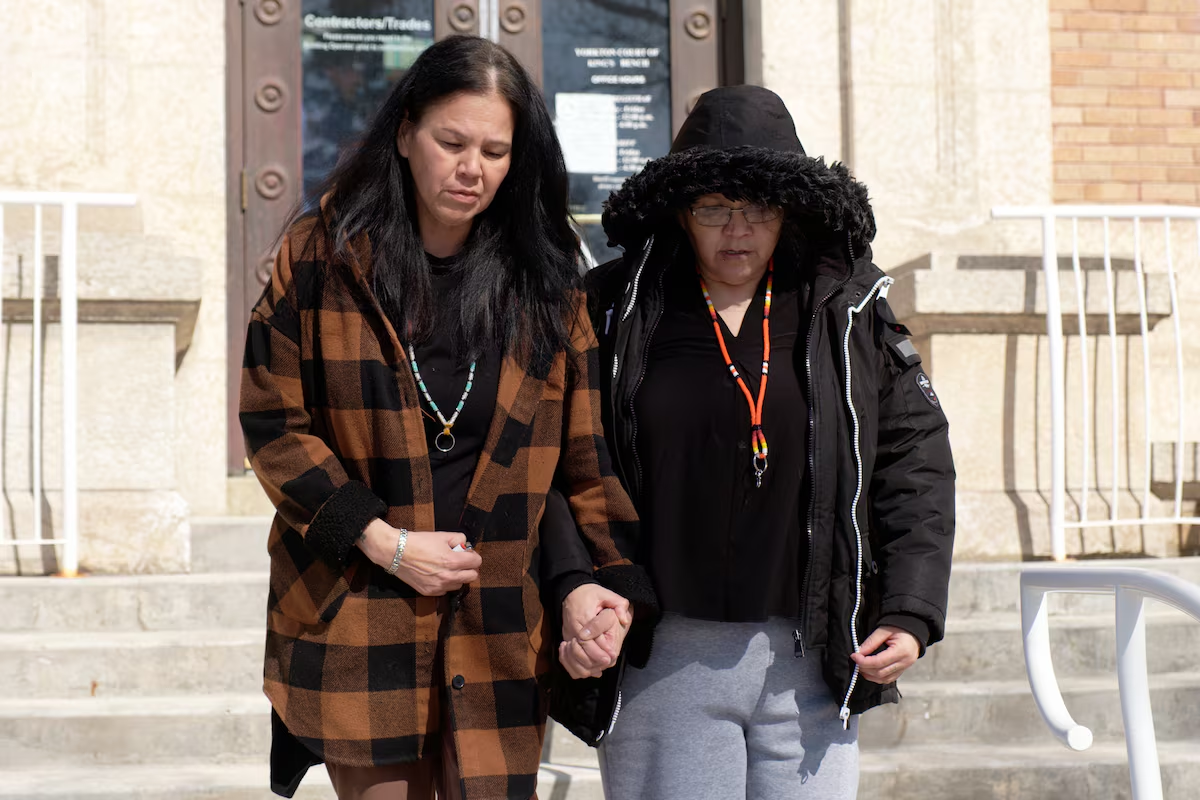
Odelia and Neressa Quewezance speak to media outside the Court of King’s Bench in Yorkton, Sask., in March, 2023.Michael Bell/The Canadian Press
Two Indigenous sisters who have maintained their innocence since they were convicted of murder more than 30 years ago will have their case reviewed after federal Justice Minister Sean Fraser ordered a new appeal.
Mr. Fraser issued a statement that said an in-depth review had concluded that the 1994 convictions of Odelia and Neressa Quewezance were likely a “miscarriage of justice.”
The sisters have spent almost three decades in prison.
While Mr. Fraser cautioned that it is up to the courts, not him, to make findings of guilt or innocence, his department said new information was identified that had not been presented to the courts at the time of the sisters’ trial or appeal.
“Our responsibility is to make sure Canadians can trust their justice system, and that means, in rare cases, returning cases to the courts for new information to be considered,” Mr. Fraser said in his statement.
From the archives: Indigenous sisters struggle to undo a 1994 murder conviction and break a cycle of parole and punishment
James Lockyer, the lawyer who represents the sisters on behalf of Innocence Canada, an advocacy group against wrongful convictions, said the new information is contained in the disclosure that the Saskatchewan Court of Appeal had to hand over to the Attorney-General but refused to give to the defence in the 1995 appeal case that was dismissed.
“We already had a basis for challenging the convictions but the new information that was provided by the Saskatchewan Attorney-General’s Office enhanced the strength of the application,” Mr. Lockyer told The Globe and Mail.
Odelia Quewezance made a statement through Innocence Canada on Thursday.
“Neressa was 18 when she was arrested and is now 52. I was 21 and am now 55. But we have never stopped fighting. Today’s announcement by the Minister is encouraging and now we will continue the fight in the Saskatchewan Court of Appeal. Thank you to all those who have kept the faith in us.”
Neressa and Odelia were arrested and charged in the stabbing death of 70-year-old Joseph Dolff, a janitor at the local residential school that the sisters attended in their home community of Keeseekoose First Nation, Sask.
From the archives: Case of Indigenous sisters serving life sentence underscores need to reform review process for miscarriages of justice, lawyer says
The sisters’ 15-year-old male cousin, whose identity remains protected because he was a youth at the time, pleaded guilty to second-degree murder and confessed to the crime.
He later testified at the sisters’ trial that he was the one who ultimately caused Mr. Dolff’s death at his farmhouse northeast of Kamsack, Sask., by tying a phone cord around his neck, throwing a television on him and stabbing him. He said the sisters only participated in the initial assault.
On the night of Feb. 25, 1993, the sisters had been drinking heavily, consuming significant quantities of beer and whisky provided to them by Mr. Dolff, who himself was not drinking. The sisters and their cousin also took prescription sleeping pills, both orally and by injection.
Court would later hear that at some point in the evening, Odelia took money from Mr. Dolff’s bedroom, and the group decided to leave.
Mr. Dolff was driving the sisters and their cousin home when he discovered the money was missing and they returned to his property. There, a violent confrontation ensued, in which Mr. Dolff was beaten, hit with household items and then stabbed to death.
The sisters and their cousin were arrested later that day.
From the archives: Saskatchewan judge orders release of sisters jailed for 30 years for a murder they say they didn’t commit
The sisters pleaded not guilty, but a jury found them guilty and a judge sentenced them to life in prison with no chance of parole for 10 years, the shortest period of parole eligibility possible for a murder sentence.
A ministerial review of the sisters’ conviction was granted in June of 2022, several months after Mr. Lockyer applied in a last bid for his clients’ freedom. The sisters were granted bail in 2023 before returning to custody for breaching release conditions.
The sisters’ time in custody, particularly in the days after their arrest by the RCMP has long been questioned by Mr. Lockyer and advocates.
Mr. Lockyer said the women’s alleged incriminating statements were never recorded and that as residential school survivors, they were more vulnerable to the pressures of police and of being in an in-custody environment that could have likely resulted in false confessions.
Innocence Canada called this week’s order of appeal a step toward vindication for the sisters.
“They were held in the Kamsack RCMP Detachment for five days, despite a judge’s order that they be taken to a detention centre away from the detachment,” Innocence Canada wrote in a press release.
Mr. Lockyer has called the Quewezance case, and the fact the sisters are still in custody, an example of fundamental inequities in the justice and correctional systems, and the discrimination that Indigenous people, particularly women, face not only from police and the courts, but also in prison and on parole.
He said he will be applying sometime in the next month for the sisters’ release on bail pending the appeal hearing.
With a report from Jana G. Pruden