
Inside an oyster hatchery on the western shore of PEI, an array of plastic vessels pumps algae-rich water to millions of tiny black dots – some as small as poppy seeds. They’re teeny, tiny baby oysters, specifically bred from the few that have survived multinucleate sphere unknown, or MSX, a deadly oyster disease caused by microscopic parasites.
These babies’ genetics are considered the best way forward for an industry on the brink of destruction as a result of the disease, which has ravaged wild and cultured oyster farms in Eastern Canada. It’s one of several responses to help PEI’s $27-million industry recover from the disease, which was first detected on the island two years ago and can kill 95 per cent of infected oysters. The Canadian Food Inspection Agency says it poses zero threat to human health or food safety.
“It is a terrible epizootic,” said Guy Perry, a molecular geneticist and manager of the Bideford Shellfish Hatchery on Lennox Island First Nation. “I have not seen anything worse than this ever, but at the same time as it does all this damage, we have a lot of hope because of the tools we have.”
Open this photo in gallery:
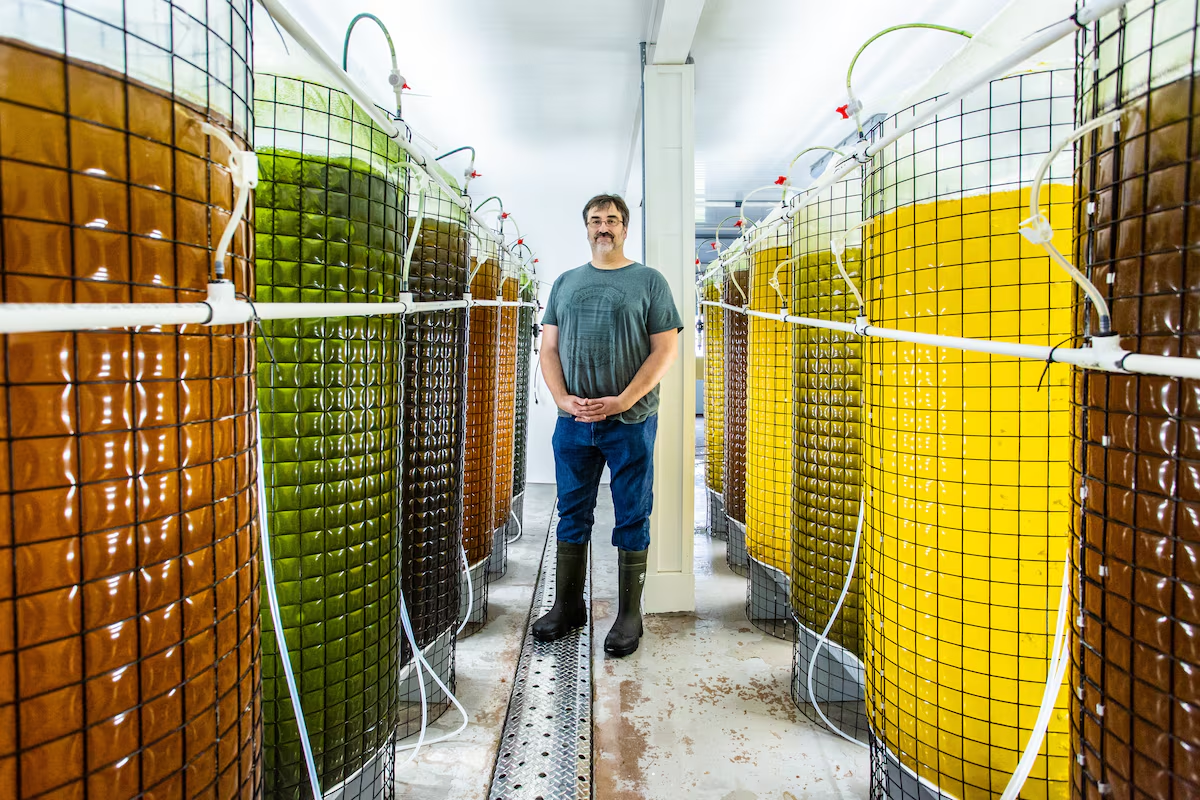
Guy Perry manages the Bideford Shellfish Hatchery, whose lab grows tanks of baby oysters, known as seed, to supply the aquaculture industry across Eastern Canada.
Open this photo in gallery:Open this photo in gallery:
A larval oyster, enclosed in a tiny shell, is just a few millimetres wide. Much of the footprint of the hatchery is dedicated to growing algae in heavy-duty plastic bags. Algae is the main source of food to grow the millions of seeds the hatchery produces annually.
At the Bideford marine research facility on the edge of an estuary on Malpeque Bay, giant bags of algae in seawater ranging in colour from green pond scum to honey-brown lager bubble away like witches’ brew – the primary source of food for baby oysters.
The hatchery is working to create homegrown disease-resistant oyster seed to sell to the aquaculture industry, which relies on infected coastal waters as a growth environment for its oyster crop. To do so, they’re breeding and hybridizing survivors from local growers and from Bedeque Bay, ground zero for the disease on the island.
MSX was first detected in Canada in 2002 when the disease was found in Nova Scotia’s Bras d’Or Lake. It wiped out the wild oyster fishery there. Dr. Perry said it’s unfortunate more wasn’t done then to create an MSX resistant oyster in Canada. “The whole industry’s short on time. This should have been started 20 years ago.”
Open this photo in gallery:
MSX and another parasite, Dermo, have done a number on this specimen at Raspberry Point Oyster Co. in New London Bay. Soft and foul-smelling meat are telltale signs; workers say some infected oysters are empty shells.
Earlier this year, the federal government approved importing oyster seed for breeding from the U.S. to develop disease-resistant oysters for aquaculture use in Atlantic Canada.
American hatcheries and universities have spent decades selectively breeding oysters for MSX resistance. Their oyster strains can achieve up to 89-per-cent survival rates against the lethal parasitic disease, which was first discovered in 1957 in Delaware Bay. Today, MSX has affected waters from the Damariscotta River in Maine to Biscayne Bay in Florida, according to the Virginia Institute of Marine Science.
Warming winter temperatures caused by climate change may be a factor in the proliferation of MSX in Canada, according to researchers. The prevalence of MSX is influenced by water temperature and salinity and is suppressed by low levels of both.
MSX was first confirmed in PEI in July 2024, and Dermo, another parasite that affects oyster growth rates and mortality, was first confirmed in PEI in July 2025. The federal government says Dermo also doesn’t pose a threat to human health.
Open this photo in gallery:
The Bideford River, dotted with oyster cages, is a short drive from Bedeque Bay on the other side of the island. Bedeque is considered the epicentre of MSX in the province.
The vast majority of Bideford’s oyster seed – 85 per cent – has survived the first year of exposure, said Adrian Desbarats, the hatchery’s aquaculture business development adviser, though he noted MSX kills 95 per cent of oysters within two to three years of infection.
“They are not dying so they are, in our opinion, the real deal,” he said. “We feel that we’re getting somewhere.”
The hatchery is also using genomic tools and hybrid breeding methods – which Dr. Perry says are fast, accurate and widely used in modern agriculture.
This involves analyzing the genes of oysters that have survived and those that have died of MSX, and running their genetic profiles through software that looks at millions of genes in rapid succession. This process has identified three genotypes in the survivors that distinguish them from those that died. Dr. Perry used the survivors’ genomic profiles for breeding oysters that are expected to be resistant to MSX.
“This could be the first genomically selected cohort for MSX resistance in Canada,” he said.
“I have high hopes for this and, frankly, the mathematics are on our side.”
Open this photo in gallery:
Dr. Perry says he’s optimistic that the new seed being grown at Bideford has a fighting chance against MSX.
The oyster seed supplier is funded by the federal Atlantic Integrated Commercial Fisheries Initiative and the Atlantic Canada Opportunities Agency. Lennox Island First Nation, a Mi’kmaq community and band, owns and operates it.
The hatchery currently produces 20 million oyster seeds annually. While it plans to double that number next year, it’s only a fraction of the 400 million required to sustain the island’s pre-MSX aquaculture industry. “We have a desperate situation in the industry,” Mr. Desbarats said. “We’re trying to provide a solution but we recognize that we can’t be the only solution. We don’t have the capacity to provide for everybody.”
A little east of the Bideford facility, Raspberry Point, a big player in the island’s oyster aquaculture industry, is also planning to build a hatchery to grow its own disease-resistant seed, the company’s general manager, James Power, has said.
Open this photo in gallery:
Raspberry Point has piled up millions of dead oysters on the Hope River this year as MSX and Dermo take their tolls.
In August, the federal government announced an oyster licence buyback program to support fishers who want to exit the industry and to ease pressures on the wild oyster population while scientists keep working on MSX and Dermo, and while the industry adapts and rebuilds. The wild oyster fishery accounted for between 25 and 30 per cent of PEI’s oyster sector, valued at an estimated at $6.8-million in 2024, the federal government says.
The PEI and New Brunswick governments have also responded to the crisis this year by providing financial relief to producers affected by the diseases.
Seafood for thought: More from The Globe and Mail
The Decibel podcast
For chefs across Atlantic Canada, this past summer was a struggle to find the seafood dishes that tourists crave, such as oysters, scallops and haddock. Food culture reporter Dakshana Bascaramurty spoke with The Decibel about how restaurants adapted in ways that might come in handy for future tourist seasons. Subscribe for more episodes.
Science of the sea
A Canadian whale scientist sees something close to a miracle
Having found a sea-star killer, B.C. scientists see a way to stop it
Teaming up on salmon hunts, orcas and dolphins in B.C. have developed a strategy that really clicks