
Open this photo in gallery:
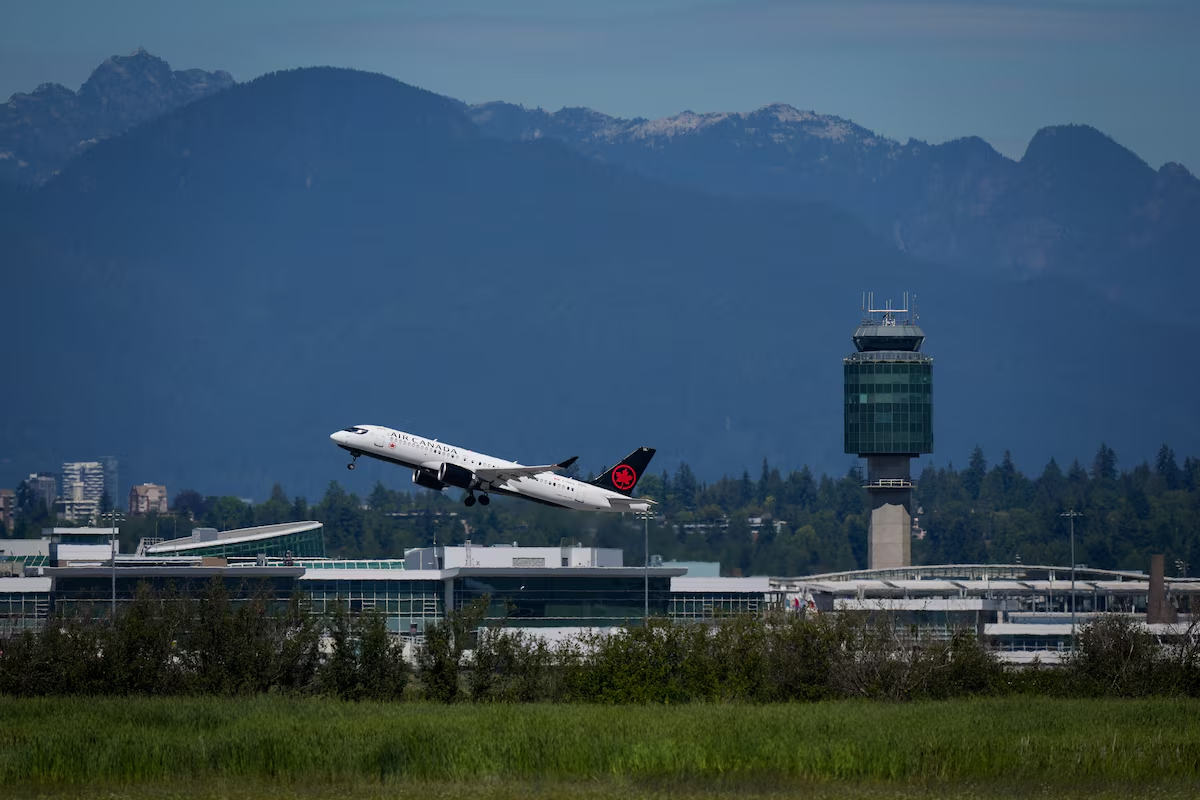
An Air Canada aircraft takes off from Vancouver International Airport in July. Ottawa said this month it was courting private investors to take over operations of the country’s four biggest airports.DARRYL DYCK/The Canadian Press
A new poll suggests a large number of Canadians support the government’s idea to put private operators in charge of the country’s largest airports – but more than a quarter aren’t sure about it.
The Leger poll finds 43 per cent of Canadians are in favour of having private operators for the Toronto, Montreal, Calgary and Vancouver airports, while 31 per cent are against the idea.
Twenty-seven per cent of respondents said they don’t know or are unsure about the proposal.
Andrew Enns, executive vice-president Central Canada at Leger, said there will always be a part of the population opposed to any kind of privatization in Canada, but he took note of the relatively low level of support.
What could airport privatization mean for travellers in Canada?
“What I found a bit interesting is you have to look pretty hard to find policy that this prime minister has introduced, that hasn’t generated 50 per cent plus, 60 per cent plus support. I mean, he’s riding a pretty good wave right now,” Enns said.
For contrast, Leger asked respondents in the same poll about their interest in becoming an “associate member” of the European Union and 70 per cent of respondents supported the idea.
Enns said having 43 per cent supporting the idea and a majority being opposed or unsure means the government is going to have to do more legwork in explaining why it wants to pursue private operators for the four biggest airports.
Prime Minister Mark Carney said at the investment summit in Toronto last week that he was courting private investors to take over operations of the country’s four biggest airports. Both he and Transport Minister Steven MacKinnon have said the government would still own the land and airports would still be subject to all federal safety regulations.
Carney said it would free up federal dollars for smaller regional airports.
The poll suggests people in Quebec are most likely to back the concept at 47 per cent of respondents. Those polled in Saskatchewan and Manitoba are most likely to oppose it, with only 32 per cent showing support.
Enns said the Prairie Provinces had a smaller sample, but said this result may be a symptom of frustration in often having to route through Toronto or Calgary, especially for Saskatchewan respondents.
“I think they might be saying, ‘instead of privatizing those airports, invest in more routes in our airports,’ because they’re pretty underserved. Like, it’s not easy getting to those markets,” Enns said.
Carney suggested at the investment summit revenue from private operator deals could be used to put more money into smaller regional airports.
Albertan respondents were not far off their Prairie neighbours with 33 per cent support and 35 per cent opposition.
About a third of respondents in the three Prairie Provinces said they were unsure about the plan, the largest proportion in any provincial sample.
The rest of Canada saw support levels in the mid 40 percentile range, with opposition around 30 per cent.
Opinion: Carney’s airport investment plan doesn’t go far enough in privatization
Canadians aged 55 years and up were more likely to support the government’s plan than their younger peers, 45 per cent compared to 39 per cent support for the 18-to-34 crowd, but opposition was around 30 per cent for all age groups.
Enns said the older Canadians tend to be very on board with what Carney proposes, but in this instance they appear to be more hesitant overall.
“They are certainly not any more opposed to the idea, but they are similar to those younger Canadians in saying, ‘hey, what’s going on?’ And I suspect in part, they also are fairly heavy travellers,” Enns said.
Leger conducted the poll of 1,533 Canadians between Sept. 19 and 21.
The Canadian Research Insights Council, an industry organization that promotes polling standards, says online surveys cannot be assigned a margin of error because they do not randomly sample the population.