
Open this photo in gallery:
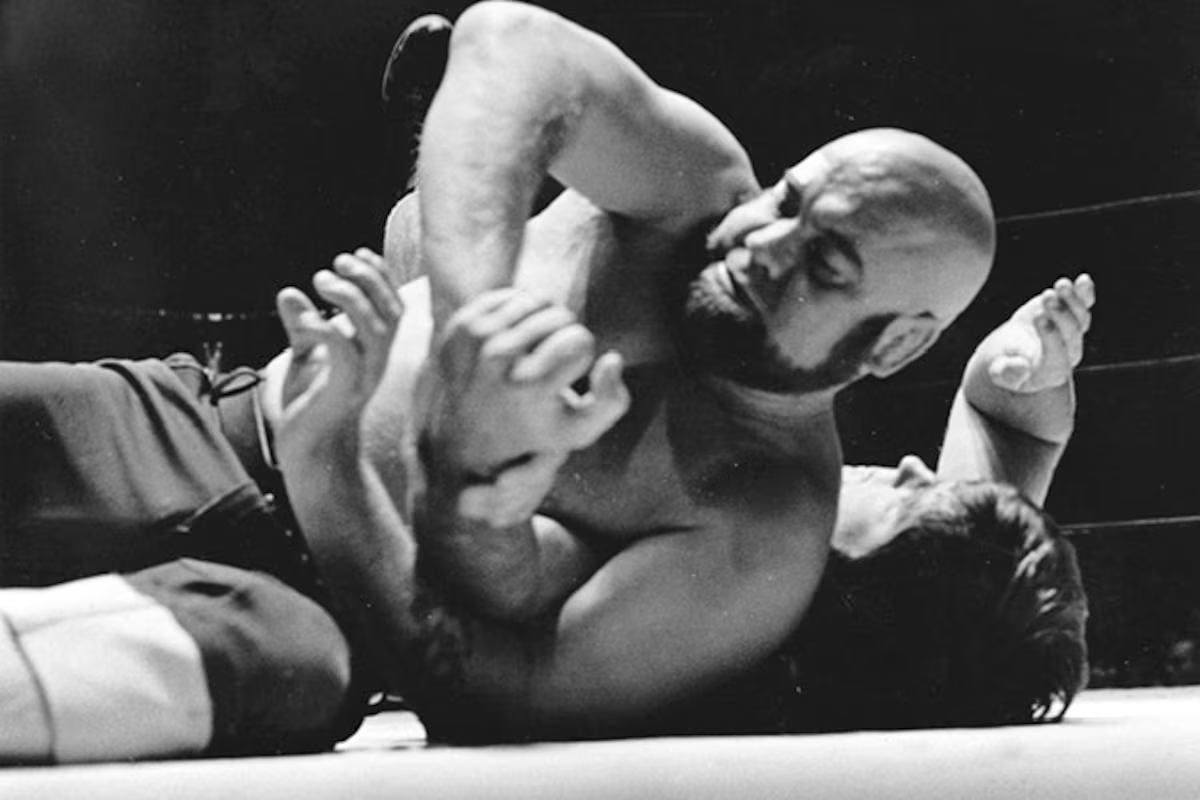
Paul Leduc and his fictional brother, Jos, attracted huge numbers of fans to their bouts, which often featured clashes with the Rougeau family and the notorious Vachon brothers.Paul Leduc Collection/Supplied
The brothers Paul and Jos Leduc wore tuques topped by a pompom, grew chinstrap beards and donned checked flannel shirts open to the navel.
Like any tough lumberjacks from the backwoods of Quebec, they also carried axes.
The fearsome tag team engaged in sweaty, bloody combat against other professional wrestlers, most notably feuding with the Rougeau family and the notorious brothers Maurice (Mad Dog) and Paul (The Butcher) Vachon.
Between Expo 67 and the 1976 Olympics, the Leduc brothers were an attraction on bills luring large crowds to the Forum in Montreal and Maple Leaf Gardens in Toronto. The Leducs also built a dedicated Quebec fan base by performing in arenas and baseball parks in such cities as Sherbrooke, Trois-Rivières and Cap-de-la-Madeleine.
Paul Leduc, who has died at the age of 89, was the smaller of the pair, standing at 5 foot 10 (1.78 metres) and weighing 195 pounds (88.5 kilograms). His brother was a massive figure, carrying 280 pounds (127 kilograms) on a slighter taller frame.
On one notable occasion, Paul brought a foreign object into the wrestling ring – a wedding ring. In that match, he was less interested in a headlock than in wedlock. Paul married Pierrette Brault in what might be called a double-ring ceremony before either 5,000 (according to the Montreal Gazette) or 10,000 (Montréal-Matin) paying guests (top ticket $4) as the opening match of a wrestling card featuring 37 fighters at the Forum on Dec. 27, 1971.
The bride wore a white silk gown with a fur-trimmed hood. The groom wore a tuxedo and a toque. Father Paul Aquin, who had married the couple two hours earlier at the Mary, Queen of the World Cathedral, once again conducted the ceremony, only this time his invocation of the Father, the Son and the Holy Ghost was each cheered by the crowd. The Forum organist played such tunes as Strangers in the Night, I’m in the Mood for Love and (Where Do I Begin?) Love Story.
The newlyweds cut their wedding cake with a swift chop from a hatchet.
Jos Leduc, who had served as best man, then joined the other wrestlers – including football’s Angelo Mosca, Baron Scicluna, Little Brutus, Little Beaver, Sky Low Low, Pee Wee Adams, Frenchy Lamont, Sonny Boy Hayes, Farmer Boy Jerome and Abdullah the Butcher – for several hours of sweaty grappling.
The newlyweds avoided such entanglements by heading off to honeymoon at a motel in Florida.
Open this photo in gallery:
Paul Leduc’s wedding to Pierrette Brault at the Montreal Forum on Dec 27, 1971. Beside Paul is his partner Jos Leduc with his children Robert and Nadine.Paul Leduc Collection/Supplied
Soon after, the Leduc brothers were wrestling throughout the Sunshine State as well as in Texas, avoiding their home province’s cruel winters.
While the Vachon brothers hailed from the same family, the Leducs’ backstory was fiction, a gimmick created to whet the appetite of wrestling crowds. The pair maintained the kayfabe (the pro wrestler code of staying in character in public and never acknowledging any scripted outcome) until Jos Leduc died in 1999. It was then revealed Jos was a former policeman who had legally changed his name, as Paul Leduc did in 1977.
Paul Leduc’s real-life story was as compelling as that of his fictional alter ego, if not more so. Orphaned at 13, he learned to wrestle in Mexico. After retiring from the ring, he became a central figure in a shocking incident of picket-line violence. He later ran a wrestling promotion known by the eyebrow-raising acronym FLQ.
Joseph Léodard Mimeault, as he was originally named, was born on Nov. 10, 1936, in Saint-Maxime-du-Mont-Louis, a fishing village on the northern Gaspé coast. He was the youngest of 15 children, not all of whom survived infancy, born to Hortense Lemieux and Edmond Mimeault, a farmer. His father died when the boy was four. When his mother died of a heart ailment nine years later, he went into foster care before elder siblings were able to take him in, according to Pat Laprade of TVA Sports.
He played hockey and trained as an amateur wrestler, a purely athletic endeavour unlike the scripted spectacle of the pro variety. After deciding to become a professional wrestler, he went south to Mexico to learn the trade. On his return to his native province, he adopted the character of a Roman gladiator. A contemporary photograph shows him in a toga with a helmet, while carrying a dog-topped sceptre in one hand and a leash attached to a drooling St. Bernard in the other.
Open this photo in gallery:
Paul Leduc in 1973. The duo often wore tuques topped by a pompom.Paul Leduc Collection/Supplied
Fighting under the name Del Leo Mimolt, the undersized (by wrestling standards) grappler struggled to build a following. It was only after he persuaded a friend named Michel Pigeon, a former constable with the provincial police, to join him in the ring that he found success.
They were introduced as the Leduc brothers from Godbout, a forestry town across the mouth of the St. Lawrence from Paul’s birthplace. The Vachon brothers had run a lumberjack gimmick before them, but only on the road. The Leducs would become heroes in their home province.
The early storyline debuted in 1968 had Paul being beaten in the ring before being rescued when his gargantuan, though awkward, brother Jos entered the fray.
The Leducs were marketable and they bounced between promotions, winning tag-team championships with Stampede Wrestling out of Calgary, as well as a Florida championship with the National Wrestling Alliance in 1973.
By jumping to the Vachon brothers’ Grand Prix Wrestling promotion in the early 1970s, the Leducs became the baby face (good guys) foils to the Vachon heels (bad guys). The brothers attracted massive crowds in Quebec, including one for a steel-cage match at the Colisée in Quebec City that was so successful the attendance, which was several thousand beyond legal capacity, could not be reported for fear the next show would be shut down.
“When the Mad Dog bit you,” Paul Leduc once said, “you felt it for two or three days.”
At a public memorial for Mr. Vachon, as reported by Mike Wyman for Slam Wrestling, Mr. Leduc recalled a dramatic bout during which Mad Dog fired his brother, the Butcher, mid-bout, vowing to defeat both Leducs on his own.
“The crowd started cheering him and booing us,” Mr. Leduc said. “At that moment Mad Dog Vachon became Good Dog Vachon. The crowd turned against us and the chairs started flying.”
Jos was the bigger attraction of the two faux brothers, and the pair often fought separately with Paul occupying bouts on the undercard. That was not always a disadvantage, as in Florida in 1974, Paul had the good fortune to be teamed with Haystacks Calhoun, who was billed as “the world’s biggest wrestler” at 601 pounds (273 kilograms). They won their match.
Open this photo in gallery:
The fictional brothers would become heroes in their home province before heart troubles persuaded Paul Leduc to abandon the ring.Paul Leduc Collection/Supplied
Heart troubles persuaded Mr. Leduc to abandon the ring and retire his tuque and flannel shirt.
Before doing so, he took a position as a vice-president with the Bureau des detectives industrielles, a private-security company.
On July 22, 1977, striking Robin Hood flour mill workers and their supporters protested at the mill, which stayed in production by hiring strikebreakers. As a small group of protesters advanced toward the mill, Mr. Leduc’s security guards fired shotguns, wounding eight protesters. The images of overweight men in shorts, T-shirts and mismatched helmets shooting at unarmed protesters shocked viewers of the nightly news.
It also overnight turned Mr. Leduc from a sporting hero to a villain.
“I was driving to work this morning and people on the street were shaking their fists at me,” he told Richard Cleroux of The Globe and Mail. “When I was wrestling, I was always the good guy. Suddenly, I’m a bad guy. I’ve become a licensed killer for hire. That’s not pleasant when that happens.
“I’ve been called a traitor and told that I’m not a true Quebecker. I’ve been told, ‘You work for Americans and live with the English’ and it’s going to affect me.
“I heard one woman say on an open-line radio show this morning that ‘the Leduc brothers lived off workers because workers went to their matches and cheered them and now they shoot workers down for the bosses.’ I don’t like that.”
The notorious incident added powerful momentum to demands for the Parti Québécois to ban the use of replacement workers, enacting what is known by unions as anti-scab legislation, which the provincial government did later that year.
Mr. Leduc’s new-found notoriety did not prevent him from finding lucrative work. One day, media magnate Pierre Péladeau saw him being interviewed on television. He called the studio and told him he wanted to hire him for Québecor. When Mr. Leduc arrived at the head office, he overheard a secretary on the phone pleading, “But Mr. Péladeau what do you want that I do with a former wrestler?!”
Open this photo in gallery:
Paul Leduc during the TOW tv pilots in 2013.Paul Leduc Collection/Supplied
He worked as a travelling salesman for the company before becoming director-general of Messageries Dynamiques, a Québecor division that distributed such newspapers as Le Soleil and Le Journal de Montréal.
Mr. Leduc wrote a wrestling column in French titled, “1-2-3,” echoing a ring referee’s countdown to a clinch.
He also operated a wrestling school with his son and held weekly bouts in the hall of the St-Jean-Berchmans church in Montreal. He called his promotion the Fédération de Lutte Québécoise, which used as an acronym FLQ, the same as the violent revolutionary group responsible for bombings and the murder of a Quebec cabinet minister during the 1970 October Crisis. The crowd’s chant of “F-L-Q! F-L-Q!” gained some media attention.
Mr. Leduc died in Montreal on Aug. 30 following six weeks of hospitalization for cardiorenal syndrome. He leaves a daughter, Kim; sons Yan and Carl, the latter of whom followed his father into the ring as a pro wrestler; as well as two grandchildren by marriage. He was predeceased by his wife, Pierrette, his bride from the Forum, who died in 2011. He was also predeceased by all his siblings, the most recent being brother Denis Mimeault, who died in 2021, aged 88.
Mr. Leduc endured many travails before finding success in the wrestling ring. Eager to be accepted by the other pro wrestlers, as a rookie he agreed to drive promoter Larry (Babe) Kasaboski and wrestlers Killer Kowalski and Édouard Carpentier (né Weiczorkiewicz) on a trip from Montreal through a tour of Northern Ontario, he told wrestling writer Gary Howard. Once in the car, the other three men spoke solely in Polish for the entire journey.
To add injury to insult, they made the young wrestler grapple with Terrible Marcus, a 181-kilogram (400-pound) bear. The bruin pinned the human as part of a card at Memorial Gardens in North Bay. The beast’s trainer rewarded the animal with a jug of pop. The defeated wrestler then had to drive the others home. It is unknown if he learned along the way the meaning of the word niedźwiedź, Polish for bear.
You can find more obituaries from The Globe and Mail here.
To submit a memory about someone we have recently profiled on the Obituaries page, e-mail us at obit@globeandmail.com.