
Open this photo in gallery:
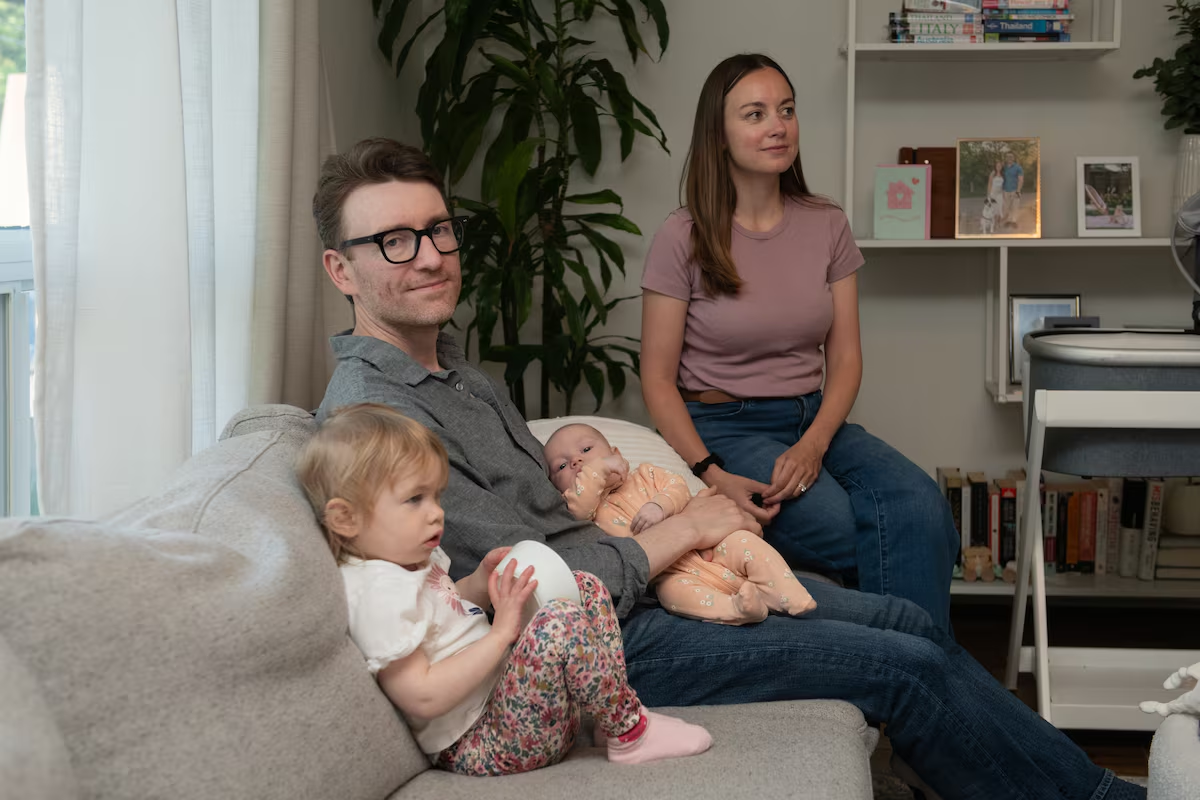
Alex Shved with his wife Agata Zieba and their two daughters. Mr. Shved, who has stage 4 melanoma, had challenged the province’s decision to deny him out-of-country coverage that would allow him to access tumour-infiltrating lymphocyte therapy in the U.S.Galit Rodan/The Globe and Mail
The Ontario Superior Court of Justice has quashed the province’s decision to refuse to cover out-of-country cancer treatment for a father of two with stage 4 melanoma, ordering a new decision by Oct. 2.
Alex Shved, a 37-year-old Etobicoke resident, had challenged the province’s decision and said Tuesday that the court’s judgment validates arguments he has put forward in his fight to see public drug coverage for tumour-infiltrating lymphocyte (TIL) therapy. His physicians support Mr. Shved accessing it in Florida.
On Tuesday, justices Jean‑Marc Labrosse and Sharon Shore set aside decisions that denied funding for Mr. Shved’s potentially life-saving treatment, finding the justifications unreasonable and inadequately explained.
They also sent the matter back to the executive officer of the Ontario Public Drug Programs and requested a new decision with an expedited timeline, emphasizing that time is now “very tight.”
“The record discloses that he will likely be dead by Christmas if he does not receive the requested treatment within a few weeks,” the justices said.
A third judge, Justice David Corbett, agreed that the decisions should be quashed. However, he disagreed on the approach supported by justices Labrosse and Shore.
He said he would have directed the executive officer to recommend treatment and would have instructed OHIP’s general manager to expedite a funding decision.
Ontario parents hope son’s death can change Canada’s approach to novel cancer treatments
In August, 2025, Health Canada approved a commercial version of TIL therapy called lifileucel. But it is not available in Canada outside of clinical trials because it is still being reviewed for public funding.
Mr. Shved is one of three Ontario melanoma patients who spoke with The Globe and Mail about their fears and frustrations waiting to access TIL therapy while it makes its way through the country’s complex system for funding new medical treatments.
He applied for a provincial out-of-country program to see if it would pay for him to be treated in the U.S. But he was denied and told the program isn’t intended to be used as an interim funding route for drugs that could eventually qualify for public coverage.
A single treatment of lifileucel costs US$515,000, not including the cost of a stay at an American hospital.
So he filed for a judicial review in court in June. He said the process to review medications for funding can take years and that there is no way for a Canadian patient to access the therapy.
“What is somebody that’s got stage 4 cancer to do?” he said.
“They don’t have two years to wait for this to get approved. And I think that is exactly what the judges saw.”
Mr. Shved, who has a five-month-old baby and a two-year-old, has also appealed to legislators to help.
Days after having surgery on his left arm to remove a tumour, he continued to reach out to politicians. He e-mailed Ontario Premier Doug Ford and Health Minister Sylvia Jones on Tuesday after the court’s decision.
“The Court has made clear that OHIP cannot deny potentially life-saving treatment based on blanket internal policies, unsupported claims about harm to ‘the system’ or superficial reasoning,” he wrote.
“There is clearly something very broken in our healthcare system.”
A spokesperson for Ms. Jones did not immediately offer comment Tuesday on the court’s decision.
Mr. Shved said he has spoken directly with Ms. Jones in the past couple of months but lamented that “she has done nothing.” He said that makes the legal challenge his only available avenue.
And while he said he grows discouraged from time to time when he does not receive anything in return from politicians, he remains hopeful.
He wants to help other patients “wrongly denied this treatment for absurd and unlawful reasons.”
“That’s, I think, what keeps me going and inspires me to continue.”
With reports from Kelly Grant in Toronto