
Open this photo in gallery:
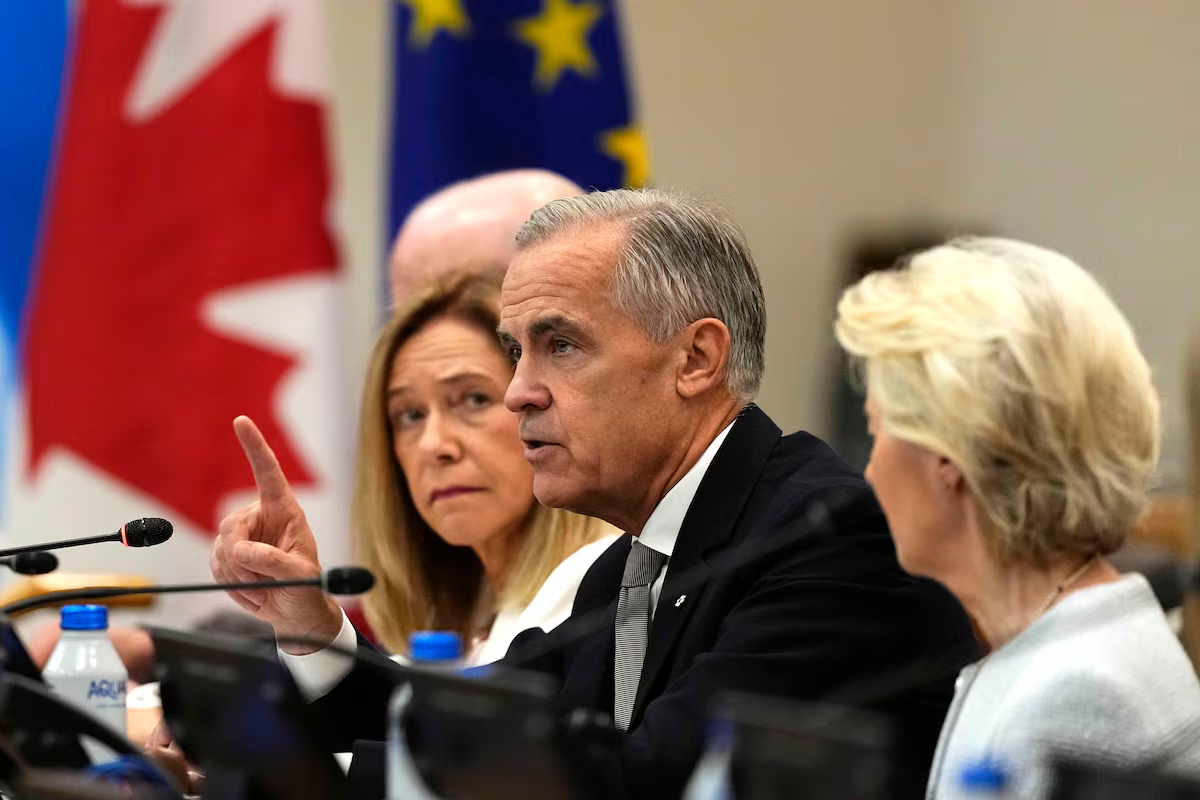
Prime Minister Mark Carney attends a high-level pledging event for the OceanEye International Alliance in support of the Global Ocean Observing System (GOOS) on the sidelines of the the United Nations General Assembly on Wednesday.Justin Tang/The Canadian Press
Canada ratified the landmark High Seas Treaty to protect marine biodiversity on Wednesday and pledged $82-million over five years to a global ocean-monitoring alliance, Prime Minister Mark Carney announced in New York on the margins of the United Nations General Assembly.
“Canada is an ocean nation. We have the world’s longest coastline as a consequence of that. That’s our inheritance, and we recognize the obligations, the responsibilities, that come with that to help lead efforts to understand those oceans, and of course, to protect them,” said Mr. Carney, speaking at the launch of the OceanEye International Alliance, co-hosted by Canada and the European Union.
Amid shifting political winds, Canada gets more of the spotlight on the UN’s stage
The money will pay for year-round moorings in the Arctic Ocean, which is warming four times faster than the global average, said Mr. Carney. It will support autonomous underwater gliders beneath the ice, expanded monitoring of the Labrador Sea and Davis Strait. It will also more than double Canada’s contribution to the global Argo ocean climate monitoring network, and help modernize the National Oceanographic Data Centre, among other investments.
The treaty, meanwhile, which became international law in January, is the first legal framework for protected areas in waters beyond national jurisdiction, which make up nearly half the planet. OceanEye, which Mr. Carney agreed in June to co-chair with European Commission President Ursula von der Leyen, pays for the instruments that monitor the global ocean’s changing condition.
Both commitments, one to protect the high seas and the other to monitor the ocean as a whole, land on a tension in Canada’s ocean record. As Ottawa builds partnerships abroad, scientists say it is dismantling the monitoring and research that underpin them at home.
“As Canadian scientists, working internationally, we are watching the instruments go dark,” wrote Frédéric Cyr and Brad deYoung in a commentary published Sunday.
Dr. Cyr, a former Fisheries and Oceans Canada oceanographer now at Memorial University of Newfoundland’s Marine Institute, and Dr. deYoung, a professor emeritus at Memorial, point to significant cutbacks at the federal department, whose own plan projects spending reductions of up to $194-million by 2028-29 and about 551 fewer full-time positions. They say Ottawa has scaled back the Atlantic Zone Monitoring Program, which has tracked changing ocean conditions for more than two decades, and withdrawn support for the international program that monitors the North Atlantic currents that regulate the climate.
In their letter, they urged Mr. Carney to reverse those cutbacks and attach sustained funding to Canada’s OceanEye role. Of today’s announcement, Dr. Cyr said he was encouraged by the investments the Prime Minister had committed, but still had questions.
Most concerningly, he hopes the funds will maintain Canada’s role in monitoring the North Atlantic currents that scientists worry could be headed for collapse.
“Our oceans form one interconnected system. Canada’s leadership on protecting the high seas is much needed. At the same time, any country that is going to lead on the high seas also needs to lead at home,” said Susanna Fuller, vice-president of conservation at Oceans North, a member of the High Seas Alliance, a coalition of more than 80 conservation groups that pushed for the treaty for over a decade.
Canada signed the High Seas Treaty in March, 2024. Becoming a party now gives Ottawa a seat when countries meet for the first time in January next year. Only 1.5 per cent of the high seas is currently protected. The treaty also requires environmental assessments for high-seas activities and sets rules for sharing the benefits of marine genetic resources found there. As of this week, nearly 100 parties have joined, with Germany, Papua New Guinea and Zimbabwe among the latest to ratify.
Analysis: Trump uses UN address to threaten and deride foes and allies alike, as usual
At Wednesday’s OceanEye Alliance event, countries were invited to pledge money or in-kind support to the UN-backed Global Ocean Observing System, the network behind the ocean data used in weather forecasts and climate models. The system draws on 8,000 instruments, from floats to moored buoys, that collect some 120,000 observations a day, according to the EU, noting it remains “vulnerable to financial and geopolitical disruptions,” given just nine countries pay for 90 per cent of that monitoring effort.
The event is the latest sign of Ottawa’s push to deepen ties with the EU, weeks before a Canada-EU summit in Canada on Oct. 29-30.
The federal nature strategy, which Mr. Carney announced in March, set aside $24.4-million over five years, plus $1.8-million in continuing funding, to ratify the treaty and carry out its commitments.
Canada will also act as host of the Our Ocean Conference in Halifax May 10-11, 2027.
Mr. Carney took a moment to acknowledge Canada’s recently named Ocean Envoy and Chair, Diana Fox Carney, his wife. “We intend to be at every table, where the future of the ocean is decided and to continue to raise our ambitions,” he said.
This story is produced in partnership with the Pulitzer Center’s Ocean Reporting Network.