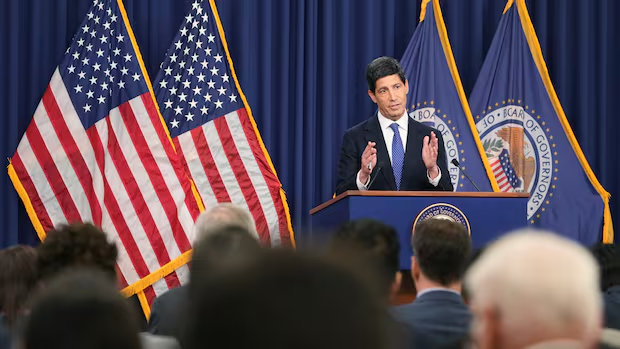
The U.S. Federal Reserve raised its benchmark interest rate Wednesday for the first time since 2023 in an effort to quell stubbornly high inflation, and the central bank signalled another rate hike could occur later this year.
The quarter-point increase lifts the Fed’s key rate to about 3.9 per cent and, over time, could result in higher borrowing costs for American mortgages, auto loans and credit cards.
The move comes as Americans are already struggling with high costs for groceries, gas and housing. Affordability has taken on a leading role in the upcoming midterm elections, just seven weeks away.
In a set of quarterly projections, the Fed also signalled that its rate-setting committee expects to hike rates a second time later this year, to 4.1 per cent.
Fed Chair Kevin Warsh, who was nominated by U.S. President Donald Trump, emphasized after the announcement that the economy has shown signs of gathering speed since the central bank decided to keep rates unchanged in late July. Inflation has also remained stubbornly above the Fed’s two per cent target, and he noted there is little sign it is cooling.
“The plain fact is that inflation is too high and has been for too long,” Warsh said.
Federal Reserve policymakers, who unanimously supported the hike, said in a statement that the move would “support a timelier return” to the two per cent goal.
Warsh also said renewed combat between the U.S. and Iran, which has driven up gas prices, had convinced Fed officials to support rate hikes.
Since taking the lead at the central bank in May, Warsh has said the Fed is firmly committed to taming inflation, and policymakers would take their cues from the data to determine if inflation was going in the right direction.
The rate hike marks a turnaround for Warsh. While under consideration by Trump last year, Warsh often suggested the Fed could reduce its key rate, echoing the president’s call for lower borrowing costs.
And in April, when Warsh’s nomination was under consideration by the Senate banking committee, Trump said in a television interview that he would be disappointed if Warsh didn’t cut rates. On the same day, however, Warsh told the committee he had not promised Trump he would cut rates and said he would be “an independent actor” as Fed chair.
WATCH | Will Bessent’s bond market intervention make U.S. inflation worse?:
Will Bessent’s bond market intervention make U.S. inflation worse? | About That
U.S. Treasury Secretary Scott Bessent’s recent intervention in the bond market is setting off alarm bells for many investors and analysts. Avneet Dhillon breaks down concerns that Bessent’s attempt to calm the markets and decrease the cost of borrowing may actually worsen inflation.
(Photo credits: The Canadian Press, Reuters, Adobe Stock and Getty Images)
Trump said Wednesday he still has confidence in Warsh, and blamed the people Warsh has to work with.
“The board is very hostile, they’re very political,” he said to reporters Wednesday evening, repeating that interest rates are too high. “They’re doing the wrong thing, they’re a bunch of politicians or people put on by politicians.”
The ongoing disruptions from the Iran war, which have pushed up average gas prices more than seven per cent from just a month ago, threaten to spread through the economy and keep broader inflation stubbornly high. An inflation report last week showed core prices, which exclude food and energy, accelerated slightly in August.
According to the Fed’s preferred measure, inflation was 3.7 per cent in July compared with a year earlier.
Earlier Wednesday, the government said retail sales jumped 1.2 per cent in August from the previous month — a sign consumers are still spending at healthy levels despite sentiment surveys indicating Americans remain gloomy about the economy.
Strong spending is a sign that interest rates at current levels aren’t necessarily restricting the economy enough to cool inflation.
“While uncertainty remains elevated owing, in part, to geopolitical developments, domestic spending has been resilient,” the Fed said, likely referring to ongoing consumer spending and strong investment in AI data centres by large technology companies.
More hikes are also possible. Wall Street investors have forecast three hikes in total, with additional increases in December and March.
WATCH | Why inflation is still a problem:
Inflation is still a problem | Mind Your Business
Statistics Canada data published Monday shows the annual inflation rate edged up to 3.2 per cent in May — the sharpest increase in more than two years. CBC’s senior business correspondent Peter Armstrong explains what’s happening and where prices could go next.
Bank of Canada not facing same pressure: economist
The rate hike south of the border doesn’t necessarily signal similar moves in Canada any time soon, according to economists.
The Canadian and U.S. central banks sometimes change interest rates in similar ways because the two economies tend to face the same challenges, explains Paul Beaudry, a professor at UBC’s Vancouver School of Economics and a former deputy governor at the Bank of Canada.
Right now, Canada is also facing rising inflation driven by rising energy prices because of the war in Iran. The pace of inflation held steady at three per cent in August — above the Bank of Canada’s two per cent target.
But Beaudry says the inflation problem in the U.S. is worse. Core measures of inflation that strip out volatile items like energy and food are at about 2.4 per cent in the U.S., compared with closer to two per cent in Canada.
“There’s more inflation underlying in the U.S. So the U.S. has more to do to try to bring it back … to two per cent,” Beaudry said.
Canada’s economy is also weaker by comparison, Beaudry points out, partly because tariffs and higher unemployment. All things considered, that means Canada doesn’t face the same pressure to raise rates.
A recent RBC Economics forecast update made the same case, saying Canada and the U.S. were both facing inflation pressures and rising bond yields, but were “entering these shocks from different starting points.”
For that reason, they predicted the U.S. would raise rates in September but did not expect the Bank of Canada to raise rates until 2027.