
Achim Hurrelmann is a professor of political science and co-director of the Centre for European Studies at Carleton University.
This essay is part of the Prosperity’s Path series. In a time of geopolitical instability and a shifting world order, the challenges facing Canada’s economy have only gotten more visible, numerous and intense. This series brings solutions.
Two years ago, who would have predicted that a Canadian prime minister, speaking in the European Parliament, would identify the European Union as key to Canada’s “alliance for the future”?
Arguably, not even Mark Carney himself expected he would be greeted by a European lawmaker wearing a Canadian hockey jersey.
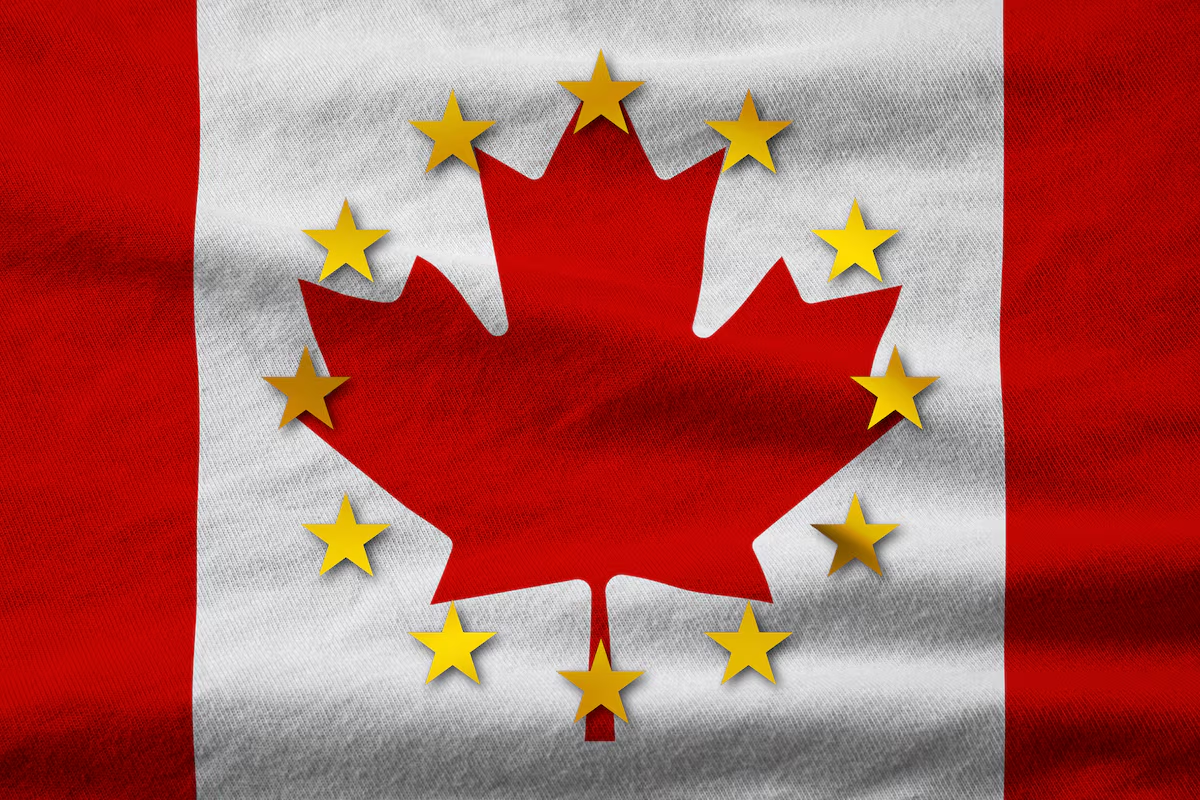
Yet all of this happened in Strasbourg, France, last week after European Commission President Ursula von der Leyen explicitly called for Canada to be the first-ever “associate member” of the EU, speaking that title into existence after prior reports caused a stir.
Open this photo in gallery:
Prime Minister Mark Carney meets with European Commission President Ursula von der Leyen, who recently caused a stir by calling for Canada to be the first-ever ‘associate member’ of the EU.Justin Tang/The Canadian Press
The current enthusiasm for Canada-EU relations can only be understood in the context of the Trump administration. Outreach to the EU is a key component of the Canadian government’s trade diversification strategy and a compelling example of the collaboration of “middle powers” that Mr. Carney called for in his Davos speech in January. For the EU, closer relations with Canada strengthen Europe’s “strategic autonomy” and reduce external dependencies in fields such as energy, critical minerals and defence.
Above all, the partnership is important symbolically: Both Canada and the EU are keen to signal to the United States, and their own populations, that they are not alone, that rules-based international co-operation is not dead and that liberal democracies can achieve big things.
What an “associate member” status would imply in practice and why it would be needed are much less clear. The term has no legal meaning. Canada and the EU already have a highly institutionalized relationship, based on the Comprehensive Economic and Trade Agreement, which eliminates most tariffs; the Strategic Partnership Agreement, which establishes frameworks for political dialogue; a Security and Defence Partnership that forms the basis for Canada’s participation in EU-supported defence procurement; and sectoral initiatives such as the “Strategic Partnership on Raw Materials.”
In the lead-up to a Canada-EU summit planned for late October, diplomats on both sides are working on initiatives that would further strengthen these relations. These include an agreement on digital trade and cybersecurity; further collaboration on energy and strategic minerals supply chains; joint security initiatives in the Arctic; and enhanced research collaboration and educational exchanges. These initiatives all have merit, but don’t require a new level of formal association.
If Canada and the EU were interested in moving beyond the current trajectories of their relationship, the only existing blueprint short of full membership would be joining the EU’s single market, following the model of Norway (and other members of the European Economic Area) and Switzerland. These countries have arrangements that eliminate all obstacles to economic exchange and allow for free movement of people. In return, they have agreed to accept EU rules, including environmental and labour standards, and make payments into the EU budget.
This arrangement makes sense for countries that are geographically close and economically dependent on the EU, but it is much less plausible for Canada. It would also appear to contradict the Carney government’s focus on protecting Canadian sovereignty.
Open this photo in gallery:
Prime Minister Mark Carney delivers an address to the European Parliament in Strasbourg on Thursday. Outreach to the EU is a key component of the Canadian government’s trade diversification strategy.Justin Tang/The Canadian Press
It is very unlikely that Canada and the EU are contemplating this. But the label of “associate member” invites this misunderstanding. Even more importantly, it distracts from an analysis of the concrete obstacles that must be overcome to intensify the Canada-EU relationship. These have less to do with the formal status of the partnership, or even an insufficient level of ambition, but rather point to the challenge of breathing more life into the existing agreements.
Canada-EU trade patterns provide an illustration. Despite increases in bilateral trade under CETA, less than 6 per cent of Canadian goods exports in the first half of 2026 went to the EU.
In contrast to trade with the U.S., Canadian businesses seeking to export to the EU must deal with higher transportation costs, language barriers and interstate differences that remain in the EU’s single market. Finding the right business partners thousands of kilometres away can prove challenging. Non-tariff trade barriers – for instance, those arising from different food and product safety standards – pose further obstacles. European exporters to Canada face similar challenges. CETA has not resulted in a major boost in investment, though the Carney government’s focus on major projects has triggered some notable announcements on that front in recent months.
These challenges do not imply that Canada-EU relations cannot or should not be further intensified. They underline, rather, that such a shift requires concrete initiatives that strengthen business-to-business and people-to-people connections. This means moving beyond the relationship between the federal government and EU institutions. In the EU, member-state governments must be more systematically engaged. This is particularly important for collaboration on energy and defence, as member states hold most powers in those areas. In Canada, the provinces must be brought on board. Canada and the EU must also explore the creation of forums that foster deeper connections between business associations, chambers of commerce, trade unions, cultural institutions, research funding bodies and universities.
Open this photo in gallery:
Closer ties with the EU would exemplify the collaboration of ‘middle powers’ that Mr. Carney called for in his Davos speech in January.Justin Tang/The Canadian Press
Ottawa and the EU can build supportive frameworks. This may entail devoting public funding to back up private investment in strategic sectors. It should include negotiating reciprocity agreements through which both parties exempt each other from their respective “buy local” policies. Reviewing the institutions and bodies that govern the administrative details of the bilateral relationship would also be useful. CETA procedures designed to speed up regulatory alignment, conformity assessments and the mutual recognition of professional qualifications have been slow to produce results. Legitimate disagreements or insurmountable opposition from sectoral interests may be to blame, but this may also indicate an unnecessarily bureaucratic approach.
In pursuing deeper Canada-EU relations, managing expectations will be important for both sides. For reasons of geography alone, the EU will not replace the U.S. as Canada’s most important economic partner. Canada’s security also calls for a North American perspective. There are good symbolic and policy-related reasons to prioritize deeper ties with Europe, but the talk about “associate membership” is much less compelling. What is needed is not a new label, but steps that encourage more buy-in from all levels of government, business and civil society.