
Open this photo in gallery:
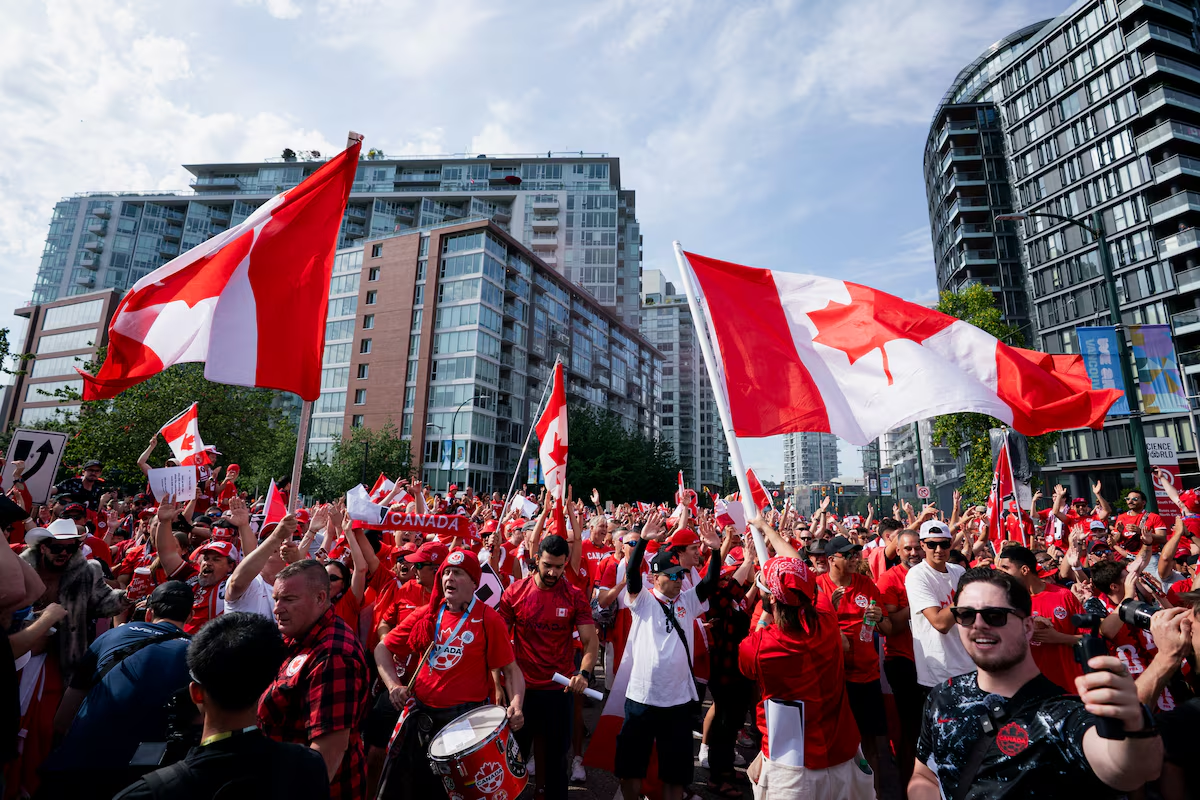
Canada fans march to BC Place before a World Cup match against Switzerland, in June.JACOB MALLARI/The Canadian Press
The 2026 World Cup drew huge crowds of Canadians to a handful of Vancouver and Toronto neighbourhoods, but left some districts with fewer visitors than usual.
New data from Toronto-based analytics company Environics Analytics, provided exclusively to The Globe and Mail, show how unevenly foot traffic was distributed in each city, bolstering reports from businesses that the tournament’s economic boost did not reach every commercial district even as governments touted broader long-term benefits.
“It was a bit of a non-event,” said Neil Wyles, executive director of Vancouver’s Mount Pleasant Business Improvement Association. Its members include the many retail shops, bars and restaurants in the trendy neighbourhood just a few kilometres from BC Place stadium, where matches were held.
“On game days, you might have seen a bit of a bump, but over the longer arc of the months no one was knocking it out of the park in Mount Pleasant.”
Canada, the United States and Mexico co-hosted the largest-ever edition of the World Cup between June 11 and July 19. Vancouver hosted seven matches and Toronto six.
In Vancouver, Yaletown saw the biggest boon, with average daily visits during the World Cup period up 18.2 per cent from the weeks before the tournament. On days that Vancouver hosted matches, visits surged 63.3 per cent.
Vancouver’s World Cup pitch finds new life beyond BC Place
Yet nearby neighbourhoods saw traffic move in the opposite direction. Compared with pretournament levels, average daily visits fell 12.7 per cent in Strathcona, 9.4 per cent in Mount Pleasant and 3.2 per cent in the West End during the World Cup. On match days, the declines were even steeper, at 15.3 per cent, 9.9 per cent and 11.4 per cent, respectively.
Open this photo in gallery:
Fans watch as Spain takes on Argentina in the World Cup final, at Toronto’s Fan Festival, in July.Sammy Kogan/The Globe and Mail
Environics Analytics’ MobileScapes database estimates foot traffic using cellular network signals with personal identifiers removed and calibrated to represent the Canadian population aged 15 and older
The estimates do not capture international visitors or other foot traffic originating from outside Canada’s resident population, an important limitation during a tournament that drew soccer fans from around the world. The exclusion may therefore understate the tournament’s impact in areas such as downtown Vancouver, an entertainment district where measured visits rose just 3.8 per cent overall and 8 per cent on game days, despite it being packed throughout the tournament.
Mr. Wyles said the findings for Mount Pleasant are not surprising, given that Vancouver’s World Cup festivities were concentrated in the downtown core. Warnings of traffic congestion and street closures also deterred some visitors, as they did when Vancouver hosted the 2010 Winter Olympics, he said.
As a BIA representing a neighbourhood with residential, commercial and light industrial properties – but no hotels – the association focused on appealing to locals, Mr. Wyles said. He also suspects that the high cost of hotels downtown during the games kept out-of-town visitors from taking more time to explore the broader city.
Meanwhile, Yaletown’s visitor surge was not left to chance. Sarah Vallely, executive director of that neighbourhood’s BIA, said the group actively sought to parlay its proximity to BC Place into longer visits by installing mini soccer pitches, murals and other programming. Local businesses also leaned into the effort with watch parties and transformed patio spaces.
“The biggest takeaway for us is probably that with these major events, you have to embrace them,” Ms. Vallely said.
“There will always be disruption, but if you give people a reason to spend time in the neighbourhood rather than just walk through it on their way to the stadium, there can be a really meaningful benefit for local businesses.”
World Cup delivered a tourism blip to Canada in June, early numbers show
Toronto saw a similar concentration of activity. Average daily visits to Liberty Village, adjacent to BMO Field at Exhibition Place, increased by 9.7 per cent during the tournament and 57.9 per cent on days the city hosted matches at the stadium. CityPlace and Fort York, which was home to the city’s official fan festival, recorded a 13.1 per cent increase across the tournament and a 37.6 per cent increase on game days.
But just north, Little Portugal saw average daily visits decline by 10.6 per cent across the tournament and 3 per cent on game days, despite being one of Toronto’s most popular destination neighbourhoods and a gathering point for Portugal supporters.
Giovanny Restrepo, a spokesperson for the Little Portugal Toronto BIA, said benefits were uneven within the neighbourhood, with increased activity at the more than 18 bars, restaurants and venues that showed matches or hosted World Cup programming, but not at other businesses.
Similar to Mr. Wyles in Vancouver, Mr. Restrepo said messaging from the city and the media that emphasized road closures, overcrowding and difficulties getting downtown – while legitimate considerations – may have discouraged people from visiting the area. Recently implemented parking restrictions are also believed to have negatively impacted businesses, he said.
For future mega-events, Mr. Restrepo said better co-ordination and communication with the city and other stakeholders could create a broader economic benefit.
“Visitors should be given clear information about how to get around, where they can park, which neighbourhoods remain accessible and, importantly, reasons to actually explore the city’s many neighbourhoods and local businesses.”
Opinion: The World Cup shows that Toronto can think big. This can be its next bold bet
Beyond visitor numbers, Environics Analytics also profiled the types of communities that people came from by linking its mobility data to its PRIZM segmentation system, which groups Canadian neighbourhoods based on shared demographic, socio-economic and lifestyle characteristics.
In both cities, the biggest increases came from multicultural communities outside the neighbourhoods where World Cup festivities were concentrated, according to the PRIZM data.
In Vancouver, the groups that contributed most to Yaletown’s surge in visitors were associated with neighbourhoods with large Asian populations, including financially secure families on the urban fringe, younger and middle-aged South Asian families and younger, university-educated singles and couples of Asian descent.
In Toronto, much of the increased traffic into Liberty Village was associated with culturally diverse, middle-income neighbourhoods, including urban-fringe communities with younger and middle-aged families.
The Globe and Mail reported in July that, despite weeks of packed bars and restaurants and persistent fears of hotel-room shortages, data suggest the marquee soccer tournament did not amount to a major economic boost.
Figures from digital payment processing giant Moneris, which handles one in three transactions in Canada, show that from June 12 to 26 total spending at Toronto bars and restaurants was up just 3 per cent over the same period last year. Spending by international visitors, however – measured using foreign-issued credit and debit cards – was up 34 per cent at those same bars and restaurants. Total spending at Vancouver restaurants and bars, and total foreign spending, each increased by 6 per cent.