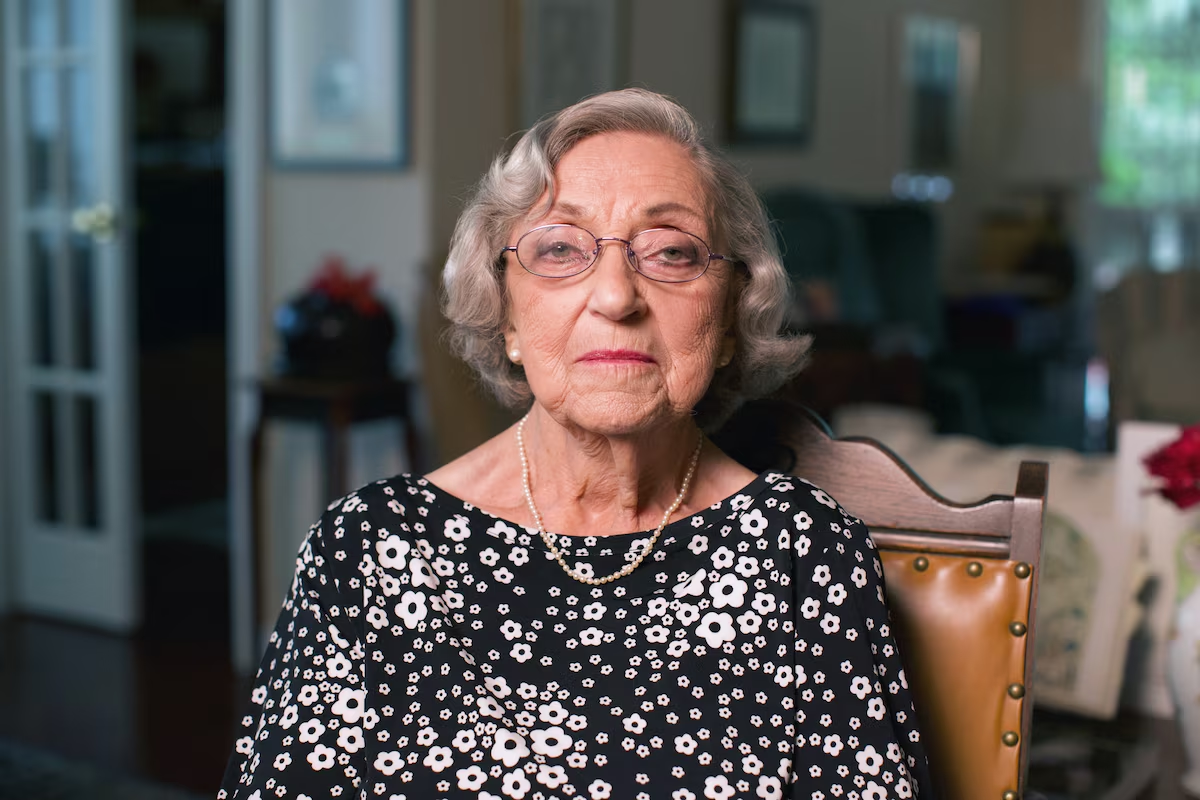

Open this photo in gallery:
Judy Weissenberg Cohen in Toronto, 2019.Courtesy of Azrieli Foundation
In 1993, Judy Weissenberg Cohen was nearing her 65th birthday and mandatory retirement when, during a lunch-break stroll through downtown Toronto, she saw a group of young people clad in black leather marching in a circle and shouting, “White power! White power!”
A certain fear was automatic, she later wrote in her memoir, like the feeling of her stomach clenching when she witnessed people being selected for death at Auschwitz-Birkenau.
“For a terrifying few seconds, the lines were blurred between past and present. I wondered, was I looking back at history or ahead?”
As she approached the curious audience, she realized she had come face-to-face with members of the Heritage Front, a white supremacist, neo-Nazi organization.
Instead of turning away, Ms. Cohen marched toward the group’s leader, Wolfgang Droege. When he claimed there had been no Black slavery in the U.S., she assumed the Holocaust would be the next thing he denied.
Before he got the chance, Ms. Cohen stepped between him and the crowd and implored those watching not to listen. She later humbly joked she was not especially heroic, since four police officers were nearby.
“Lady, don’t aggravate yourself. They only have a permit for 20 minutes.”
“My luck!” Ms. Cohen later wrote. “I caught the 20 minutes that would soon spur me to action.”
For the next three decades, she dedicated herself to Holocaust education and public speaking, urging people — particularly students — to recognize the warning signs of hatred and become witnesses to history. She also became a leading advocate for raising awareness about women’s experiences during the Holocaust, eventually creating a website devoted to preserving those stories.
Ms. Cohen died on Sept. 6 at 97 years old.
“The memory of the death camps and being victims of the Nazi Holocaust never fades, but I no longer consider myself a victim,” she wrote. “Instead, through the decades, I became a politically and socially aware activist. I must work relentlessly to ensure that memories like mine will not become the memories of future generations.”
Open this photo in gallery:
Ms. Cohen (far right) and her sisters Évi (left) and Klári (centre), Debrecen, Hungary, 1933.Courtesy of Azrieli Foundation
She was born Judy Weissenberg in Debrecen, Hungary, on Sept. 17, 1928, just after Rosh Hashanah, the Jewish New Year. The youngest of seven children, she developed an early dislike of being ordered around — and a willingness to question people in power that never disappeared.
“Judy always had a lot to say,” said Liam Romalis, the producer who worked with her on video testimonies and the audiobook of her memoir. “She was so sharp-witted, and would disagree with you but was still so open to dialogue.”
Mr. Romalis would pick Ms. Cohen up for the 45-minute drive from her Toronto home to the recording studio. She barely stopped talking the entire way, whether about something she had seen or an article she had read.
In 1938, when Judy was 10, news of the war reached her family in Hungary. She wrote that the children absorbed the adults’ grave concerns by osmosis.
By 1944, Hungarian Jews were forced to wear yellow Stars of David in public. Judy attached one to her jacket but covered it with the books and notes she held as she travelled to and from local tutoring gigs. She called it her “little act of resistance.”
A few months later, Judy and her family were forced into the overcrowded Debrecen ghetto. It was only a month before they, along with hundreds of others, were packed into cattle cars. They were only given two pails: one filled with clean water, and one to be used as a toilet.
Open this photo in gallery:
Ms. Cohen, sitting on the hood of the car on the right, and her sister Évi, sitting on the hood of the car on the left, with their friends, Montreal, 1948.Courtesy of Azrieli Foundation
Three days later, they arrived at Auschwitz-Birkenau, where an estimated 1.1 million people were murdered. Men and women were immediately separated. It was the last time she saw her father, her mother and her sister-in-law, who was holding her infant son.
Then the processing began. The women’s body hair was shaved, they took a brief shower and were given clothing previously worn by other prisoners. Judy found herself looking at hundreds of now-identical prisoners. After shouting through the crowd to find her sisters, they could barely recognize one another.
“We started to painfully laugh, how drastically we changed within a few hours.”
One night, around 700 women crowded into a barracks to observe Yom Kippur. Jewish religious practices were forbidden in the camps, but the kapos – prisoners appointed to supervise other prisoners in exchange for special privileges – allowed 10 minutes while guarding the doors for SS officers.
Someone lit a candle and a hush fell over the barracks. One woman began to recite Kol Nidre, the prayer that opens Yom Kippur.
“In this place where we felt that instead of asking for forgiveness from God, God should be asking for forgiveness from us,” Ms. Cohen recalled.
The prayer turned into “the sound of this incredible cry of hundreds of women.” The moment eventually inspired the title of Ms. Cohen’s memoir, A Cry in Unison.
Her older sister Böske helped keep her alive, carving spoons from wood and sneaking her extra pieces of bread, until they were eventually separated. In her sisters’ absence, Judy found solace and strength in two young women who became her “camp sisters.”
As the war neared its end, Judy and the women she was with were forced on a death march, and what she called a never-ending road with no food and no water, wrapped in dirty rags and seeing corpses that looked like them dotting the path. One morning, after they slept in an abandoned barn, the mayor of the town woke them shouting, “Fräulein, sie sind frei!” This translates to: “Women, you are free.”
Open this photo in gallery:
Ms. Cohen with her husban, Sidney, in their garden, Toronto, 2000.Courtesy of Azrieli Foundation
When Judy returned to Debrecen in August, 1945, she reunited with her brother Laci in her hometown and her sister Evi in the Bergen-Belsen Displaced Persons Camp in Germany.
Judy was later accepted to move to Montreal when a garment commission came to Bergen-Belsen looking for people to work in Canada’s clothing industry.
Entering a country filled with new people who spoke a completely new language, Judy learned to put her trauma on the back burner, as when she tried to talk about it, she was often met with apathy.
She met her future husband, Sidney Cohen, whom she would move to Toronto to be with and eventually raise their kids, Michelle and Jonathan. She took a business course and found jobs in bookkeeping and real estate.
“Mom set an example for us. She was active in the community. She was very proud to vote regularly, to do things to help other people. Not to show that she was any better than anybody else, but because it was the right thing to do,” Jonathan said.
While she tried to put the past behind her, she wanted to understand what had happened to her and the millions who perished. After her encounter with the neo-Nazis, she visited what is now the Toronto Holocaust Museum, asking how she could combat “this emerging assault on the Holocaust and the historical truth.” While this was no small feat, Ms. Cohen read intently about the events that lay beneath the decisions and actions of the Holocaust perpetrators as well as the experiences of its victims.
“She was always thinking, always theorizing, always researching. She and my father encouraged the value of education, books, learning, culture, art and definitely of treating other people well,” Jonathan said.
Over the final three decades of her life, Ms. Cohen emerged as a public speaker in high schools and universities across North America. As she found her voice, she became co-chair of the Holocaust Centre Speakers Bureau to help fellow survivors tell their own stories. She participated in four March of the Living trips, travelling to Poland and Israel with students as a survivor-faciliator. Her goal was not to make young people sad to hear her story, but “to be historically knowledgeable, and be able to recognize the signs if and when something similar re-emerges and combat it.”
As Ms. Cohen dove deeper, she noticed that most of what she was reading was written by male authors, seen through the eyes of men. Recognizing that the collective voices of survivors help bring attention to what happened, she felt like half of survivors’ experiences were excluded: those of women.
She learned about women’s roles in the ghettos and in the resistance, and “the immense suffering of women and their struggles to survive in the places I knew so intimately myself.” She made it clear that learning about gender differences doesn’t mean competing in a hierarchy of suffering. “The aim of researching gender-specific suffering in the Holocaust is to hear the voices of all the victims … so as to enhance our understanding of history.”
Armed with determination, a friend’s technical help and her husband’s patience, her website Women and the Holocaust — a Cyberspace of Their Own, was born. It offered essays, book reviews, poems, stories and educational material about women’s experiences to reach all audiences. She also contacted other survivors, transcribing and publishing their stories under the heading “Women of Valour.” Little by little, the research grew and the site became a home for Holocaust education, specifically through a gender lens.
Ms. Cohen’s voice will continue to be shared long into the future. Her testimony is available through the Toronto Holocaust Museum, and she was also one of the first survivors to record an audiobook version of her memoir with the Azrieli Foundation.
Last month, Ms. Cohen offered a reflection with the Temple Emanuel congregation.
“I turn 98 on Sept. 17. I never imagined I was going to live this long, honestly. I wish I were wise enough to have a message for the next generation, but I am a pessimist, that’s where I start.”
While she was a pessimist, she married it with real action. Audiences left every room she spoke in feeling inspired to act, and to be precise in how that action happens.
“For even a good ideology can go astray in the hands of people who are using it, not toward the original goal. That’s politics. People say politics is a dirty word but we have to understand that and handle it. This is my message for any generation,” Ms. Cohen said.
You can find more obituaries from The Globe and Mail here.
To submit a memory about someone we have recently profiled on the Obituaries page, e-mail us at obit@globeandmail.com.