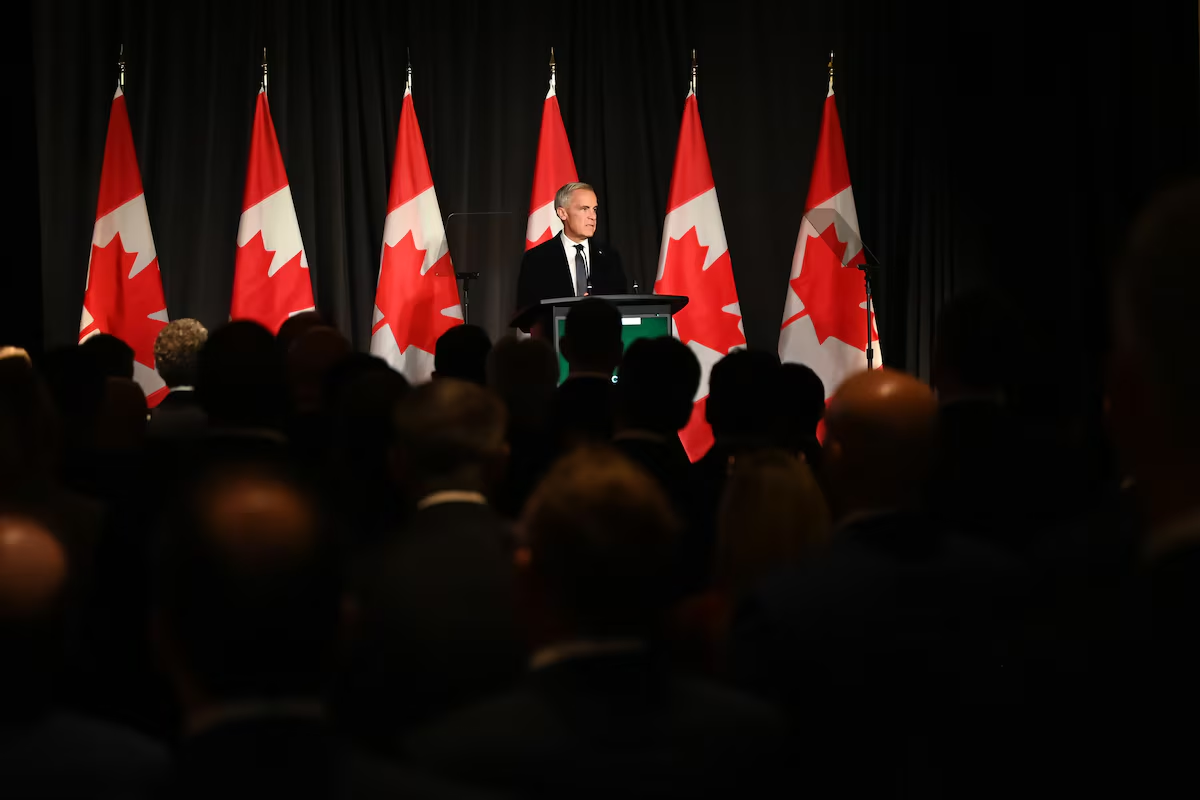

This week investors from around the world have descended on Toronto for the Canada Investment Summit, Prime Minister Mark Carney’s effort to show the world the country is ready to build big things again.
As part of that, Ottawa has identified scores of projects to showcase during the event, which 120 Canadian and international funds and investment companies with roughly $120-trillion in combined assets under management are expected to attend.
Here’s a look at possible candidates for deals and some of the big-name investors set to show up for the summit.
The deals
Ahead of the summit, the federal government identified more than 160 projects that are open for development, which it compiled into a “prospectus” that was shared with attendees.
Some of the projects are well underway, with permits in hand and construction already started.
Many others are, at best, a twinkle in an entrepreneur’s eye.
Prospectus for Carney’s summit highlights more than 160 projects open for investment
The prospectus grouped the projects into eight sectors and included details on the current state of each project and the estimated capital spending (capex) required to bring them to fruition.
All told, the prospectus included projects with capex needs of roughly US$620-billion.
Mr. Carney has said he wants to attract $1-trillion in new investment over the next five years by slashing red tape and developing mining, energy, infrastructure and other projects.
Landing deals on any of these projects would help meet that ambitious target.
Advanced manufacturing
Telesat Lightspeed low-Earth-orbit satellite constellation
Company: Telesat Corp. TSAT-T
Project capex: US$5.2-billion
Publicly traded Telesat’s Lightspeed aims to build a communications network of 225 low-Earth-orbit satellites. It’s one of four space-related projects on the summit prospectus.
While the Lightspeed network is already fully funded, Telesat is offering minority stakes either in the company itself or in the Lightspeed program. In return, sovereign investors would score dedicated capacity on the network for their home countries once the service is up and running in the first quarter of 2028.
Telesat, MDA Space shares soar on news of satellite contract with Canada’s Armed Forces
Other notable projects:
Red Leaf Pulp Ltd., a Regina-based alternative fibre company, is pitching a US$860-million biorefinery to convert cereal straw into pulp.
Saskatoon-based CellCore Technologies Inc. bills itself as Canada’s first Indigenous-owned manufacturer of nitrocellulose, a highly flammable material, and it is developing a US$220-million facility to produce military-grade propellant products.
A long shot: Project Arrow Defence Industries, a joint venture between the Automotive Parts Manufacturers’ Association and South Korea’s Hanwha, plans to build specialty industrial vehicles using Canadian steel and aluminum, though the $1-billion project is still in the development phase.
Clean energy
Nova Scotia renewable energy park
Company: Octopus Energy Generation Ltd.
Project capex: US$4.5-billion
Nova Sustainable Fuels, a company backed by U.K.-based Octopus, is developing a facility to produce sustainable aviation fuel and other products near Goldboro, N.S.
While the project is still relatively early in its development, preliminary engineering is complete, and last December, the project received environmental approval from the province.
Mark Carney plans to thread the needle on trade with Asia, Europe through investment summit
Other notable projects:
Elemental Clean Fuels, a New York-based clean energy company, has proposed a $1.3-billion biofuels facility near Prince Rupert, B.C., on the site of the former Skeena Pulp Mill.
The US$800-million Alberta Industrial Heartland 1.0 project would convert municipal solid waste from the City of Edmonton into electrical power with carbon capture. The project has been greenlit by the Alberta Utilities Commission.
A long shot: The New Brunswick government has proposed expanding nuclear capacity at its Point Lepreau facility, though the concept is still at the initial project design stage.
Conventional energy
Ksi Lisims liquefied natural gas terminal
Company: Ksi Lisims
Project capex: US$28.5-billion
The Ksi Lisims LNG project, backed by the Nisga’a Nation along with Rockies LNG and Western LNG, received regulatory approval last year, with a goal of exporting LNG to Asia from northwest B.C. starting in 2029.
The project has received the backing of five First Nations, which have signed benefits agreements with Ksi Lisims. The final investment decision on whether to proceed is slated for next year.
Ksi Lisims LNG project in B.C. gains support from Gitga’at First Nation
Other notable projects:
South Bow Canada Services Ltd.’s SOBO-T Prairie Connector is a proposed US$2.1-billion pipeline expansion to connect Hardisty, Alta., to the Canada-U.S. border, with a final decision due in mid-2027.
CSV Midstream Solutions Corp.’s US$1-billion Gold Creek Industrial Complex bills itself as a “shovel-ready” natural gas processing hub in northeastern B.C.
A long shot: The US$440-million Blue and Turquoise Hydrogen and Methanol Modular Processing Plant is an Alberta project proposed by Bolton, Ont.-based Enervoxa, though the company’s website makes no mention of the project.
Digital technology
AI Hub of Innovation
Company: Havenz Corp
Project capex: $2.7-billion to $3.2-billion
One of several data centre-related developments on the government’s prospectus, the project, featuring an on-site power energy centre, is located near Red Deer, Alta.
The centre, designed to be a large-scale AI and innovation hub, is currently under construction on 119 acres, with the potential to expand to more than 500 acres.
What is happening with AI data centre development in Canada, according to our experts
Other notable projects:
The Redcliff AI data centre campus, a $14.5-billion project proposed by Norway’s BW Velora, would be located near Medicine Hat, Alta., though the permitting process is still continuing.
The US$620-million Leif Erikson transatlantic fibre system, proposed by Norway’s Bulk Infrastructure Group AS, would connect Atlantic Canada to Norway and bills itself as “execution ready.”
A long shot: Xanadu Quantum Technologies XNDU-T, which went public in March, is developing a photonic quantum computer. The prospectus acknowledges the $1.3-billion “Project Optimism” has a “long-term development horizon, with full realization targeted for 2040.″
Marine and port infrastructure
Port of Churchill Plus
Proponent: Manitoba government
Project capex: US$57-billion
The Port of Churchill expansion, the largest project on the prospectus, had a home-province booster at the summit on Monday in Manitoba Premier Wab Kinew, who announced the project would receive an exemption from the province’s 7-per-cent retail sales tax.
The goal of the expansion is to transform the port into a four-season gateway through rail upgrades, a port modernization project and the construction of all-weather road access.
Ottawa wants LNG to be shipped from Port of Churchill by 2030, Manitoba Premier says
Other notable projects:
With all permits secured, the US$350-million Qikiqtarjuaq Deep Sea Port (Qik Port) project bills itself as a shovel-ready deep-water Arctic port, located on the western shore of Broughton Island, in Nunavut.
The US$357-million Melford International Terminal is also considered shovel-ready for a fully permitted deep-water terminal and rail hub in Nova Scotia.
A long shot: Port Saint John has pitched a brownfield expansion to upgrade warehouses and a new Canada Border Services Agency container examination facility, but it remains at the planning stage with no capex estimate.
Minerals and metals
Rook 1 uranium project
Company: NexGen Energy Ltd. NXE-T
Project capex: $1.6-billion
Construction is under way on the uranium project in northern Saskatchewan, located roughly 155 kilometres north of the town of La Loche, with NexGen arguing it could become one of the largest new sources of uranium in the world.
The publicly traded company estimates the mine could produce 30 million pounds of uranium each year when it is fully constructed, and is seeking institutional investors to support its capital needs.
Infrastructure investment needed to ‘supercharge’ Canadian mining, BMO analyst says
Other projects:
The US$2-billion Crawford nickel mine, north of Timmins, Ont., is in the preconstruction phase but Canada Nickel Company CNC-X, which is backing the project, expects it to produce more than 1.6 million tonnes over its 40-year life.
The US$881-million Prairie Lithium project in southeast Saskatchewan is under construction.
A long shot: An Alberta critical minerals and rare earth refining complex, budgeted at between US$216-million and US$360-million, is the second Enervoxa-backed project on the prospectus, which says a scoping study will be completed this year.
Power and utilities
Marguerite Lake Energy Storage
Company: Cache Power Corp.
Project capex: $790-million
The project is a large-scale energy storage facility that works by compressing excess grid electricity into underground salt caverns, then releasing it through turbines to generate power on demand.
Last December, EllisDon, a large construction services company, partnered with Cache Power to develop the project, which would be capable of storing up to 48 hours of energy once completed.
Canadian cities brace for tariff pain as trade war escalates
Other notable projects:
The Mactaquac Generating Station in New Brunswick is embarking on a US$5.1-billion to US$6.6-billion project to ensure the station operates for its intended lifespan out to 2068.
The $3.4-billion Inuit-led Kivalliq Hydro-Fibre Link would connect Nunavut to the North American electricity grid and fibre-optic network for the first time.
A long shot: While Novatron Energy’s onshore and offshore wind project carries one of the largest price tags in the prospectus, at US$36-billion, the project is still in its early stages.
Transportation
Area 55
Company: Thompson Regional Airport
Project capex: US$178-million
Area 55 is a cold-weather research and testing facility at the Thompson Regional Airport in northern Manitoba. It gets its name from the 55th parallel and was formerly operated by Ford Motor Company.
The facility is in the midst of expansion and the prospectus says it would be the first Indigenous-owned northern research and innovation centre. When completed, it would also provide testing for emerging technologies such as drones, robotics and automated vehicles.
Opinion: The investment summit is Canada’s opportunity to seize the day
Other notable project:
The future of Halifax’s aging A. Murray MacKay Bridge is up in the air, with the Nova Scotia government launching a business case study in July for the project, which would exceed $3-billion.
A (pair of) long shots: In Canada’s long-delayed quest for high-speed rail, the prospectus includes two competing high-speed rail lines that would eventually link Calgary and Edmonton: the $10.9-billion Prairie Link High Speed Rail project, and the $22-billion TransPod Alberta ultrahigh-speed corridor.
The money people
For Canada to meet Mr. Carney’s sky-high investment goals, the Prime Minister reached into his contact list to tap the heads of some of the largest money managers in the world – individuals he has rubbed elbows with many times over the years in his previous careers.
The scores of big names expected in Toronto this week include:
Larry Fink, CEO of BlackRock
Open this photo in gallery:
Anna Moneymaker/Getty Images
Mr. Fink built BlackRock BLK-N into the world’s largest asset management company, overseeing more than US$15-trillion of investments. The company was a founding member of the Glasgow Financial Alliance for Net Zero (GFANZ), which Mr. Carney co-chaired from 2021 to 2024. Before that, Mr. Carney, in his role as chair of the Financial Stability Board from 2011 to 2018, monitored asset managers like BlackRock.
Jonathan Gray, president of Blackstone
Open this photo in gallery:
PATRICK T. FALLON/Getty Images
With Mr. Gray as president since 2018, Blackstone BX-N expanded its assets under management to more than US$1-trillion. On Tuesday morning, Mr. Gray is expected to join Mr. Fink, Annette Mosman, the CEO of APG Group, a large Dutch pension provider, and Dilhan Pillay, the CEO of Singapore’s state-owned Temasek Holdings, in a panel discussion about Canada as an international investment destination.
Annette Mosman, CEO of APG Group
Ms. Mosman has been the head of APG Group, one of the Netherland’s largest pension funds overseeing US$700-billion in assets, since 2021. That year, APG formally signed on to the Net Zero Asset Managers initiative, one of the alliances under GFANZ, while Mr. Carney was co-chair.
Camilla Languille, co-CEO of private equity at Mubadala Investment Company
Open this photo in gallery:
Fred Lum/The Globe and Mail
Ms. Languille has served as the co-head of private equity at the US$385-billion Abu Dhabi state-owned investment fund since 2013. In November, 2025, Mr. Carney met with Mubadala’s leadership as part of talks on an investment pact between Canada and the United Arab Emirates, which led to a pledge by the UAE to invest $70-billion in Canada.
Dilhan Pillay, CEO of Temasek Holdings
Open this photo in gallery:
Temasek Holdings is a Singapore state-owned investment company with roughly US$400-billion in assets under management. In 2021, Temasek was a founding investment partner when Brookfield Asset Management launched its Global Transition Fund, of which Mr. Carney was co-head. He and Mr. Pillay also worked together at GFANZ.