
Open this photo in gallery:
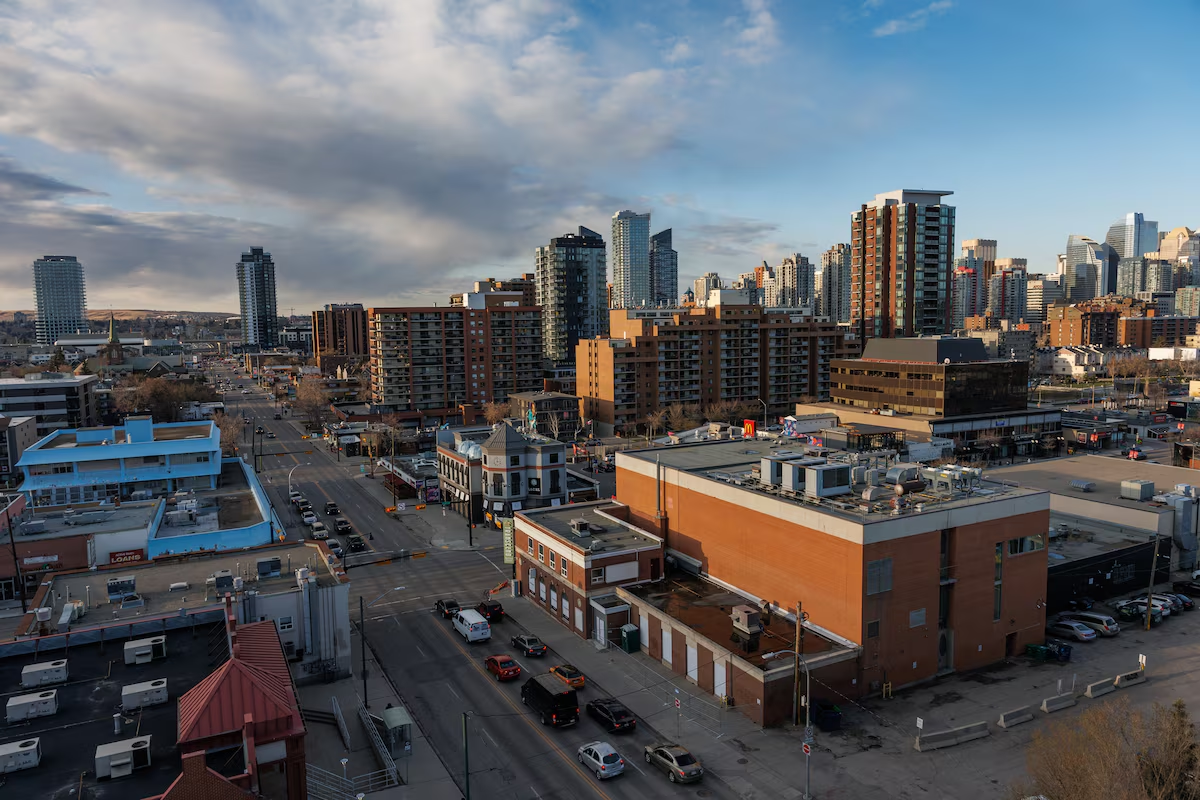
Calgary’s financial projections underscore the challenges ahead for municipalities if the trade war continues in the longer term.Amir Salehi/The Globe and Mail
In Calgary, city officials are projecting new tariff costs reaching close to half a billion dollars. Other cities across the country are anticipating economic pain in their communities. Candidates for local government, expecting turmoil, are turning to trade as a campaign issue in approaching municipal elections.
Canada’s trade war with the United States is beginning to hit home for municipalities. And with the possibility of tariffs and countertariffs lasting months or years, cities are starting to look into how the trade war could blow holes in their budgets.
“Municipalities are bracing for this,” Tim Tierney, president of the Federation of Canadian Municipalities, said in an interview. Local governments are on the front lines of the trade war, but many of them don’t have extra money to spare for spiralling costs.
“Municipalities need the money. We can’t simply talk about it and plan for the future and do it in future budgets. The money is needed now.”
Open this photo in gallery:
Calgary’s estimates show the city’s transit system is now likely to face $84-million in tariff costs.Jude Brocke/The Globe and Mail
On Sept. 8, administrators with the City of Calgary estimated the latest tariffs and retaliatory measures by the U.S. and Canadian governments could cost the city between $315-million and $466-million on the remaining lifespan of existing contracts.
Calgary’s financial projections underscore the challenges ahead for municipalities if the trade war continues in the longer term, a reality for which Prime Minister Mark Carney has said the country should prepare.
Most municipalities across Canada haven’t assessed the extra costs that tariffs will inflict on their budgets but are preparing for deep economic wounds. The issue is becoming an increasingly important factor for voters in the lead up to municipal elections in Ontario, British Columbia, Manitoba and Prince Edward Island.
Open this photo in gallery:
Toronto Mayor Olivia Chow, seen here speaking at a housing announcement, and her main challenger, councillor Brad Bradford, are presenting different visions for how they would handle the trade war as the city heads into an October municipal election.Sammy Kogan/The Canadian Press
In Calgary, even though 95 per cent of the city’s contracts come from Canadian suppliers, many of those contractors are exposed to tariffs because they source materials from the U.S., Bill Black, chief executive officer of the Calgary Construction Association, said in an interview.
Calgary’s estimates show the city’s transit system is now likely to face $84-million in tariff costs on top of $535-million in future spending that city hall has already committed to its transportation network. Scotia Place, the glitzy $800-million arena scheduled to open at the beginning of the Calgary Flames’ 2027-28 season, is expected to face an extra $30-million in tariff costs, and projects for Calgary’s aging water infrastructure will feel the bite of an additional $21-million price tag.
Calgary Mayor Jeromy Farkas said the extra costs would be equal to an annual property-tax hike of between 12 per cent and 18 per cent. His office said he is proposing for the federal government and Canada’s big-city mayors to find ways that will ensure cities aren’t at the losing end of a tariff fight.
Canadian countertariffs take effect on $28-billion of U.S. imports
The Globe and Mail reached out to more than a dozen municipalities across the country. The City of Brampton in Ontario was the only municipality apart from Calgary to outline the tariffs’ estimated impact, pegging its potential capital cost exposure at between $100-million and $150-million.
An official for the federal Department of Finance said in an e-mailed statement that municipalities can ask Ottawa for financial relief on tariffed products. However, municipalities typically recoup that money through their contractors, who are often responsible for paying the duties in the first place.
John Fragos, a spokesperson for Federal Finance Minister François-Philippe Champagne, said that Ottawa is always looking at ways to better support municipalities.
Evan Robinson, a spokesperson for Ontario’s Economic Development Minister Vic Fedeli, pointed to a $40-million fund for “trade-impacted communities” to reshore critical supply chains, attract new investment and diversify economies.
Open this photo in gallery:
A welder works at Walters Group Steel fabrication plant in Hamilton, in July, 2025.Chris Young/The Canadian Press
Hamilton’s incumbent mayoral candidate, Andrea Horwath, said there is a sense of “concern and foreboding” in her Ontario city, which employs about 28,000 people in steel, manufacturing and food processing.
“People are really uncertain about the future,” she said in an interview. “There’s no doubt that Hamiltonians feel like we are specifically under attack.”
Marianne Meed Ward, the incumbent mayoral candidate in Burlington, who chairs Ontario’s big-city mayors’ group, said the tariffs will force cities to defer costs that will only become more expensive in the future. She said 43 per cent of Burlington’s businesses are directly affected by tariffs or countertariffs, representing about half the city’s jobs.
“It’s quite staggering, and very eye-opening,” she said.
The trade war has particularly animated Toronto’s mayoral race, where incumbent Olivia Chow and her main challenger, councillor Brad Bradford, are presenting different visions for how they would handle the issue in office. Election day is Oct. 26.
Ontario to expand tariff support program eligibility to businesses affected by new U.S. tariffs
In a statement, Ms. Chow’s campaign defended her response so far, pointing to an economic action plan released in March, 2025, with the goal of diversifying Toronto’s trade and buying local. More than 98 per cent of the city’s spending now goes to Canadian companies, her campaign said. She has also launched a grant program for businesses and introduced a new industrial property tax deferral program.
Mr. Bradford, meanwhile, suggested the city’s tariff response has been inadequate. He has floated numerous proposals, including establishing a permanent tariff-response group, speeding up permit approvals for companies and tax relief. Mr. Bradford said he fully supports Mr. Carney’s efforts in the trade fight but added that cities such as Toronto are absorbing the costs.
“Every month this drags on is more pressure on a municipal budget that’s already stretched thin. It’s crucial for Ottawa to step up and provide tariff relief so cities aren’t left carrying this cost alone while Washington keeps moving the goalposts,” he said in a statement.
Analysis: Why Trump’s new trade barriers are more bark than bite
Elsewhere, other cities say they have either been able to withstand the effects of the tariffs so far or haven’t yet measured the repercussions on local budgets.
The issue has bubbled to the surface in Vancouver, where candidates are gearing up for the city’s Oct. 17 municipal vote.
Late last month, Vancouver councillor Lucy Maloney, who is running for re-election, called for a special meeting to push incumbent mayoral candidate Ken Sim to take urgent measures on U.S. tariffs. Mr. Sim declined Ms. Maloney’s plea, calling tariffs a national matter and stating that he is planning to support Ottawa “without adding unnecessary noise to the process.”
The City of Vancouver said it hasn’t conducted modelling similar to Calgary’s yet.
On the Prairies, where Manitoba is holding municipal elections this fall, City of Winnipeg spokesperson Adam Campbell said the city’s public service department is reviewing U.S. supplier arrangements to analyze “the potential economic impact of the tariffs.”
Open this photo in gallery:
Many of the companies in Brandon, Man., are involved in the agricultural sector.Shannon VanRaes/The Globe and Mail
For Brandon, Man., incumbent Jeff Fawcett said his larger concern as mayor had been tariffs from China before they were rolled back earlier this year, as the levies directly affected the agriculture sector in and around what is colloquially dubbed the Wheat City. “The U.S. tariffs haven’t necessarily been as big of a problem for us,” Mr. Fawcett said in an interview.
One province over, in Saskatoon, chief financial officer Clae Hack said the city hasn’t yet calculated the impact, noting that it’s hard to examine how much costs will be passed on to the municipality.
A majority of East Coast cities – including Halifax, St. John’s and Charlottetown – say they are less vulnerable to tariffs compared to the rest of Canada, in large part because of diversified trade initiatives with Europe. Over the years, the Atlantic provinces have worked collectively toward solidifying export and sales pathways with countries such as Britain and Spain, which have particularly benefited the seafood and energy industries.
In Canada’s ‘most tariff-exposed’ city, uncertainty over the trade war looms large
Still, the U.S. is Atlantic Canada’s largest international export market by a wide margin. Continued tariffs “will have impacts” on those local economies, including on Prince Edward Island, said City of Charlottetown spokesperson Jessica Bradley.
The situation, however, is more dire in New Brunswick. Last year, the Canadian Chamber of Commerce designated Saint John as the most tariff-vulnerable municipality in the country. Its exposure to risk is vastly higher because of southbound exports to the U.S., particularly in the energy and forestry sectors.
The seaport city, home to roughly 78,000 people, hasn’t yet run the numbers, said Lisa Kennedy, Saint John’s director of external relations.
“At this point, there is still too much uncertainty to put a firm number on the impact.”