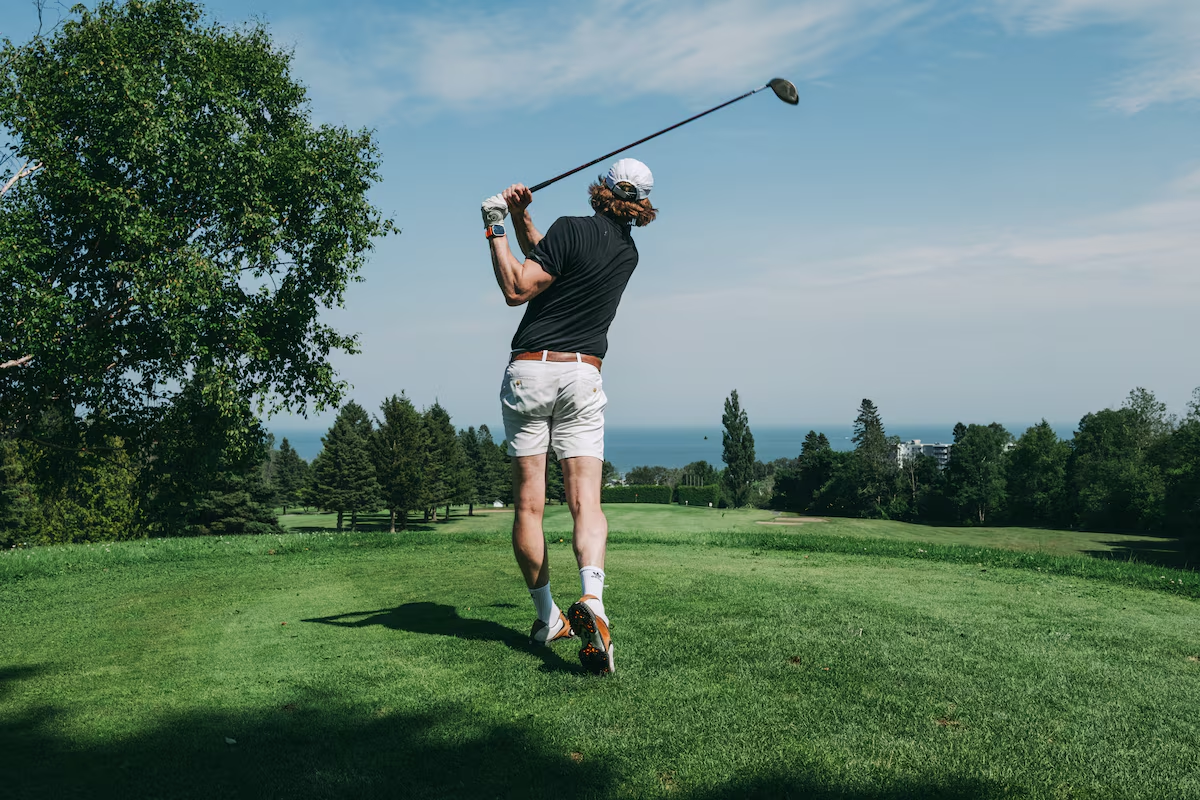
When “summer” was a verb, Murray Bay, Que., was the place to be.
Rich Americans began escaping the heat and disease of industrial cities for the Charlevoix resort as early as the mid-19th century, arriving on steamships to stay for months at a time.
The air vivified like champagne without the hangover, according to Murray Bay stalwart – and onetime U.S. president – William Howard Taft. The gin, meanwhile, flowed like the mighty St. Lawrence as cocktail hour descended on the Boulevard, where the summer residents had their mansions. The pews of Murray Bay Protestant Church were stuffed with tycoons from Chicago, financiers from Montreal and Vanderbilt heiresses.
Open this photo in gallery:
The Murray Bay golf club in Quebec bills itself as the third-oldest institution of its kind in North America.
But the real social nexus of this improbable concentration of English-speaking privilege deep in rural Quebec was the Murray Bay Golf Club. Starting in 1876, Cabots and Culvers and Tiffanys began hitting the links on an old cow pasture as they summered in style.
That was 150 years ago, a landmark the club has celebrated with a glossy coffee-table book and multiple festivities. Murray Bay claims to be the oldest golf course in North America still in its original location, and while that is debatable – a course in Niagara-on-the-Lake, Ont., pegs its beginnings a year earlier – it remains a venerable looking glass through which the history of Quebec emerges, first in sepia and later in Technicolor.
Much of the old course is proudly unchanged since the first players whacked gutta-percha balls with mashie-niblick clubs over grazing livestock. But the club and the community have changed over the years, quietly but dramatically, in ways that reflect the evolving society around them.
The bay lies two hours northeast of Quebec City, on the north shore of the St. Lawrence, hugged by the lush green hills of Charlevoix.
It’s easy to see what Gilded Age Yankees would have liked about the region. It lay within a seigneury, a feudal holdover from the days of New France, owned by the English-speaking Nairne family, and later the Duggans. The climate was mild, the hunting and fishing were bountiful, and the supply of local French-Canadian servants nearly bottomless.
Québécois cooks and gardeners often stayed with the same anglophone families for generations, summer after summer, and sometimes even returned with them to New York or Boston in the winter.
The same pattern emerged at the golf club. Although there was always a smattering of bourgeois francophone members – Quebec premier Lomer Gouin, pioneering feminist Thérèse Casgrain – more common were the adolescent caddies from the village who were chosen by the Anglo golfers every morning before tee time.
Open this photo in gallery:
La Malbaie, formerly Murray Bay, once welcomed visitors by steamship from Montreal and the eastern United States. Some guests would stay for months.
The optics of this linguistic hierarchy may seem cringeworthy today, but they were pretty well accepted in Murray Bay for decades, said Martin Guérin, the club’s current director of operations, whose father served as one of those caddies.
“Our families were so connected, I don’t think it was frowned upon,” Mr. Guérin said.
Such dynamics were common across Quebec at the time. An English-speaking elite controlled the commanding heights of the economy from Montreal while successive governments welcomed waves of American capital. The early 20th century saw the creation of hundreds of private hunting and fishing clubs that claimed the most picturesque slices of the province.
Life was grand for those who cruised into Murray Bay on the famed bateaux blanc in that era. Stockbrokers in Montreal who couldn’t get away for the whole season could take overnight steamers from Montreal on Fridays, sleeping off their three-martini dinners in private berths. Shorts and sandals were unheard of: A Wednesday evening dinner party on the Boulevard would typically be a white-tie affair.
The golf club dominated the summer colony’s social life. Taft was a regular on the links, known for harrumphing “piffle” or “posh” after a bad shot.
When The New Yorker profiled Murray Bay in 1926, it observed that the great homes each had a telescope or opera glasses to locate the master of the house down on the course. Conversation among the expats, the magazine reported, was “easy, intimate, and usually about golf.”
Open this photo in gallery:
In the last century, car culture was one of the reasons that Murray Bay fell out of fashion with the rich: Families had more options to take their vacations anywhere.
This heyday began to wane after the Second World War, when the rise of the car and commercial air travel changed American vacationing patterns. Summering in one boreal location started to fall out of fashion: Now families were more likely to take shorter road trips, or else fly to the Caribbean if they could afford it, said Alain Chaput, author of a recently published history of the club.
That led to a decline in membership, and a corresponding effort to recruit more local francophones – mostly professionals and well-off businessmen at first, Mr. Chaput said. “They didn’t want to open the doors to just anyone.”
The move dovetailed with the growing assertion of a secular French-speaking identity against the old hegemony of the Catholic Church and English business. The last anglophone to win the club golf tournament for decades, J.M. Livingood, claimed the crown in 1959, at the dawn of Quebec’s Quiet Revolution.
Open this photo in gallery:
Queen Elizabeth II, in Quebec City in 1959, sailed past Murray Bay to get here on the royal yacht. That year was the last one for decades when an anglophone won the club tournament.Harold Robinson/The Globe and Mail
The Murray Bay revolution was indeed quiet, and slow at times. The club bylaws were only translated into French in 2007, Mr. Chaput observed, and the club still clings to the name Murray Bay, as opposed to the official French name, La Malbaie.
The clubhouse, meanwhile, is the oldest of its kind in Quebec – partly built in 1905 – and retains a comfortably down-at-heel, old-money atmosphere, with dingy green carpeting and an ancient stone fireplace.
But today, the membership is almost entirely francophone and solidly middle-class. The neighbouring golf course of the Manoir Richelieu – a luxurious Fairmont hotel dating to the 1920s – is more expensive and high-toned, Mr. Chaput said.
Open this photo in gallery:
Local golfers have more than one course to choose from, Murray Bay and the Manoir Richelieu next door.
Vestiges of the old days can still be found around town. Members of the Taft family still visit in the summers. The Boulevard, long since renamed le Chemin des Falaises, is still dotted with grand private homes that look out on the bay. The golf course is a lovely period piece, with features that are “rustic, even bizarre,” Mr. Chaput said, such as little tea-saucer greens and camel-hump fairways. The golf historian recommended the nine-hole Peter Ryan course for those who want to relive “the ambiance of the era.”
After a century and a half, other aspects of Murray Bay’s past have been shed like an old mohair coat, left in the steamer trunk of history. Gone are the days when “the Americans controlled membership,” Mr. Guérin said. “We’ve democratized.”
Not even Taft could object to that.

Quebec in depth: More from The Globe and Mail
The Decibel podcast
How do today’s young Quebec sovereigntists differ from other generations since the Quiet Revolution? Reporter Maura Forrest spoke with The Decibel about how age and ideology shape Quebec politics, and could decide this year’s provincial election. Subscribe for more episodes.
How Quebeckers live
At a Montreal housing collective, women live intentionally and age joyously
A father and daughter teach Mi’kmaw basketry and revive more than a craft
Which Quebec city is the world’s true maple capital? A sticky battle is afoot