
Listen to this article
Estimated 4 minutes
The audio version of this article is generated by AI-based technology. Mispronunciations can occur. We are working with our partners to continually review and improve the results.
The federal government is moving ahead with changes that will exempt a number of energy projects from a layer of its environmental assessment process. At the same time, a senior government source says the Liberals are preparing to back down on proposed changes that would have bypassed regulations meant to protect at-risk species.
The government proposed a suite of regulatory changes as part of a suite of measures in May in an effort to streamline project approvals.
One of those proposals would have exempted certain projects from the “jeopardy test” required under the Species at Risk Act, if they’re deemed to be in the national interest.
More than 600 species are listed under the legislation. Five former chairs of a panel that advises the federal government on endangered wildlife have published an open letter in August, saying the proposed changes could lead to the “wilful extinction” of endangered species.
A senior federal government source told CBC News that upcoming legislation will ultimately preserve the powers of the act, including jeopardy tests. The source spoke confidentially because they were not authorized to speak publicly. The Toronto Star first reported this news.
Projects now exempt from some regulatory review
The government publicly announced Wednesday that it would delist specific energy projects from the purview of its environmental review agency, arguing that it will “streamline the review process for certain projects.”
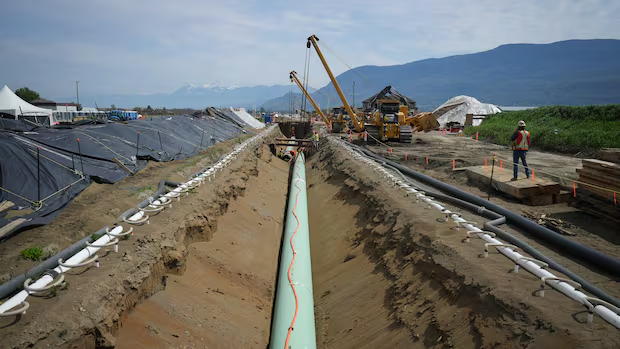
Projects including pipelines and transmission lines that cross international or provincial borders, as well as offshore renewable energy projects, will no longer be subject to an environmental review by the Impact Assessment Agency of Canada (IAAC), according to the new regulations published in the Canada Gazette on Wednesday.
Instead, those projects will be solely reviewed by the Canada Energy Regulator (CER).
“The CER has expertise conducting impact assessments that review a project’s effects on a range of environmental factors, including air, water, soil, climate change, wildlife, species at risk and Canada’s environmental obligation,” a government news release said.
Certain oilsands extraction projects and fossil fuel-fired power generating projects are also being removed from the list of projects that will be subject to IAAC review, the news release said.
WATCH | Ottawa, Quebec reach deal over major project regulation:
Major projects to get only one environmental assessment as Ottawa, Quebec strike deal
Projects in Quebec that once required both federal and provincial environmental assessments will now only need provincial approval — a long-awaited shift for the mining industry.
“These projects and facilities will continue to be subject to equally robust applicable provincial and federal assessment processes,” the release reads.
Heather Exner-Pirot, director of energy, natural resources and environment at the Macdonald-Laurier Institute, said the changes “concretely will help attract investment in this country” by reducing costs.
“Regulatory costs are a big burden. You’re paying a lot of up front legal due diligence costs before you make a single cent,” she said.
A ‘wrecking ball’ to regulations: environmental group
The changes come after Prime Minister Mark Carney promised to streamline regulatory approvals for major projects during the last election.
The Liberals, with the help of the Conservatives, passed Bill C-5 shortly after the 2025 election. That legislation allows the government to fast-track major projects it deems to be in the national interest. But these changes will impact the reviews for other major projects that don’t receive that designation.
The government held consultations on the proposed reforms that wrapped up in July. The report on those consultations was published on Wednesday, the same day the regulatory changes were announced.
“There was no forewarning of this decision,” said Julia Levin of the Environmental Defence advocacy group in a statement.
“Prime Minister Carney has once again taken a wrecking ball to Canada’s environmental safeguards and climate progress.”
But Exner-Pirot insisted that there will still be an environmental assessment, but it will only be done by one regulator instead of two. She also noted that the regulatory change comes as Carney is about to host an “investors summit” next week.
“This is the Carney government showing the people who are going to show up in Toronto next week that they’re not just talking big game, they’re doing something on the ground that will help make capital welcome in Canada,” she said.