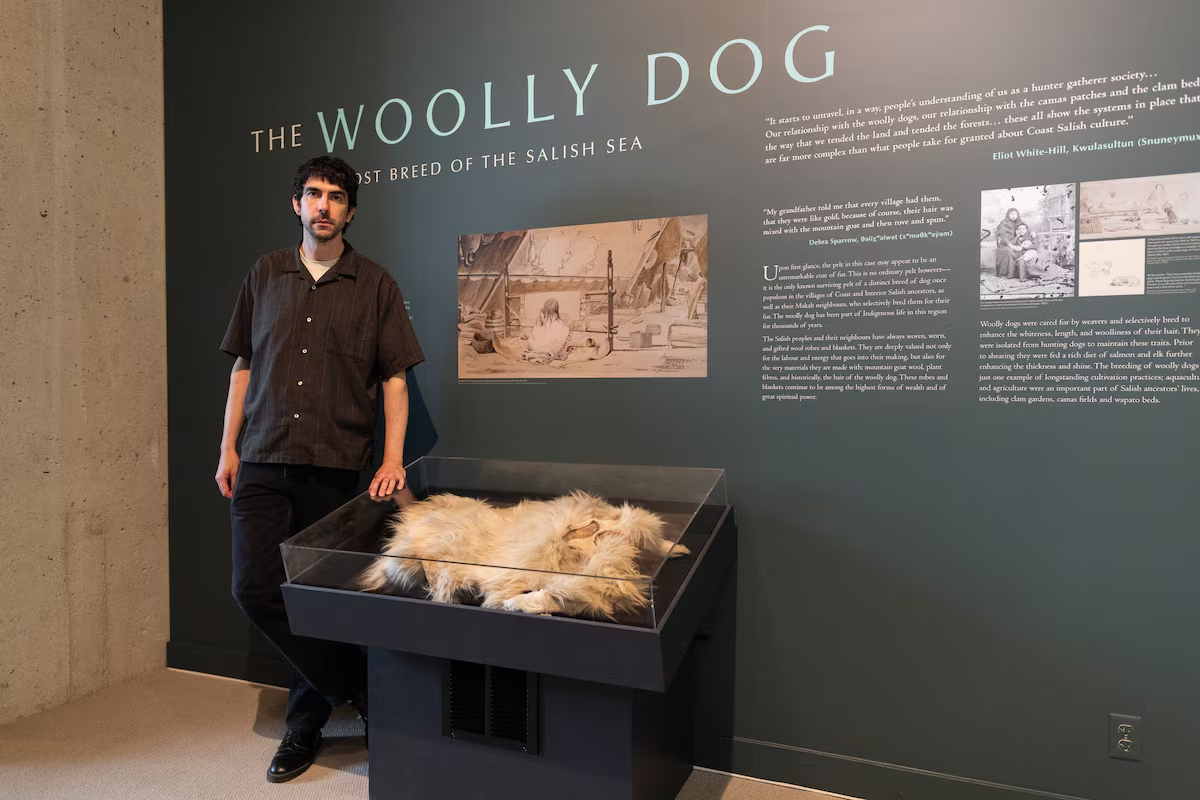

Open this photo in gallery:
Museum of Anthropology curator Jordan Wilson stands next to the only known woolly dog pelt in existence, which is on display for a year at the museum in Vancouver.Jesse Winter/The Globe and Mail
After more than 160 years in storage at the Smithsonian Institution in Washington, the only known pelt of an extinct woolly dog is back on Canada’s West Coast.
Woolly dogs were once abundant, bred by Salish and Makah peoples along the Pacific coast for their soft, woolly fur, which was woven into clothing, blankets and robes, according to the Museum of Anthropology at the University of British Columbia.
They had fluffy light-coloured coats, curled tails and pointy, fox-like faces, similar to a Samoyed, only smaller. They were occasionally shorn for their coats, which were often combined with mountain goat hair and the fibres of plants to make a strong, warm wool. They were considered extinct by the late 1800s, according to UBC, though one was photographed in the 1930s.
Now, the only known pelt in existence is on display at the Museum of Anthropology at UBC until September, 2027, on loan from the Smithsonian.
When Atheana Picha first laid eyes on it Friday morning during a special private event for the Indigenous community, emotion welled in her throat. She’d grown up hearing stories of woolly dogs passed down through generations.
“The woolly dogs were a big part of our family life,” Ms. Picha said. “Having met this relative now, who left us 200 years ago, is pretty powerful.”
Open this photo in gallery:
Woolly dogs, whose fur was used for weaving but are now extinct, were once common in Pacific coastal Indigenous communities.Jesse Winter/The Globe and Mail
For generations before European contact, textiles such as robes and blankets that included woolly dog fur were considered prized possessions, and used sparingly to mark significant community milestones such as marriages and funerals.
While woolly dogs largely disappeared more than a century ago, knowledge of their importance was kept alive in Salish and Makah oral history and traditional weaving. Ms. Picha herself learned those stories, and now helps keep the tradition alive.
“When we see a weaving … it’s talking about whose territory we’re on, what history’s here,” she said.
Landing place: Meteorite sacred to generations of Indigenous peoples to be returned after routing through museums
Ms. Picha explained that Salish oral history describes how it was primarily women who cared for the woolly dogs, often keeping them isolated on small islands so they wouldn’t breed with other village dogs used for hunting. They were fed special diets to keep their coats healthy, and shorn about once a year for their fur.
After European contact, the practice of weaving remained an important trade tool for Salish people, but the introduction by settlers of industrially woven fabrics began to erode First Nations’ textile production.
It wasn’t long before colonial laws started banning many Indigenous cultural practices. Residential schools sought to erase Indigenous cultures altogether, said Jordan Wilson, the museum’s curator of Pacific Northwest and contemporary Indigenous art. The federal government’s decades-long potlatch ban, which barred First Nations from participating in traditional ceremonies, was particularly devastating, eroding a central hub for sharing cultural knowledge, he said.
In recent years, interest in woolly dogs and other traditional wool has grown as efforts to revive Salish weaving took off. Ms. Picha is a member of the Tsartlip First Nation on Vancouver Island, and learned traditional Salish weaving from master weaver Debra Sparrow of the Musqueam Nation. In the decades after European contact, the art of Salish weaving was nearly lost. Ms. Picha is part of a new generation of Salish women who are helping to bring it back, and having the chance to see a woolly dog’s fur up close, to feel its curl and texture, is invaluable, she said.
“Seeing the fibres on the pelt, they’re already twisting,” Ms. Picha said, tracing her finger over the pelt’s glass case. “They want to be spun. It’s just hungry to be turned into a blanket, turned into warmth.”
Indigenous repatriation is under way – but gaps remain in measuring progress
The pelt now on display in Vancouver is from a dog named Mutton, who was the companion of naturalist George Gibbs. Mr. Gibbs helped carry out land surveys establishing the Canada-U.S. border in the mid-19th century.
It’s not known exactly how Mr. Gibbs came to own Mutton, but Mutton is believed to have come from near present-day Chilliwack, B.C. Genetic research suggests Mutton lived to be about 18 months old. Mr. Gibbs sent the pelt to the Smithsonian along with other specimens from his time in Salish territory.
According to Mr. Wilson, the loan was made possible because of work by the Stó:lō House of Respect Caretaking Committee, a group of elders and knowledge-keepers from Stó:lō communities in the Fraser Valley and Fraser Canyon area. The group helped advocate for its temporary return.
Mr. Wilson is now part of the team responsible for caring for it. He first saw the pelt himself at the Smithsonian years ago, as part of his professional museum training. It’s one of the innumerable Indigenous cultural items removed from their homelands by settlers and sent to museums across the globe, separating the artifacts from their communities.
He said the opportunity to display the pelt close to its original home, even temporarily, is a major milestone.
“I think this is really important,” Mr. Wilson said.
It’s particularly special for the museum he works at. The Museum of Anthropology is usually focused on human creations and cultures, Mr. Wilson said. Western academia tends to view specimens such as Mutton’s pelt as natural history artifacts, not anthropological ones.
Earlier: Indigenous artifacts at Vatican Museums heading back to Canada after repatriation campaign
But Mr. Wilson said that sort of stark division between the human and natural realms isn’t how Indigenous people view the world, or themselves.
From a genetic science perspective, Mutton’s pelt represents the extinction of a unique breed, one of the many profound impacts of colonialism, he said. But from an anthropological perspective, it represents the generations-long sinew of Indigenous culture and history tying past to present.
“That really speaks to our ancestors’ connections to territory and place and the beyond-human world,” Mr. Wilson said.
Along with all that history, Ms. Picha sees a long-lost family member finally home for a visit.
“Looking at this pelt, I think of all the things that fed this dog to make it stronger,” Ms. Picha said. “I think of all the people that gave this dog a hug during its life, and all those people who fed it and petted it and saw so much joy.”
The pelt will be on display at the Museum of Anthropology on UBC’s campus until the end of August, 2027.