
Listen to this article
Estimated 5 minutes
The audio version of this article is generated by AI-based technology. Mispronunciations can occur. We are working with our partners to continually review and improve the results.
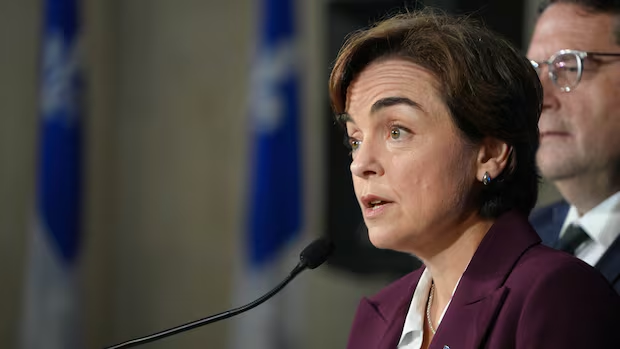
Quebec Premier Christine Fréchette warned of difficult times ahead and called on Quebecers and municipalities to pivot away from American businesses and support the local economy, in a news conference Tuesday morning.
“Quebec will not back down in the face of Trump,” she said, describing the U.S. president as a bully. “In fact, we will use every tool available to the state to buy more Quebec-made products in order to protect our jobs, protect our economy and protect our workers.”
Fréchette, who is in the midst of a provincial election campaign, announced new measures Monday evening to help the province cope with Canada’s counter-tariffs on several American products, which went into effect just after midnight.
The measures include giving Quebec-based companies an advantage in public tenders as well as steps to help them find new markets across Canada.
On Tuesday, Fréchette said the measures affect $1.5 billion in contracts over the next four months, adding that American businesses generally represent under 10 per cent of public contract bidders.
WATCH | Fréchette’s measures draw criticism:
Fréchette’s measures to support Quebec against new tariffs draw criticism
Amid Quebec’s election campaign, Premier Christine Fréchette held a special cabinet meeting on Monday, announcing five measures to help the province cope with new 50 per cent tariffs from the U.S. as well as Canada’s counter-tariffs on U.S. products, which took effect just after midnight Tuesday.
When asked if she feared further retaliation from President Donald Trump, she said that at this point, she wouldn’t be surprised given how the last year has unfolded.
“We will still go forward because we need to strengthen our economy and to be united. And we are inviting everyone who can be part of that movement to answer the movement,” she said.
Tuesday morning, U.S. Trade Representative Jamieson Greer said the U.S. will consider imposing retaliatory tariffs on Canadian goods as early as Tuesday.
WATCH | Quebec Premier Christine Fréchette on trade war:
Quebec ‘will not back down in the face of Trump,’ premier says
Quebec Premier Christine Fréchette took some questions in English on Tuesday about her plan for the province as Canadian counter-tariffs on the U.S. took effect. Frechette said her priority is protecting jobs and the economy.
Fréchette also touched on threats made toward Montreal-based aerospace company Bombardier by Trump in a Truth Social post on Monday. She said sometimes those posts are a preamble to concrete change — and sometimes they lead to nothing.
“At the same time, we have to prepare ourselves,” she said, adding that she’s been in contact with the company’s CEO.
“For now, it’s just a publication, so we are sticking to that, and we won’t adopt measures before there is even a real threat.”
Measuring the impact on Quebec
Monday evening, Québec Solidaire co-spokesperson Ruba Ghazal criticized Fréchette for not being able to answer questions about the impact of Canada’s retaliatory tariffs on the province as the Sept. 8 deadline approached.
On Tuesday, Fréchette was able to offer some figures, saying the counter-tariffs are expected to impact 8.8 per cent of the country’s imports, including five per cent of Quebec’s imports.
She said the impact on Quebec’s job market is still to be determined, adding that August alone saw 18,000 layoffs across the province.
“So, for sure that’s not dissociated from the tariff war,” she said in French on Tuesday.
The premier also said federal rebates should effectively neutralize the counter-tariff burden on Canadian businesses. She called on the federal government to make sure those reimbursement processes are efficient, fast and easy to navigate.
She said there isn’t a meeting of the premiers planned in the coming days as far as she knows.
Fréchette stepped away from the campaign trail Monday to convene her cabinet and discuss Quebec’s strategy in the face of Canada’s retaliatory tariffs just before they came into force.
In the lead-up to that meeting, the Coalition Avenir Québec leader was accused by rival parties of using the tariff war to gain traction among voters. She addressed those claims on Tuesday.
“This is real life, and we need to face it, and we need to adjust our approach,” she said.
The economic effect of social solidarity
Fréchette’s message to buy local was reiterated by Prime Minister Mark Carney in a video released later Tuesday morning.
“The most powerful actions have come from you, buying Canadian and travelling in Canada,” he said about Canadians.
Moein Javadian, who teaches marketing at Concordia University, says the pivot to local products is ultimately a short-term strategy while governments work to diversify exports for the long term.
The movement’s success hinges on transparent product labelling and whether local producers have the resources to increase their output.
Messaging from politicians also plays a key role, says Javadian, adding it can contribute toward disincentivizing companies from jacking up prices in response to more demand.
“Social solidarity among buyers of domestic goods and a little bit of social pressure on buyers of U.S. products … these dynamics actually create a downward pressure on prices,” he said.
He says the same can be said about the inflationary effects of counter-tariffs.
“The whole point of encouraging Canadians to participate in these campaigns is to essentially divide the burden across many people,” he said.