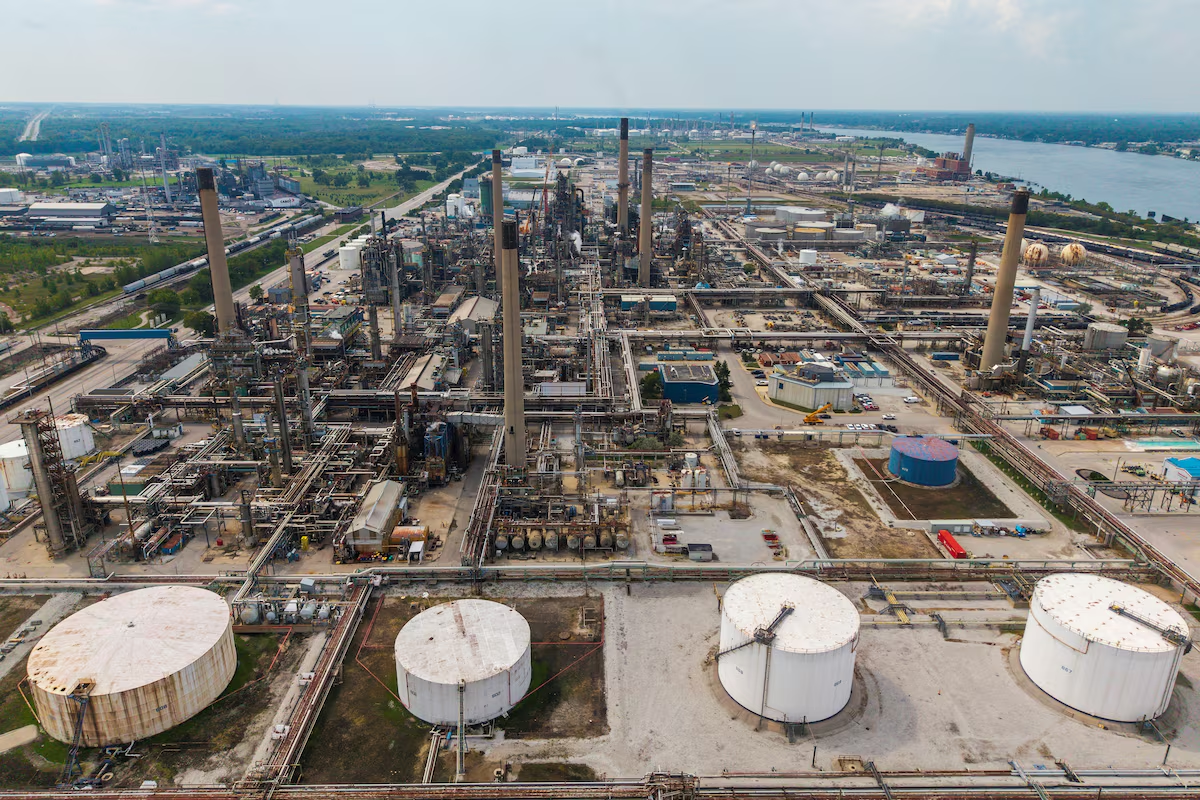

Open this photo in gallery:
The Imperial Oil refinery in Sarnia, Ont., on Sept. 2.Carlos Osorio/Reuters
Mark Winfield is a professor of environmental and urban change at York University and co-editor of Sustainable Energy Transitions in Canada (UBC Press 2023).
Donald Trump’s renewed trade war has revived discussions on where Canada has leverage over its more economically powerful neighbour. Energy and natural resource exports, including electricity, oil, gas, thermal coal, potash and other minerals and materials, have all been identified as areas where some form of export restrictions could have large economic consequences for the U.S.
The U.S. has telegraphed its own sense of its vulnerabilities through the exceptions it has made in its tariff war on Canada, including energy, potash and certain other minerals and materials. There is historical precedent, going back to the original oil crisis of the 1970s, when Canada imposed charges and restrictions on energy exports to the U.S. The availability of energy-related export restrictions was actually reinforced by Trump’s removal of the energy-sharing provisions from the original 1988 Canada-United States Free Trade Agreement in negotiating the 2020 United States-Mexico-Canada Agreement.
Canada, U.S. trade talks reach an impasse
In more specific terms, despite Ontario Premier Doug Ford’s loud threats, Canada’s leverage regarding electricity exports to the U.S. is limited, because of a combination of operational considerations and reduced export capacity in the key provinces of Manitoba and Quebec. Canada-U.S. trade in fossil gas is increasingly two-way, with substantial imports of gas from the U.S. coming in to central Canada.
But the story with respect to oil is much more one-sided. The U.S. imports nearly four million barrels of oil a day from Canada. An export charge on Canadian oil sold to the U.S. could increase the cost of gasoline and other fuels across the border. These are already politically sensitive issues in light of the effects of the war that the U.S. and Israel initiated with Iran earlier this year. Trump’s new deal with Venezuela may provide the U.S. with options in the longer term, but it will take years to restore Venezuelan heavy oil production.
Andrew Willis: As Trump pivots to Venezuela for energy, U.S. big oil and big money invest in Canada
Certain minerals and materials also represent significant bargaining chips. Potash exports to the U.S., which provide the basis for agricultural fertilizers, are perhaps Canada’s strongest card in this regard. Canada provides more than 80 per cent of the American supply of potash and the U.S. has no obvious alternative sources.
Despite the objections of the Premiers of Saskatchewan and Alberta to controls or taxes on oil and potash exports to the U.S., there is no question regarding the federal government’s jurisdictional authority to impose export taxes and restrictions on Canadian resources and commodities. That authority would flow from the same jurisdiction over international and interprovincial trade and commerce that enables Ottawa to force pipelines through B.C.
The federal government could also draw on the emergencies branch of its authority to legislate for the “Peace, Order and Good Government” of Canada. Parliament could even use its declaratory power under Section 92 of the Constitution Act to declare specific facilities or infrastructure to be for the “general advantage of Canada” and place them under federal jurisdiction.
The challenges with these options are therefore political rather than legal or constitutional. The responses from Premiers Danielle Smith and Scott Moe have significantly weakened Canada’s bargaining position with the U.S. by suggesting divisions on the Canadian side and attempting to take some of Canada’s most powerful options off the table.
Opinion: Using oil to retaliate against the U.S. would be exceedingly stupid
The objections from the Alberta and Saskatchewan governments were also profoundly overwrought. No one, at this point, is seriously suggesting (Doug Ford’s rhetorical statements notwithstanding) a complete, overnight shutdown of exports of oil and potash to the U.S., as Premiers Smith and Moe seem to be suggesting. But even talking about the possibility reminds the Americans of their exposure.
In reality, restricting oil and potash exports would likely take the form of an export tax, applied for the duration of the Canada-U.S. trade dispute. In the absence of any ready substitutes for these commodities, the effect would be to raise costs for U.S. consumers without fundamentally disrupting supply chains and affected industries on both sides of the border.
Canada’s strategy has so far been mostly letting the economic and political consequences of the Trump administration’s actions play out in the U.S. over the short term. Trump’s trade war with Canada is already deeply unpopular there, particularly among states with close economic ties to Canada. The President’s Republican Party seems almost certain to lose control of the House of Representatives, and quite possibly the Senate as well, in the upcoming U.S. congressional midterm elections.
Even the threat of taxes on Canadian exports of oil, potash and other commodities to the U.S. would likely reinforce those dynamics, and remind America’s leaders that, although they may be the larger economy, Canada holds more than a few strong cards of its own in this conversation.