
Open this photo in gallery:
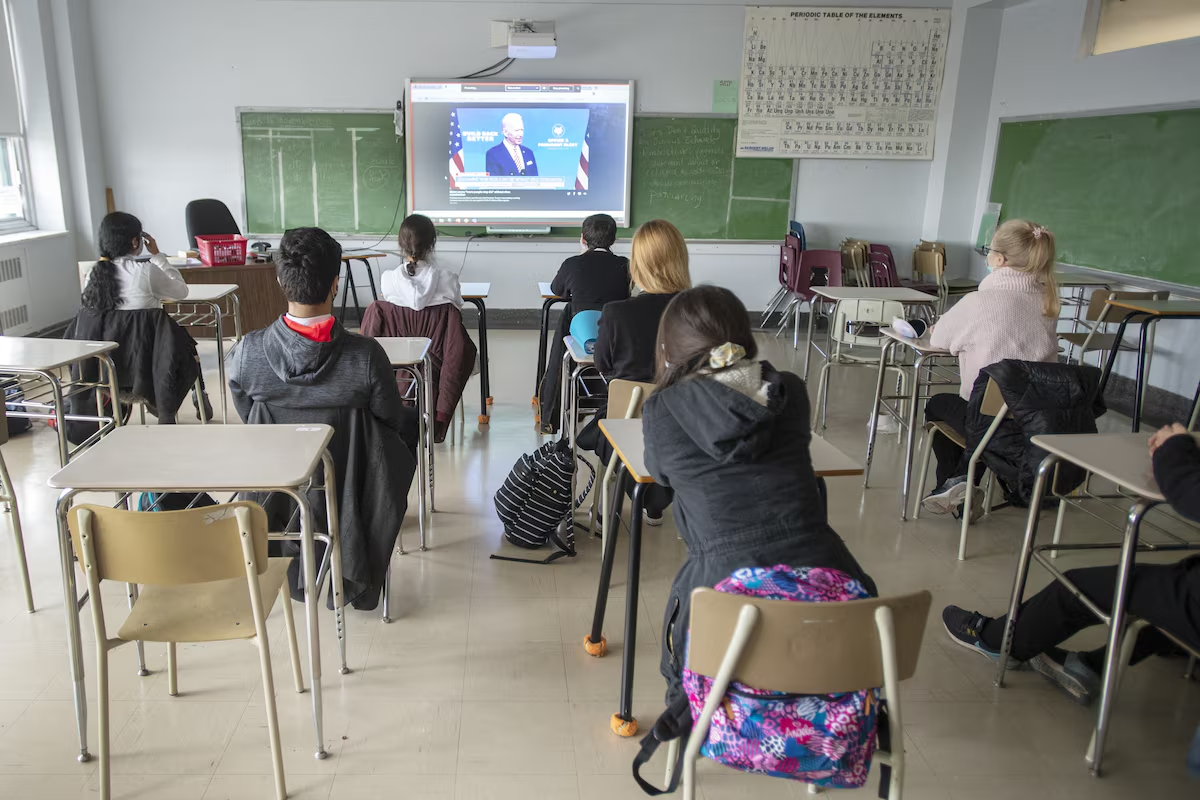
Results for the OECD’s Program for International Student Assessment, released Tuesday, show Canada in the top 10 among 91 countries and economies that were evaluated.Ryan Remiorz/The Canadian Press
Canadian high-school students are outperforming many of their international peers in science, math and reading, but their overall scores in these subjects are also declining, according to a new international ranking by the Organisation for Economic Co-operation and Development.
Results for the OECD’s Program for International Student Assessment, released Tuesday, show Canada in the top 10 among 91 countries and economies that were evaluated.
The OECD conducts the assessment, which measures the performance of 15-year-olds in science, math and reading, every three years. Science was the main focus of this latest round of assessments. Math and reading were also tested, but there were fewer questions asked.
In 2025, about 24,600 students from across the 10 provinces participated in the assessment.
The results showed that Canada’s scores in science, math and reading have all been declining, a trend also seen in other countries.
In science, Canada’s mean performance dropped five points compared to 2022. Its math score dropped 12 points, while reading saw a drop of 17 points.
Most other countries saw similar, if not worse, declines.
“I would look at Canada as one of the success stories that we have, because academic outcomes remain strong,” Andreas Schleicher, the OECD’s director for education and skills, said in an interview. “Yes, they have declined, but they remain strong overall.”
Canadian students are faring well compared to the majority of OECD countries, but they are “near the top of a falling curve,” said Anna Stokke, a mathematics professor at the University of Winnipeg.
In math, 26 per cent of Canadian students performed below level 2, the baseline proficiency level the OECD says is required to participate fully and productively in society, while 11.1 per cent performed at levels 5 and 6, the highest levels.
In 2003, 10.1 per cent of students performed below level 2, while 20.3 per cent of students performed at levels 5 and 6.
The latest results showed that while 74 per cent of students in Canada were at level 2 or above in math, more than 85 per cent of students in China, Singapore, Japan, Estonia and Korea performed at or above that level.
When it comes to reading, 21.8 per cent of Canadian students performed below level 2 in 2025, compared to 9.5 per cent in 2003.
Only 9.4 per cent of students reached levels 5 and 6 in reading in 2025, compared to 12.6 per cent in 2003.
Performance in science saw a similar pattern: roughly 16 per cent of students performed below level 2, compared to 10 per cent in 2006, the earliest year for which data is available.
In 2025, 10.6 per cent of students reached levels 5 and 6, compared to 14.4 per cent in 2006.
At the provincial level, New Brunswick had the highest percentage of students who performed below level 2 in reading, at 33 per cent. Ontario had the lowest percentage, at 20.9 per cent, according to an assessment by the Council of Ministers of Education, Canada.
Alberta had the highest percentage of students reach levels 5 and 6 in reading, at 12.3 per cent. New Brunswick had the smallest percentage at levels 5 and 6, with 5.1 per cent.
The provinces that have scored highest should share best practices with others, said Paris Semansky, coexecutive director of People for Education, a Toronto-based charitable organization.
“What can the rest of the country learn that makes sense and is adaptable?” she said.
The declines in reading skills in Canada and around the world are especially concerning, Mr. Schleicher said.
It’s not just reading as a whole that has declined, he said. “We are seeing particularly drops [in] reading skills that are particularly important in today’s world.”
Students now have a harder time navigating complex texts and distinguishing fact from opinion, he said.
Declines in reading scores are likely due to several complex factors, including that students spend more time with technology and are less likely to read for pleasure, Mr. Schleicher said.
Strong reading skills, however, are needed in an age that will be dominated by artificial intelligence, he said.
Prof. Stokke echoed the sentiment. Canada’s worsening performance in math and reading need to be addressed immediately, she said.
“Reading and math are really the roots of all the other subjects,” she said.
The number of students who perform at levels 5 and 6 in math has flatlined, she said, adding that these are the students who are most likely to pursue careers in math-dominated fields.
“We need people like this for our economy to be globally competitive,” Prof. Stokke said.