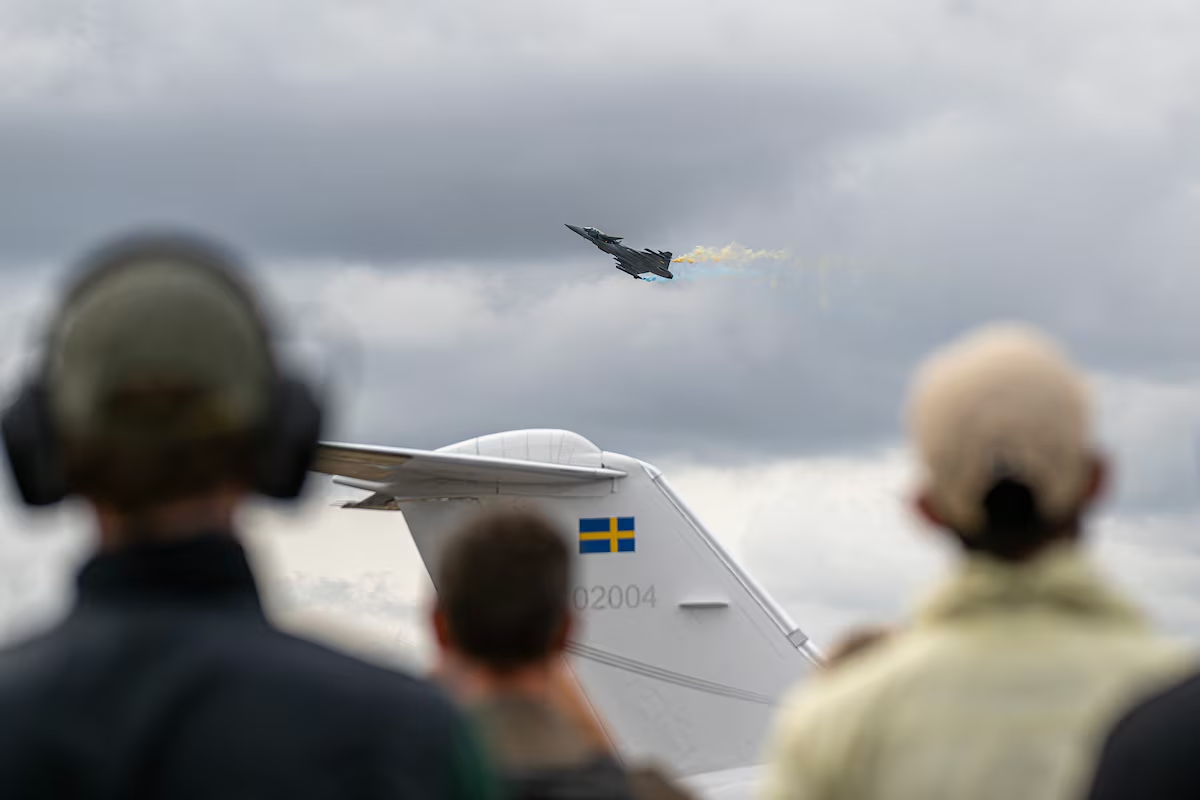

Open this photo in gallery:
A Swedish JAS 39E Gripen flies overhead at the centenary event of the Swedish Air Force at Malmen Air Base outside Linkoping, Sweden, on Aug. 22.Gavin John/The Globe and Mail
In the final-assembly hall for the Saab Gripen fighter jet in the Swedish city of Linkoping, the flags of Saab’s eight customer countries hang above the production line. A ninth spot holds a white banner reading, in red capital letters, RESERVED.
Asked whether it was for Canada, a Saab official smiled, shrugged and said nothing.
Behind the scenes, though, Saab is pulling out all the stops in order to put Canada’s name on the banner.
At a recent briefing at Saab’s Linkoping headquarters that included The Globe and Mail, company officials laid out a range of benefits that Canada can expect should it go ahead with a major order for Gripen jets.
Saab had already promised a Canadian assembly line for the Gripen but had yet to detail the scope of that promise. The company is proposing to build the fighter jets in Canada from parts to finished aircraft, across a network of roughly 10 prime partners and some 250 suppliers in several provinces.
Canada would be the first start-to-finish Gripen production line outside Sweden, provided the order is large enough to justify it, Saab officials say. Canada has also been invited by Saab and the Swedish government to join Sweden’s next combat-aircraft program in the future, if the Gripen is selected.
It’s not clear at what stage and how detailed talks are between Saab and the federal government. The company’s promises come amid a growing trade rift between Canada and the U.S., traditionally this country’s largest military supplier. And Ottawa is still determining whether to forge ahead with a deal to buy additional U.S.-made F-35 fighter jets.
Carney’s summit to push Canadian resources, defence and tech to global investors
Saab’s previously announced partners include Bombardier, CAE, IMP Aerospace & Defence, Arcfield Canada and Cohere.
Beyond that, a document viewed by The Globe showed plans for half a dozen “Saab innovation hubs” across Canada for R&D, AI, cybersecurity and Arctic innovation.
Saab, which manufactures the JAS 39E Gripen, lost a competitive bid in 2022, when Canada, looking to replace its aging fleet of F-18s, chose U.S.-based Lockheed Martin to buy 88 F-35s.
The deal locked in the purchase of the first 16 planes, which are now in production, but when American tariffs were first introduced a year and a half ago, Prime Minister Mark Carney ordered a review of the contract for the remaining 72 planes.
After trade talks collapsed late last month, Canada announced that it would fight U.S. President Donald Trump’s latest levies with countertariffs that are set to take effect next week.
Here’s how Canada’s countertariffs could hit your wallet
The F-35 review, and any potential decision on the Gripen, are now caught up in the intensifying trade war, with Washington reportedly demanding that Canada complete the full F-35 buy while calls mount for the federal government to cancel the rest of the order.
At the same time, Saab continues its comprehensive multiyear campaign to woo Canada with no assurances that it will bear fruit.
In an interview, Saab CEO Micael Johansson put the decision in larger terms. “Canada has to decide, [does it] want the sovereign aerospace industry and is that important to them? That’s the first decision,” he said. “And then if they take that decision, Sweden and Saab is the best choice.”
He does not expect the F-35 to disappear; Canada has 16 under contract and has paid long-lead costs on 14 more. “I don’t think Canada will give up F-35 completely,” he said. “I have no clue how many.”
Mr. Johansson insists that Saab is not asking Canada to choose between suppliers. “We’re not trying to replace F-35. That’s a Canadian sovereign decision to go F-35,” he said. And a minute later: “It’s not replacing F-35. It’s both.”
Open this photo in gallery:
Micael Johansson speaks at Malmen Air Base in August. The Saab CEO said he does not expect Canada to ‘give up F-35 completely,’ despite the escalation of the U.S. trade war.Gavin John/The Globe and Mail
A spokesperson for the office of Industry Ministry Mélanie Joly said in a statement that the minister has been in constant contact with Saab, as well as Lockheed Martin. “Her objective remains to create good-paying jobs for Canadians, especially at a time where Canada’s manufacturing sector is dealing with the impacts of the trade war,” said Gabrielle Landry, deputy director of media relations.
Mr. Carney vowed last spring that “the days of our military sending 70 cents of every dollar to the United States are over” and has already made moves to diversify its purchases, including Canada’s continuing negotiations with Saab for a separate program: six GlobalEye early-warning aircraft.
Mr. Johansson said in the recent interview that a term sheet for the GlobalEye was due to be signed by the end of August.
The Defence Investment Agency, the federal body negotiating the purchase, said in a statement that, “The term sheet has not been signed.” The statement added that “Canada has been in constant and productive discussions with Saab regarding the GlobalEye” and that “these negotiations are not related to trade discussions between Canada and the U.S.”
The company’s ambitions, however, are much larger than that, and include the sale of at least 40 Gripen fighters, which Saab says is the number it would need to make building the aircraft in Canada viable. Saab says it needs a third final-assembly line, in addition to those in Sweden and Brazil, for its Gripen E fighter to meet demand.
Canada can maintain sovereign control over the aircraft’s military software, Saab says, and keep a classified program office in Montreal under Canadian control.
Invading Canada would be ‘preposterous,’ U.S. commander says at Indo-Pacific military meeting
Saab officials offered a breakdown of estimated regional benefits. A document dividing production of both Gripen and GlobalEye by region shows that 50 per cent will go to Quebec, 26 per cent to Ontario, 14 per cent to the West and 10 per cent to Atlantic Canada.
Slightly less than half the work would be production and mechanics; the rest would be research and development, and program management.
In addition to establishing groundwork on the supply side, Saab has also moved to try to overcome one of the biggest hurdles. The Gripen’s one American part is its most important: the F414 engine, made by General Electric. Its export is governed by the International Traffic in Arms Regulations, or ITAR, the U.S. rules that allow Washington to approve, restrict or refuse the export of American military technology and dictate where it is repaired.
“Every contract that we secure is also backed by a licence from the U.S.,” Mr. Johansson said. So far, it has held: “It’s never been a problem, GE supporting us tremendously, and GE is also supporting doing things in Canada.”
On July 22, GE Aerospace and Canadian company Magellan Aerospace signed a memorandum of understanding to overhaul the engines in Mississauga if Canada buys the Gripen, so the engines would be fixed in Ontario rather than shipped to the United States. The hedge was negotiated by Saab and GE, its American supplier; Ottawa has said nothing publicly about seeking such assurances itself.
The office of Stephen Fuhr, the Secretary of State for Defence Procurement, said in a statement that it “regularly engage[s] with defence-industry representatives including from Saab.”
However, it noted: “Engagement does not constitute the launch of a procurement process, a commitment to procure or an assessment against requirements.” The F-35 procurement, the statement said, “is currently under review,” and the DIA “does not comment on the receipt of solicited or unsolicited proposals from industry.”