
Listen to this article
Estimated 4 minutes
The audio version of this article is generated by AI-based technology. Mispronunciations can occur. We are working with our partners to continually review and improve the results.
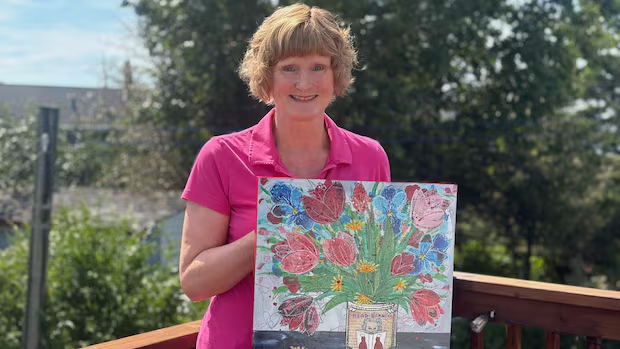
Chris Warburton Hulme was “appalled” when she learned that U.S. President Donald Trump’s latest round of 50 per cent tariffs on nearly $28 billion worth of Canadian goods included original artwork.
For the mixed-media artist from Eastern Passage, N.S., that was the final straw. Despite about half of her customers being American, she will no longer ship her pieces south of the border.
“Sorry, it’s not going to the U.S. anymore. It’s stayin’ in Canada,” said Hulme.
“It’s original artwork. It should be free speech. It should be freedom of expression. And to tariff that … it restricts everything that an artist should be able to do.”
The new tariffs apply to a range of Canadian art, including paintings, drawings, collages, decorative plaques, engravings, prints, sculptures and more.
While the Canadian government announced dollar-for-dollar counter-tariffs on products imported from the U.S. effective Sept. 8, the retaliatory measures do not include original art.
 One of Hulme’s latest pieces featuring the iconic pro-Canadian phrase, ‘Elbows Up!’ (Celina Aalders/CBC)
Cole Harbour artist Miranda Jordan has also halted all sales to the states.
She said since the trade war first began, it’s been challenging to navigate the ever-changing rules and shipping restrictions.
“I don’t work for the U.S. government and I don’t want to be an unpaid customs clerk for them, so I’m just not doing it anymore,” she said.
 Miranda Jordan paints on repurposed bottles and glassware to create accent lamps. She sells her products online, which has been her full-time gig for years. (David Laughlin/CBC)
“I would rather just do designs that appeal to Canadians and ship to Canadians.”
Journalist and former CBC Radio host Tod Maffin said he wanted to use his large social media following to support small businesses impacted by the latest tariffs.
He and his wife started an online directory where people can promote their products, while customers can browse locally made items.
Maffin said while the federal government has been offering financial support for larger industries, he doesn’t want the small players to be overlooked.
“That often leaves a lot of the smaller parts of the engine of our economy — which are the small businesses, the home businesses, the hobby businesses — that may not be employing five or 10 people, but may be a really important part of putting food on the table for that family,” said Maffin.
“I think that’s just as important.”
 Some of Jordan’s hand-painted lamps, including one adorned with a maple leaf. (David Laughlin/CBC)
CARFAC National, a non-profit advocacy group for professional artists in Canada, said in a statement that artists “cannot be an afterthought” in the country’s response to the trade war.
“Canadian artists are independent workers and entrepreneurs,” said interim executive director Jenna Faye. “Unlike large businesses and corporations, individual artists don’t have the financial resources to absorb new costs associated with these tariffs.”
Targeting Canadian buyers
While the new tariffs have already hindered their operations, Hulme and Jordan are both adapting and taking the opportunity to target Canadian buyers.
“I know that people want to support their creative community,” said Hulme. “Sometimes they can’t afford a $300 piece of art, but they can afford a $10 card.”
Hulme said she’s registering for more craft shows to get her work in front of local audiences, and she also plans to start a series of paintings inspired by trail-blazing Canadian women.
Jordan said she hopes people will make a concerted effort to buy local and engage with Canadian creators when possible.
“It doesn’t mean, of course, that we can all go out and spend all of our money on art before we start paying our mortgages, or rent, or food on the table. But I think art really does make life colourful,” she said.
MORE TOP STORIES