
Listen to this article
Estimated 3 minutes
The audio version of this article is generated by AI-based technology. Mispronunciations can occur. We are working with our partners to continually review and improve the results.
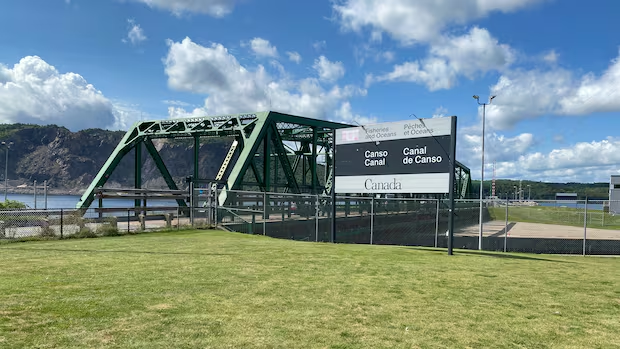
Newly installed fencing around the Canso Canal has abruptly blocked public access to one of Cape Breton’s most popular recreational mackerel fishing spots, following federal warnings over aging infrastructure.
The Canadian Coast Guard and the Department of National Defence closed the canal’s north and south mooring berths indefinitely after an engineering assessment found the structures in “critical condition.” The barrier cuts off a decades-long tradition for generations of local anglers.
For Port Hawkesbury resident Waddie Long, the closure marks the end of a family ritual. He grew up walking the railway tracks to fish the span as a child and later brought his two sons.
‘There’s a lot of upset people around’
“By the time we were 13, 14 or 15 years old, we were actually there all night,” said Long, who lamented that he won’t be able to share the tradition with his grandchildren.
Longtime fishers, who routinely congregate at the causeway in groups of 30 to 40, say federal officials are ignoring their understanding of the risks inherent to recreational fishing.
“I think it’s ridiculous that they’re closing that spot off for safety,” said Robin Murphy, who has fished the canal for 40 years, often bringing her children and grandchildren.
 Port Hawkesbury resident Waddie Long, an instructor at Nova Scotia Community College’s Strait Area Campus, says Canso Canal operators should explore alternatives to fencing off the mooring berths. (Adam Cooke/CBC)
Murphy said the site is one of the few shore-accessible spots free of dense seaweed that typically snags gear.
“Anyone who fishes knows it’s a wilderness activity that requires trekking to dangerous spots with rough terrain and all the hazards that go along with being near open water,” Murphy said.
“This is the deepest section that a person can access on foot without needing a boat… It’s an entirely different experience altogether fishing from the rocks as opposed to fishing along the fence line.”
Fellow Port Hawkesbury resident Peter Britten, who caught his first mackerel at the causeway when he was 15, shared his frustration.
“There’s a lot of upset people around,” Britten said.
He hopes officials will consider safety upgrades over total exclusion.
“If they had better reinforcement for the pier, and maybe more signage, more lighting, it would make it more safe.”
 Members of Robin Murphy’s family cast for mackerel at the Canso Canal in 2017. Four generations of her family have fished the site over the past 40 years. (Robin Murphy)
Beyond recreation, Long emphasized that mackerel fishing has historically provided an essential source of food for Strait area families.
“It’s not just sport — a lot of people around here fish mackerel for food,” said Long, an instructor at Nova Scotia Community College’s Strait Area Campus.
He recalled his early days of fishing in the 1960s and ’70s, when harvesting wild food was standard practice.
“It was very common for a lot of households around here to snare rabbits, to hunt bears, to make preserves, grow gardens, fish, and preserve fish and can fish for the winter. And mackerel was one of those things that you did in the summer, and continued into the fall.”
 Ottawa fenced off the Canso Canal berths earlier this summer over safety and structural concerns. (Adam Cooke/CBC)
Craig Macartney, a communications adviser for the Canadian Coast Guard and the Department of National Defence, said in a statement that an independent engineering assessment revealed the canal’s south mooring berth “has lost its primary load-carrying capacity.”
“Any future project to replace the structure would be subject to prioritization against other infrastructure requirements and available funding,” Macartney said. “As a result, there is currently no timeline for redevelopment or reopening the area to public access.”
MORE TOP STORIES