
Listen to this article
Estimated 4 minutes
The audio version of this article is generated by AI-based technology. Mispronunciations can occur. We are working with our partners to continually review and improve the results.
As the Canada-U.S. trade war escalates, CBC photographer Evan Mitsui has been visiting tariff-affected businesses across southern Ontario. Whether it’s furniture, live flowers or circuit boards now subject to new U.S. tariffs, one word comes up at each business: “Uncertainty.”
Saeid Mohmedi, founder and president of MIS Electronics Inc. in Richmond Hill, Ont., has weathered storms in his 25-plus years in business. But nothing like this.
“With this idiot guy [in the White House], we just don’t know,” Mohmedi said, when asked what the next three to six months look like for the company.
MIS manufactures printed circuit boards (PCBs) for clients in the automotive, electronics and other sectors.
“My business is mostly with Canadian companies,” Mohmedi said. But his clients — he’s reticent to name-drop, though MIS’s website lists Sony, Samsung and Toyota among them — export to the United States.
This means the products those companies make are on the hook for the Canadian content.
 MIS founder and president Saeid Mohmedi, who stands on the shop floor in Richmond Hill on Aug. 27, has weathered storms in his 25-plus years in business, but nothing like this trade war. (Evan Mitsui/CBC)
A period of constriction
Mohmedi’s costs are going up, too. Even though many of the components that go into the PCBs that MIS builds are made by Taiwanese companies, the path to procuring them often runs through the U.S. — an increasingly circuitous and costly process.
It’s a period of constriction in a business that thrives on R&D and long lead times. As MIS vice-president John Tryhub puts it, “beyond six months, the forecasts are all down.”
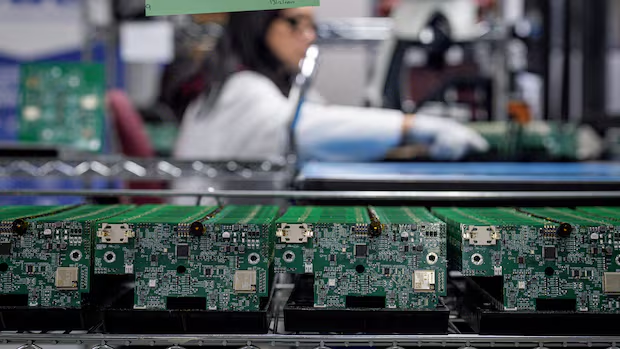
 Workers at MIS Electronics assemble printed circuit boards at the Richmond Hill facility. (Evan Mitsui/CBC)
Centred in the manufacturing hubs of Markham and Richmond Hill, Ontario’s tech industry specializes in the production of PCBs — the rigid green wafers onto which transistors, diodes and chips are soldered to form the brains and central nervous systems of electronic devices.
Ontario is home to several massive multinationals — the likes of Siemens and Celestica — that make enterprise electronics of the sort that run power grids and data centres. However, much of the sector’s output is from companies like MIS, focused on business-to-business orders, 10,000 units at a time. Those PCBs go into things like handheld radios, EV chargers, slot machines and medical devices big and small.
 Plant manager Ali Reza shows a component that goes into PCBs at MIS’s facility. (Evan Mitsui/CBC)
With 70 employees and 47,000 square feet of manufacturing space, MIS is the quintessential small-to-medium-sized business that stands to bear the brunt of Trump’s trade war.
The United States International Trade Commission puts the total value of Canada’s electronics sector exports into that country at $4.1 billion US. The latest Section 338 tariffs — which began Aug. 22 after no Canada-U.S. trade deal materialized — target Canadian-made PCBs specifically and at the highest rate (50 per cent), putting companies like MIS right in the crosshairs.
Major threatened sectors
Next steps
When asked how he plans to cope, Mohmedi says now is the time to help businesses onshore their supply chains.
“Canadians need to step up and support Canadians. Incentivize Canadian manufacturing,” he said. “We can make it here for cheaper than importing [from the U.S.].”
He’s gotten the ball rolling by starting another company that makes touchless faucets using MIS parts — all made in Canada. It’s a niche he decided to fill after discovering American faucets were being imported due to a lack of domestic alternatives.
Mohmedi says if there’s to be a silver lining, perhaps this is it: the opportunity to increase demand for Canadian-made things.
“Why are we doing it in the U.S? It can be cheaper to make it here.”