
Open this photo in gallery:
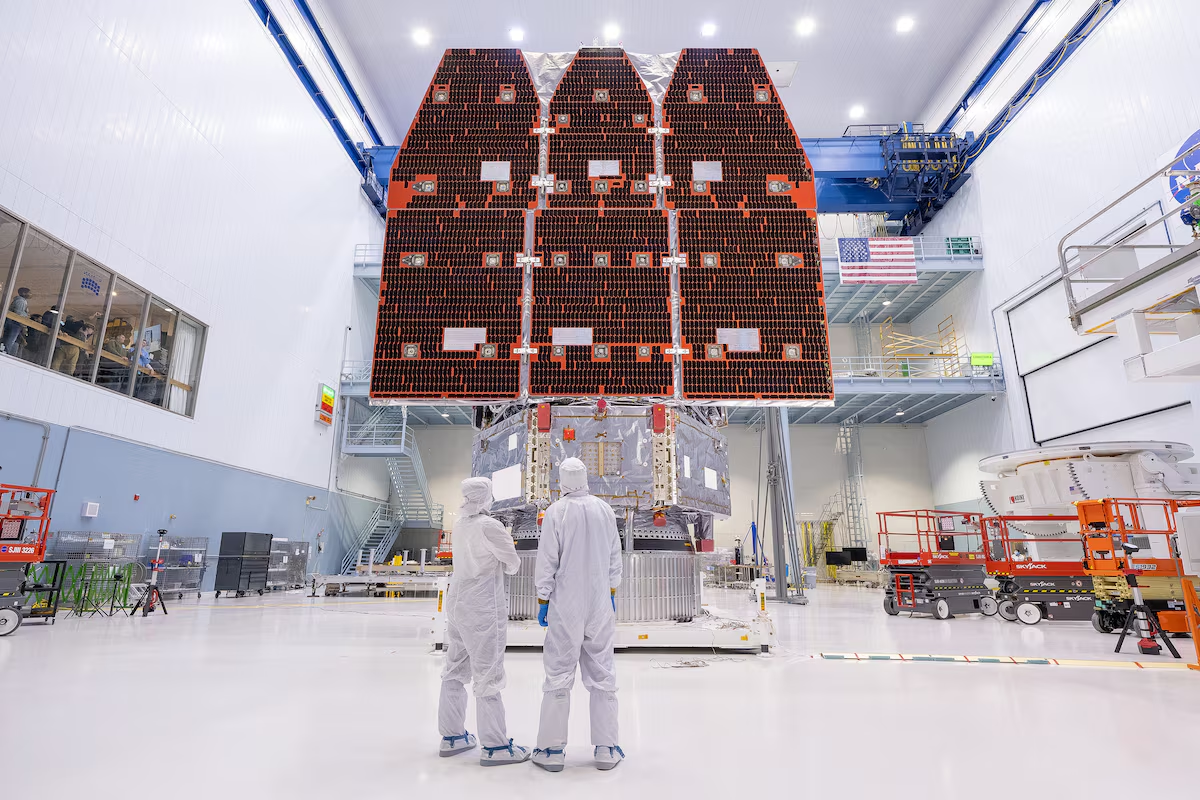
NASA technicians connect the inner and outer segments of the Nancy Grace Roman Space Telescope at the Goddard Space Flight Center in Greenbelt, Md., in November, 2025Jolearra Tshiteya/The Associated Press
Andrea Crespi was still a middle school student in Italy when three American astronomers won the 2011 Nobel Prize in physics for discovering that the expansion of universe is speeding up.
Back then, the mystery of that acceleration and the curious phenomenon called dark energy that powers it seemed like an unsolvable problem.
Fast-forward 15 years and Mr. Crespi, now a graduate student at Ontario’s University of Waterloo, may be among those with the best shot yet at cracking the riddle of dark energy.
That exciting possibility moved a step closer to reality on Sunday morning with the successful launch of the Nancy Grace Roman Space Telescope at the Kennedy Space Center in Florida.
Astronaut Jeremy Hansen opens Canadian National Exhibition
Named after NASA’s first chief astronomer, who helped usher in the era of astronomy in space, the telescope is now poised to explore some of the deepest questions that researchers have about the universe, with dark energy topping the list.
“It feels like an opportunity,” said Mr. Crespi about the launch. “Like we’re at the turning point of the story.”
Despite concerns that weather would postpone the early morning liftoff, conditions proved favourable enough for a SpaceX Falcon Heavy rocket to send the telescope roaring on its way at 7:26 a.m. ET.
The bus-sized observatory is now on a 100-day journey to L2, a point in space about 1.5 million kilometres away, where gravitational forces are balanced in a way that allows objects located there to easily maintain their position relative to Earth.
Open this photo in gallery:
A SpaceX Falcon Heavy rocket lifts off carrying NASA’s Nancy Grace Roman Space Telescope at the Kennedy Space Center in Cape Canaveral, Fla on Sunday.Joe Skipper/Reuters
After a period of testing, the Roman telescope is expected to begin its epic survey of the universe in the coming months. Astronomers in the U.S. and around the world are gearing up for the trove of data that will pour from the newly-launched instrument and deliver discoveries across a range of subfields.
“It’s going to be revolutionary,” said Jason Rowe, an astronomer at Bishop’s University in Sherbrooke, Que., who is part of the team that will be using the new telescope to probe the characteristics and distribution of alien solar systems around our galaxy.
NASA’s new flagship astronomical observatory was launched into space from Florida on Sunday on a mission to probe some of the biggest mysteries in astrophysics and cosmology.
Reuters
Years in the making, the 10.5-tonne, US$4.3-billion satellite is NASA’s third large-scale astronomical observatory in space – and the most unique in its purpose and history.
Whereas the Hubble and James Webb Space Telescopes were built to peer at tiny patches of sky to make their penetrating discoveries, Roman has a field of view that is roughly 100 times larger. It’s forte is less about zeroing in on individual targets than it is looking at the universe in bulk – either by taking in the myriad of stars that make up the Milky Way, or by gazing out at the innumerable galaxies that lie beyond.
By seeing more, it will also have a better chance of spotting what is fleeting or rare, including supernovas and other short-lived phenomena.
The Nancy Grace Roman Space Telescope has officially launched and is heading to its forever home at L2!
Over the next three months, the observatory will perform final checks and power its instruments before revealing its first images by early 2027.https://t.co/IdabpolHmh pic.twitter.com/tuDHAEzgKh
— Nancy Grace Roman Space Telescope (@NASARoman) August 30, 2026
“Our universe puts on spectacular cosmic displays every second, but they happen very quickly, so they often elude our telescopes,” said Julie McEnery, senior project scientist, during a press briefing on Saturday. “With Roman’s panoramic vision, we’ll not only catch these events, but we’ll see many at once.”
Fittingly for a telescope so well-suited for spying on the cosmos, the instrument’s primary mirror was originally meant to be used for spying secretly on other countries.
Measuring 2.4 metres across, it is as large as the Hubble’s main mirror but has a much shorter focal length, which accounts for its more expansive view of the heavens.
Mark Clampin, NASA’s Deputy Associate Administrator for Science, says the new telescope’s panoramic view of space and its rapid survey speeds offer the opportunity for scientists to study the cosmos as never before, with wide-field surveys examining its structure, composition and evolution.
Reuters
When it was created more than two decades ago by a division of ITT Corporation, now part of L3Harris Technologies Inc., the mirror was to be used in a spy satellite. But when the satellite was cancelled in 2005 the exquisite mirror became a white elephant. In 2012 the National Reconnaissance Office, a branch of the U.S. military, officially gifted it to NASA. (The gift originally included two mirrors but NASA was later asked to return the second.)
The surprise donation could not have come at a better time. Less than a year after the Nobel prize was awarded for the discovery of dark energy, astronomers were now looking at the possibility of an instrument that could see enough of the universe to definitely measure its effects.
Shades on and batteries charging! 😎 🔋
Roman’s Solar Array Sun Shield and Lower Instrument Sun Shade have successfully deployed, powering the observatory and shading its instruments! https://t.co/RAUgaDDx0Z pic.twitter.com/9LVHCElTT7
— Nancy Grace Roman Space Telescope (@NASARoman) August 30, 2026
Other areas of interest to astronomers were also sure to benefit, including the search for exoplanets – planets around other stars.
The telescope that took shape around the mirror was tailored for purpose. Its design ensured that it would be extremely stable, offering views of distant galaxies that would enable astronomers to perceive how mass is distributed in the universe based on how gravity distorts the light of objects in the background.
It was also geared to observation at infrared wavelengths, which are best for capturing the faint light of galaxies as the universe expands.
And with the mirror already in hand, the project, then called the Wide-Field Infrared Survey Telescope, or WFIRST, had a big head start on its way to the launch pad.
The trip has not been a smooth one, however. U.S. President Donald Trump tried to cancel the telescope in 2019 during his first administration. Congress ultimately rescued the project, and did so again after a second attempt by the White House to cut it last year.
Open this photo in gallery:
The 10.5-tonne, US$4.3-billion satellite is NASA’s third large-scale astronomical observatory in space.Sydney Rohde/The Associated Press
The outcome was not as happy for the Canadian Space Agency, which initially saw an opportunity to partner with NASA and build a calibration system and other hardware for the telescope’s Wide Field Instrument. This is the device that is crucial for the telescope’s dark energy measurements. In exchange, Canadian astronomers would have access to the telescope. (Similar arrangements have earned Canada time on both the Hubble and Webb space telescopes).
Ultimately, Ottawa balked at the $100-million price tag for a Canadian contribution to the telescope, and in 2018 withdrew from the project. The decision left Canadian astronomers out in the cold.
Yet Canada has maintained a presence on the Roman telescope, even if it is not an official one. A second instrument, called a coronagraph, which is designed to spot exoplanets orbiting distant stars, utilizes cameras built by Nüvü Camēras Inc. of Montreal. The equipment was assembled and prepared for space flight by Quebec-based tech company ABB Canada.
Frederic Grandmont, an astronomer by training who is technology and business manager for ABB, has been with the project from the start. He says it was thrilling to see the Canadian-made hardware in images of the telescope’s scientific package – and sobering to realize its significance to the coronagraph.
“If our component doesn’t work, nothing works,” he said.
NASA’s Pandora is on a mission to help answer the question: Is there other life out there?
The coronagraph is designed to suppress the light of stars in order to reveal planets that orbit around them. Its presence on the Roman telescope is primarily to test a technology that one day can be used to ferret out Earth-like worlds in a proposed future space telescope, called the Habitable Worlds Observatory.
But the coronagraph is just one of the ways the telescope is expected to shed light on solar systems beyond our own.
Starting next year, astronomers will use the Wide Field Instrument to stare at a star-rich portion of our Milky Way, looking for planets and moons that may reveal their presence when they momentarily cross in front of and distort the light of background stars. At the same time, the telescope will identify planets that orbit around some of those stars in cases where a planet repeatedly blocks a portion of a star’s light.
With upwards of 100 million stars in the telescope’s field of view, it is inevitable that the new data will provide an unprecedented look at the demographics of worlds across different regions of our Milky Way galaxy.
“How do planetary systems end up like our solar system?” said Dr. Rowe. “I think will be a key question we’ll answer with Roman.”
Get ready to widen your view 🤩
While you wait for launch, brush up on some key facts about Roman! https://t.co/GnRI37hM9L pic.twitter.com/NNNGTn6iYJ
— Nancy Grace Roman Space Telescope (@NASARoman) August 29, 2026
In the longer term, Roman will gradually amass data on galaxies that will be used to trace the expansion of the universe over a large chunk of cosmic time.
It’s this measurement that researchers hope will ultimately pin down the degree to which dark energy is causing the expansion of space to accelerate. Once that number is quantified and confirmed by other independent measurements, including Europe’s Euclic Space Telescope and the Vera Rubin Observatory in Chile, researchers hope they can identify the physical mechanism behind the acceleration.
“Putting them all together and getting that full picture across, basically, all of the history of the universe is going to be very exciting,” said Will Percival, a professor at Waterloo who is Canada’s lead researcher on the team that will be using the Roman telescope to clock the motion of distant galaxies as the universe expands.
Both Dr. Percival and Dr. Rowe are participating in Roman science through grants from the Canadian Space Agency that were awarded last year.
For Mr. Crespi, who is a part of Dr. Percival’s team, the successful departure of the telescope on Sunday signals the start of an adventure that could define his career.
“It was really great,” he said after watching the launch. “It’s amazing to be part of this moment that is going to shape the cosmology of tomorrow.”