
Open this photo in gallery:
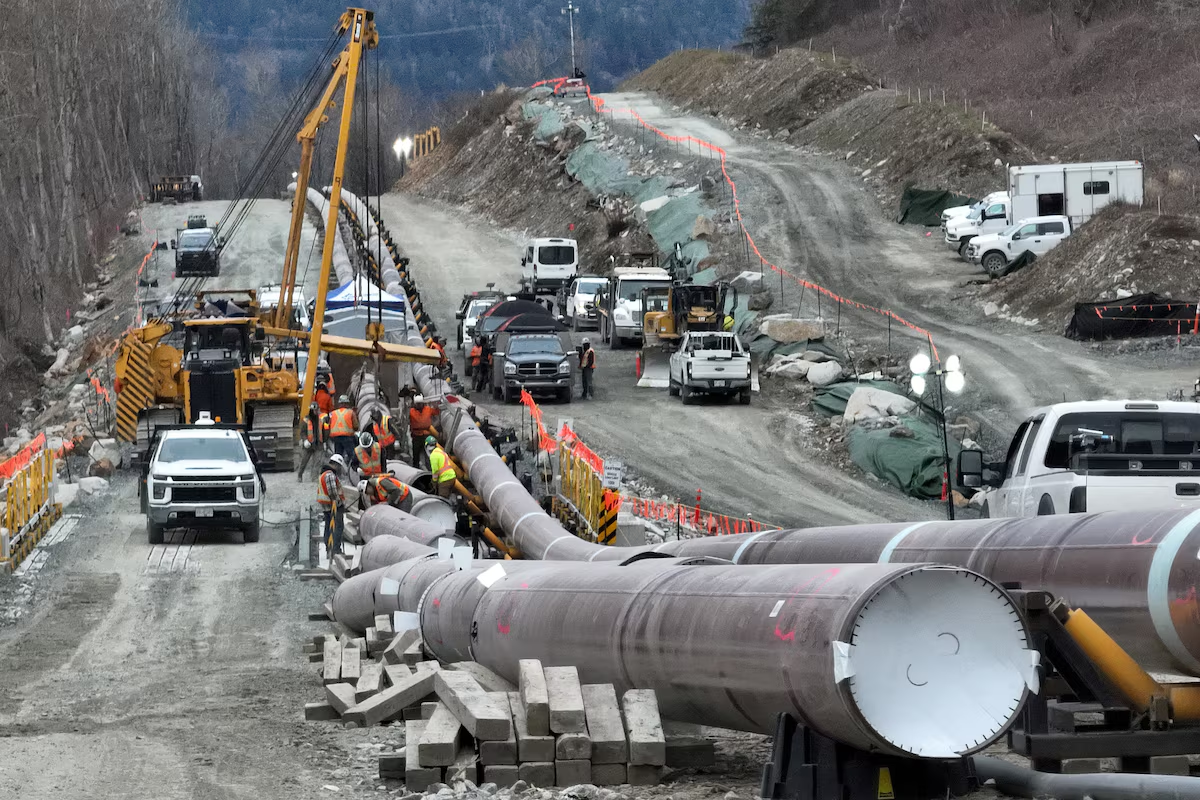
CEO Mark Maki says Trans Mountain is in the process of making operational improvements that will boost the pipeline’s capacity to 1.2 million barrels per day.Chris Helgren/Reuters
Government-owned Trans Mountain Corp. pumped $450-million into federal coffers over the past three months, as the company’s pipeline from the oil sands to the Pacific coast ran near capacity and prepared for massive expansion.
On Friday, Calgary-based Trans Mountain announced its network moved an average of 840,000 barrels of oil each day, running at 94 per cent of capacity during the second quarter of the year. Trans Mountain customers – the country’s major energy producers – shipped 65 per cent of this oil to Asian refineries.
The crown corporation turned a $138-million quarterly profit and continued to generate a significant return on taxpayers’ $34-billion investment in the pipeline.
Trans Mountain’s quarterly payment to the federal government consisted of $150-million in interest payments and $300-million in cash dividends. Trans Mountain has returned $2.6-billion in interest and dividends to Ottawa since the controversial purchase and expansion were completed just over two years ago.
“Trans Mountain is delivering long term value for Canadians,” said Mark Maki, the company’s chief executive officer, in an interview. The federal government acquired Trans Mountain in 2018 from Houston-based Kinder Morgan Inc.
Trans Mountain is in the process of making operational improvements that will boost the pipeline’s capacity to 1.2 million barrels per day. Mr. Maki said these engineering projects are projected to be completed by the end of 2028.
Opinion: Canada is building a new pipeline through our lands – before honouring its promise on the last one
In July, the federal and Alberta governments announced Trans Mountain would take the lead on building and operating the proposed West Coast pipeline running along roughly the same route as its existing system. The project is expected to cost up to $44-billion.
Hard-won insights from Trans Mountain’s expansion, which vastly exceeded its original projected $7.4-billion budget, will help ensure the West Coast pipeline gets built efficiently and runs safely, said Mr. Maki.
“This is a challenging project, but we learned our lessons,” said Mr. Maki. He said Trans Mountain is already doing preliminary work on the engineering and route planning for the West Coast pipeline.
The West Coast project’s challenges include using larger diameter pipes operating under higher pressure than the existing Trans Mountain network, Mr. Maki said. The pipeline would end at a facility that needs to be constructed at the Roberts Bank terminal in Delta, B.C., where it could fill larger supertankers than those servicing Trans Mountain’s existing Westridge Marine terminal in Burnaby.
The Alberta government has asked the federal government’s Major Projects Office to declare the West Coast pipeline as being in the national interest by Oct. 1, a move meant to speed the approval process. Pembina Pipeline Corp. PPL-T and Indigenous groups are potential investors in the project, which would also carry a million barrels of oil each day.
Trans Mountain reaches toll settlement with oil firms after prolonged negotiations with shippers
The federal government is eventually expected to sell Trans Mountain to the private sector, with Indigenous groups included in the ownership group. Mr. Maki said his message to politicians on the company’s future is “be patient.”
“When you look at the scale of [Trans Mountain] and its role in the global energy industry, there is nothing like it in the world,” said Mr. Maki. He said if the company also had Indigenous equity holders, and the social license that implies, “then I am confident this company would have enormous value to future owners.”
Trans Mountain’s customers are the country’s largest oil sands producers, including Cenovus Energy Inc. CVE-T and Canadian Natural Resources Ltd. CNQ-T. The companies pay the pipeline fixed fees to transport oil and typically sign long-term contracts for up to 20 years.
Recent increases in oil and gas prices, due to Iran’s response to the U.S. and Israel’s attacks, had no impact on Trans Mountain’s finances but have sparked new interest in the oil sands from Asian refiners.
“We are working with our partners, the oil producers, to help educate potential buyers on the reliability and quality of Canada’s energy industry,” said Mr. Maki.
In the most recent quarter, Trans Mountain pumped roughly 60 per cent of the oil it transported into tankers at its Burnaby terminal. About 28 per cent of its oil went into Washington state via the Puget Sound Pipeline. B.C. refiners purchased the remainder.
To allow larger loads in tankers leaving B.C., the Vancouver Fraser Port Authority plans to dredge Burrard Inlet’s Second Narrows, which lie between the Trans Mountain terminal and the Pacific Ocean. The work is scheduled to begin in September.