
Listen to this article
Estimated 4 minutes
The audio version of this article is generated by AI-based technology. Mispronunciations can occur. We are working with our partners to continually review and improve the results.
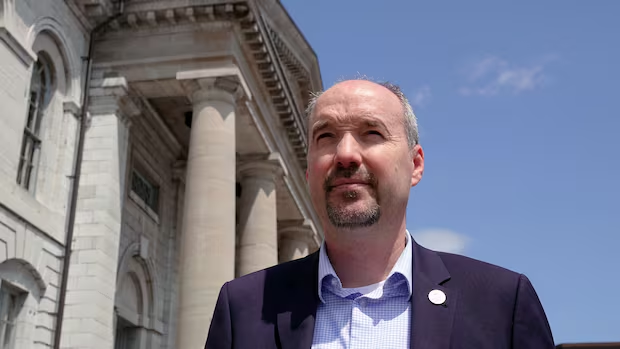
The mayor of Kingston, Ont., says a snicker is the only response Donald Trump will be getting from his community following the U.S. president’s move to have Lake Ontario henceforth be known as Lake America.
“The primary reaction is just laughter,” said Bryan Paterson, who was still shaking his head hours after the announcement. “I mean, it’s just so silly. It’s so utterly ridiculous.”
Paterson’s voice was just one in a Canadian chorus denouncing the executive order Trump signed Thursday which the president said renames the body of water between Ontario and New York “effective immediately.”
Among the dissenters on this side of the border was Prime Minister Mark Carney, who flatly denied the name was changing for Canadians.
In a post on social media, Carney wrote that the lake takes its title from “the Wendat word Ontari’io,” meaning “’the lake is beautiful, the lake is big.'”
Carney pointed out the name is more than 400 years old, “predating both the Confederation of Canada and the Declaration of Independence of the United States of America.”
The Wendat Nation also spoke out, with Grand Chief Pierre Picard writing in a statement that its members are “outraged, appalled, shocked,” adding that he sees the change as an attempt to “eradicate” the nation’s history.
WATCH | ‘Lake America’ latest shot at Canada amid trade war:
Trump renames Lake Ontario as ‘Lake America’ in latest shot at Canada
U.S. President Donald Trump ratcheted up tensions with Canada even more with an executive order renaming Lake Ontario as ‘Lake America,’ but it’s unclear how legally binding the order is. Trump also repeated his intention to use tariffs to cripple Canada’s auto industry.
Paterson said the lake runs “deep to the core” of what Kingston is and its name won’t be “changed on the whim by someone sitting in the White House.”
The city grew and flourished at the strategic intersection of three waterways: the St. Lawrence River, what eventually became the Rideau Canal, and Lake Ontario.
Kingstonians know the water. They swim in it, boat in it and live along its shores.
They’ve seen sunlight glitter and flash off its rolling surface on clear days and watched waves and ice slam the shoreline during winter storms.
 A man takes pictures of the waves on Lake Ontario during a wind warning at Portsmouth Olympic Harbour in Kingston, Ont., Jan. 5, 2022. (Lars Hagberg/The Canadian Press)
That’s one reason Paterson said people in town are dismissing this episode as a “joke.”
Kingston’s Lake Ontario Park — one of the jewels of the city — is a popular place for families and friends to gather.
The mayor said he’s already been asked if there are plans to rename it.
“I just laughed. I said, ‘That’s ridiculous. Of course, we would never do that.’ It’s always going to be Lake Ontario Park because, quite frankly, it’s always going to be Lake Ontario.”
Rochester, N.Y. city council denounces Lake America
Across the border, the largest U.S. city on Lake Ontario says it will continue referring to the Great Lake by its original name.
Rochester’s city council unanimously signed a proclamation on Friday to continue using Lake Ontario in all official local capacities.
“No government entity … has the right or the ability to erase centuries of Indigenous history simply by giving a new nickname to a Great Lake whose cultural legacy will outlive us all,” the council wrote in the proclamation.
Paterson said everyone on council has been asked about Trump’s latest move and how they intend to reply.
“The overwhelming sentiment is that it’s not worth even responding,” said Paterson. “It’s not worth wasting our time. The best thing we can possibly do is just ignore the silliness.”
 People take a photo at Lake Ontario Park in Kingston, Ont., on April 7, 2024. (Justin Tang/The Canadian Press)
A large Canadian flag has been hanging in front of city hall since the trade war with the U.S. first began.
The mayor said that, if anything, all of this “bluster and … craziness” has only strengthened the community’s resolve and sense of unity along with that of the rest of Canada.
Asked if he’s ever looked across the border and coveted his neighbour’s land or considered changing some names to lay claim to it, Paterson just laughed and said “definitely no.”
“Being a border community … we understand the value of friendship and relationship[s],” Paterson said. “We know that’s going to be there long after Donald Trump is gone.”