
Open this photo in gallery:
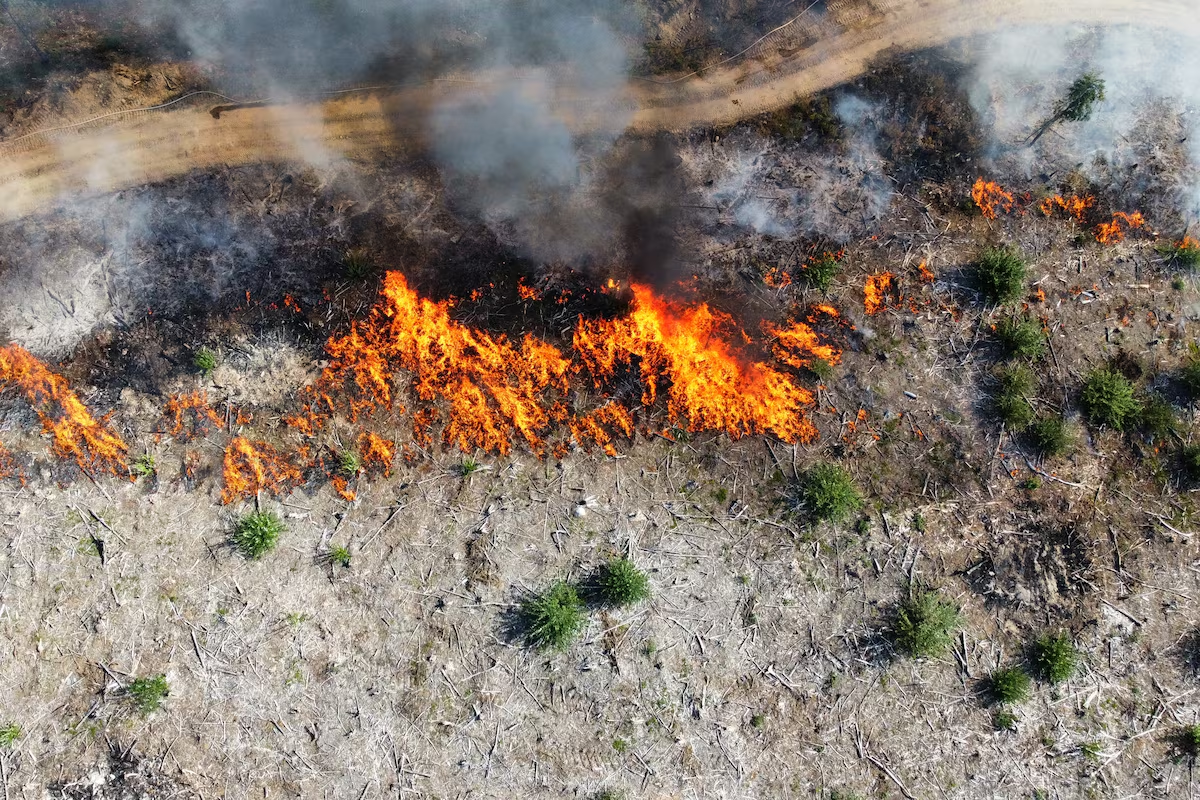
A prescribed burn is completed inside the Whitehorse South Fuel Break near the Mary Lake subdivision in Whitehorse, Yukon. Experts say strategic firebreaks could help minimize future wildfire damage.Supplied
With wildfires threatening more homes, livelihoods and vast amounts of land in Canada than in the past, some communities are creating firebreaks in an attempt to slow extreme blazes.
So far this year, about 4.5 million hectares across the country has burned in wildfires, according to Natural Resources Canada.
In an attempt to ward off future blazes, provincial and municipal authorities have worked to construct natural barriers in several communities in Newfoundland, Alberta and the Yukon.
The Yukon government is constructing a roughly 20 kilometre long firebreak on the southern end of Whitehorse. It’s clearing out highly flammable conifer species and planting trembling aspen, native deciduous trees that act as a buffer against wildfires.
“These spaces go from being kind of high-hazard forest fuels to being low-hazard forest fuels that don’t burn very well,” Luc Bibeau, manager of the Yukon’s prevention and mitigation unit in wildland fire management, said. “They’re fire resistant, but they’re also fire resilient.”
Opinion: Canada is not working together to confront the wildfire crisis
A report commissioned by Whitehorse city council in 2019 found that wildfire posed the greatest risk to the city. It recommended clearing flammable brush, introducing fire bans and other initiatives. Work began on the firebreak in 2020 and is expected to finish around 2030, Mr. Bibeau said.
The Yukon government is also upgrading firebreaks around Haines Junction and Teslin, about 155 kilometres west and 175 kilometres southeast of Whitehorse respectively. The Teslin firebreak will also undergo a stand conversion, creating a band of deciduous aspen trees, similar to the firebreak in Whitehorse.
Trembling aspen can slow and stop the progression of wildfires, according to Flavie Pelletier, who researched the subject for her doctoral thesis at McGill University.
She said the aspen could have a “fire-barrier effect” when grown together in a patch. The trees hold more moisture than other species in the area, reducing the ability of fire to spread within the patch.
Open this photo in gallery:
Yukon Wildland Fire Management staff tag an aspen seedling for long term monitoringSupplied
“Our forests are resilient and we should be leveraging the forests, in this case the aspen, to protect ourselves against climate change,” Ms. Pelletier said.
But the protection of a lone firebreak lined with aspen is not enough, according to Bob Gray, a B.C.-based fire ecologist with R.W. Gray Consulting Ltd.
He said fast-moving wildfires, like the Bald Range wildfire in Summerland, B.C., may be slowed or stopped by a firebreak, but the wildfire will continue to cast embers beyond it, potentially sparking flames in unburnt forest.
Inside the early battle against the ferocious Bald Range wildfire
Researchers from Thompson Rivers University in Kamloops, B.C. found in a review published on the Springer Nature Link platform in February, that firebreaks can be effective when strategically placed or when used with suppression efforts, but that extreme events can breach a fire break.
The review emphasizes the need to use firebreaks along with fuel reduction, community preparedness and land-use planning.
Mr. Gray said his work in B.C. takes a holistic perspective, protecting key infrastructure like watersheds by thinning forests over a large area and performing prescribed burns.
In the mountains surrounding Canmore, Alta., about 100 kilometres west of Calgary, the municipal government is clearing a firebreak, with funding from a provincial program.
Creating the firebreak requires crews to remove trees, prune lower branches and remove brush closer to the ground, said Jason Lyon, deputy chief of community risk reduction in Canmore. He said consideration was given to how the natural environment in the valley would have looked before the railroad was built through the area.
“The natural environment would have created these firebreaks through lightning and small intensity fires,” he said.
Mr. Lyon said the firebreak isn’t a silver bullet, especially if tested by a fast-moving, extreme fire event, like the Bald Range wildfire this summer or the wildfire that burnt a third of Jasper in 2024.
“If we’ve got that coming down the valley, it’s not going to hit this fire guard and stop. It’s going to hit this fire guard, and it’s going to slow it down,” he said. “It’s going to buy us some time, and it’s also going to allow us to create some defensive lines where we can actually tackle this fire before it enters town.”