
Listen to this article
Estimated 4 minutes
The audio version of this article is generated by AI-based technology. Mispronunciations can occur. We are working with our partners to continually review and improve the results.
Krista Vescio has been in recovery from drug addiction for nearly 16 years but the Thunder Bay, Ont., woman said the decision to stop using was rooted in grief.
Her sister died of a drug overdose in 2007, leaving five children behind.
“When my sister passed away, unfortunately it was the worst day of my life but a blessing as well, ‘cause I got myself clean,” Vescio said. “Here we are, 16 years in September, and going strong.”
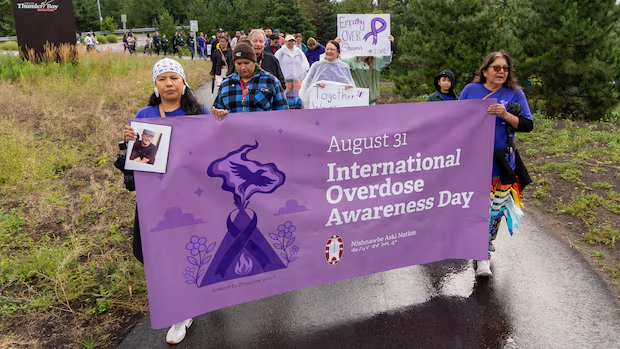
Vescio was among dozens of participants in a walk led by Nishnawbe Aski Nation (NAN) on Wednesday to raise awareness of the drug crisis.
The Thunder Bay district has the highest opioid-related death rate in Ontario at more than five times the provincial average in 2025, according to the Office of the Chief Coroner.
Those at Wednesday’s walk made their way from Marina Park to the Intercity Shopping Centre, a roughly five-kilometre route bringing them to another overdose awareness event hosted by the City of Thunder Bay Drug Strategy and Thunder Bay District Health Unit (TBDHU).
 Krista Vescio has been in recovery from drug addiction for nearly 16 years. She says the death of her sister in 2007 from an overdose motivated her to seek help. (Marc Doucette/CBC)
Vescio said there needs to be more resources available to help people when they’re ready for it.
“It’s gotta start somewhere, right?” she said.
Anna Betty Achneepineskum is a deputy grand chief with NAN and a member of Marten Falls First Nation. She’s long advocated for more support in the city, including long-term, sustainable funding for agencies that work directly with those affected.
“We do have detox centres here but I don’t believe they’re adequate to be able to support the need,” Achneepineskum said.
“We also need to ensure that there is a transition and aftercare for individuals that are coming out of recovery — that is very important — and we need to ensure that there is housing for individuals that are looking to get help and to recover from drug addictions.”
With a municipal election coming up this fall, Achneepineskum said she hopes the city’s next council does more to push for solutions.
‘It’s never too late’
There were 61 confirmed opioid-related deaths in the Thunder Bay district last year, the Office of the Chief Coroner reports.
“I think it’s really important to understand that behind those numbers, behind every statistic that we talk about, is a person,” said Kandace Belanger, manager of street outreach, harm reduction and sexual health with the TBDHU.
“Those represent loved ones, friends, neighbours, members of community — and that has an impact.”
 Northern Ontario communities such as Thunder Bay continue to be among those hit hardest by the opioid crisis in the province. (Marc Doucette/CBC)
Events like International Overdose Awareness Day on Aug. 31 help foster more open conversations about addiction and services people can access, Belanger said.
She reminds people that naloxone kits, which can be used to reverse the effects of an opioid overdose, are available for free at pharmacies or through the health unit.
“It’s also really important for people who may have experienced a loss related to overdose to have an opportunity to honour their person, their loved one, and have a place for their grief temporarily and to be amongst people who can support them,” Belanger said.
 Elaine Keesick, left, and Marilyn Keno, centre, both from North Spirit Lake First Nation are seen participating in Wednesday’s overdose awareness walk in Thunder Bay, Ont. (Marc Doucette/CBC)
Elaine Keesick, a member of North Spirit Lake First Nation, said she attended Wednesday’s walk for her family and friends who have lost their lives to addiction, as well as those actively living with it.
“Hopefully more people can come together and try to support each other,” added Marilyn Keno, also from North Spirit Lake First Nation, who walked alongside Keesick.
Keesick’s message to those living with addiction is simple: “you’re not alone.”
“There’s a lot of people here that want to see you succeed and get your life back on track and live a good, healthy life,” she said.
Those sentiments were echoed by Vescio.
“Just don’t give up. There’s always a light at the end of the tunnel and it’s never too late, right?” Vescio said.
“You’ve got family that loves you and you are worth it.”