
Open this photo in gallery:
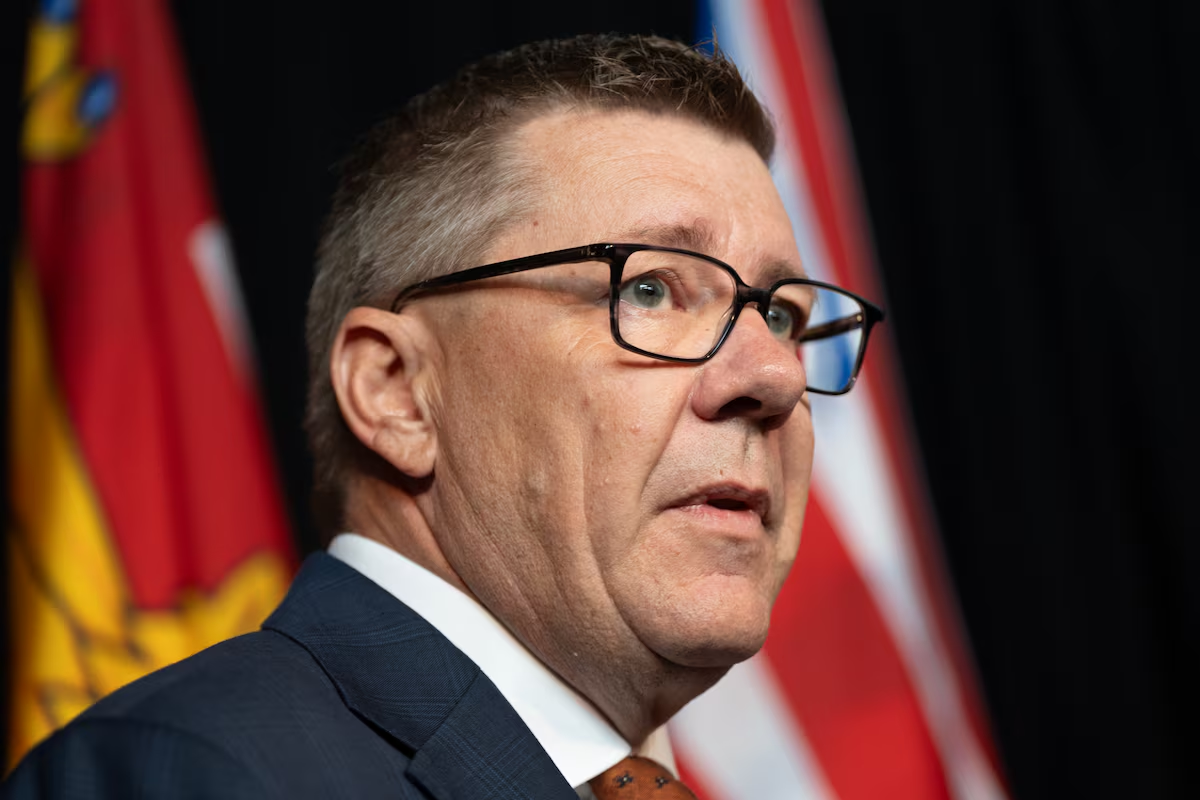
Saskatchewan Premier Scott Moe says he doesn’t support export tariffs on oil and potash as a measure to hit back against U.S. duties.Darren Calabrese/The Canadian Press
Saskatchewan Premier Scott Moe on Wednesday fiercely rejected any suggestion that Ottawa should apply export levies on natural resources like potash and oil in retaliation for the United States introducing new tariffs on Canadian goods.
But he announced the province will impose a reciprocal tax on American alcohol, a tactic that has proven to be a major irritant to U.S leaders.
The Premier, speaking to reporters in Prince Albert, supported the federal government’s decision to strike back at the U.S. with countertariffs, but only so long as they did not impinge on natural resources key to his province’s economy.
“What we, as a province, can not and will not support is any kind of export tariff on our natural resources or any of our resources that are being exported to the U.S., or through the U.S. to other areas of the world,” he said.
Ottawa lays out strategy to hit back at $27.6-billion in U.S. products
He highlighted potash and oil when making this appeal, noting he believes Ottawa has been negotiating in good faith on behalf of all provinces.
Saskatchewan, Mr. Moe said, will soon supply half of the world’s potash, which is used for fertilizer. Should Canada apply an export tariff to the commodity, the U.S. would switch suppliers. He suggested Belarus as a likely replacement candidate.
He also argued using oil exports as a weapon in the trade war should remain off the table, echoing Alberta Premier Danielle Smith’s long-standing position.
“We can not, in any way, support the adding of export tariffs on a product like oil,” Mr. Moe said. “It would be an unsustainable hit to our Canadian economy and, in particular, our Saskatchewan and Alberta economy.”
As for alcohol, he says starting Sept. 8, Saskatchewan will impose a 50-per-cent fee on American imports.
“It will be good for our Saskatchewan producers with domestic and local sales,” he told reporters.
Unlike the rest of the country, Saskatchewan and Alberta have not banned American alcohol.
Opinion: Canada’s response to Donald Trump is a nation-defining moment
While Mr. Moe thinks Canada should shield potash and oil from the trade battle, he reiterated that he backs Prime Minister Mark Carney’s strategy to match a new batch of U.S. tariffs dollar-for-dollar.
Trade talks between Canada and the U.S. crumbled late Friday, giving way for U.S. President Donald Trump’s 50-per-cent tariffs on US$20-billion worth of Canadian exports, including alcohol. Mr. Carney pledged to match the value of those tariffs on Sept. 8.
Mr. Moe, and other premiers across the country, backed this strategy.
“We are supportive of these very targeted countermeasures,” he said Wednesday.
“But only when those tariffs are focused and targeted to have a minimal impact on Canadian industries and families – and a larger impact on our trading partner that we want to bring back to the table.”
Mr. Moe, while pushing for a return to the negotiating table, faulted the United States for sparking the trade war.
“It was not Canada that got us into this situation,” he said.
Saskatchewan’s economy is relatively isolated from the current tariff battle.
Mr. Moe noted roughly 6 per cent of the provincial economy is affected by the U.S. tariffs, while Canada’s countertariffs will affect about 11 per cent, or $1.6-billion, of Saskatchewan’s imports from the United States.
Four takeaways from Canada’s tariff counterpunch
“We may see those, unfortunately, escalate in the days ahead,” he said of both the measures taken by both countries.
“We need to have one goal, with all of the very intentional actions that we take, and that goal has to be for both parties to return to the table,” Mr. Moe said.
Alberta’s Ms. Smith is scheduled to speak to reporters about the trade battle on Wednesday afternoon.
Federal Industry Minister Mélanie Joly, speaking to reporters in Calgary Wednesday morning, refused to address whether Ottawa would lean on natural resources in an attempt to inflict pain on the U.S. in the trade war.
“I know you would like me to answer in detail that question, but I also know that you know that I can’t. Because, of course, we don’t negotiate in public,” she said. “We’ve already made important decisions when it comes to countermeasures.”