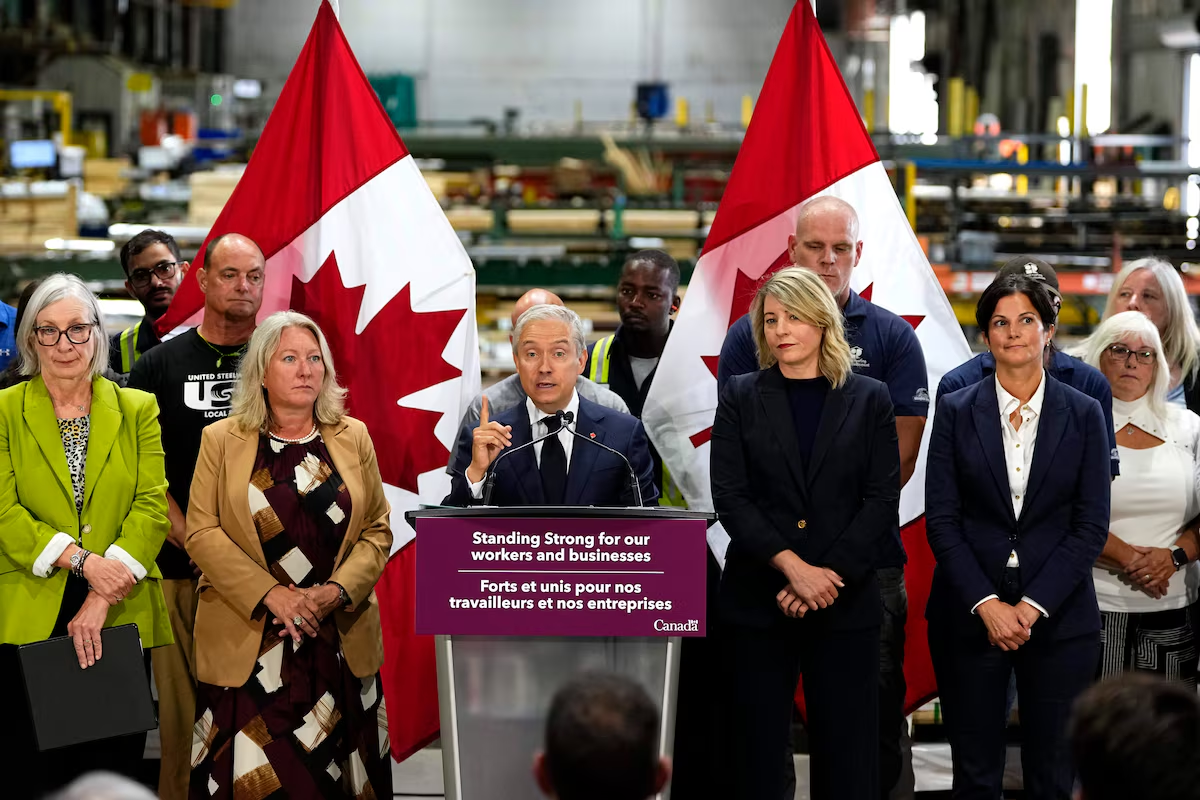

Good morning. Ottawa has responded to U.S. tariffs, including with dollar-for-dollar retaliation. More on that below, along with a deeper look at an exhibit at the Canadian Museum for Human Rights and a goodbye to Dolly Parton.
Open this photo in gallery:
Finance Minister François-Philippe Champagne speaks at a roofing company in Ottawa on Tuesday.Justin Tang/The Canadian Press
TOP STORIES
Ottawa announces retaliatory tariffs and supports
Canada is hitting back against the United States with countertariffs on $27.6-billion worth of American products, including metals, seafood, clothing, home appliances and electronic devices. Ottawa is targeting nearly 900 different items, with most of the levies set at 25 per cent or 50 per cent, while a small number are subject to a lower 15-per-cent duty. They take effect on Sept. 8.
The supports: Ottawa also outlined a $7.5-billion support package. The Canadian measures include easier access to employment insurance for affected workers and a range of loan programs for businesses.
Another threat: President Donald Trump said he is considering changing the name of Lake Ontario to “Lake America” as the trade war intensifies. To some, threatening to rename the body of water marks an attempt to erase First Nations’ language and impose American nationalism.
Other pushback: U.S. tariffs are pushing Canadian alcohol producers to rethink their biggest export market. Meanwhile, Ontario Premier Doug Ford struck a conciliatory tone yesterday after he and Trump exchanged a series of public and personal insults.
Keep reading
- In charts: Four takeaways from Canada’s tariff counterpunch
- Andrew Willis: Canadian CEOs are fighting a ground war, rather than a battle for headlines
- Barry Hertz: Canadian film and TV industry is not the easy bargaining chip Washington thought it was
- Tony Keller: Why Trump’s trade war against Canada won’t Make America Great Again
- David Shribman: Whether it’s Iran or Canada, for Trump, the result is the same
- Andrew Coyne: The whole world is watching as Canada stands up to Trump
Open this photo in gallery:
Palestine Uprooted – Nakba Past and Present, an exhibit at the Canadian Museum for Human Rights in Winnipeg.John Woods/The Canadian Press
Winnipeg’s human rights museum board was divided over Nakba display
Multiple trustees at the Canadian Museum for Human Rights raised concerns last fall that a new exhibit on the Palestinian Nakba could damage the institution’s reputation and hurt fundraising efforts. But management rebuffed the board members, telling them content curation is not their responsibility, according to internal meeting minutes.
The investigation: The Globe and Mail obtained a copy of the minutes, which include around 200 pages of records from November, 2025, to this past May, and conducted interviews with one former trustee and four current ones.
The display: The Nakba exhibit examines what the museum describes as an “ongoing process” beginning in the 1940s, when hundreds of thousands of Palestinian Arabs were displaced from what is now Israel. It will remain on display for at least two years.
Open this photo in gallery:
Iranian Foreign Minister Abbas Araghchi meets with Omani Foreign Minister Sayyid Badr al-Busaidi in Tehran on Tuesday.Iranian Foreign Ministry/Reuters
Iran vows retaliation for U.S. sanctions
Tehran pledged to fight back against expanded, but vague, U.S. sanctions aimed at isolating its economy. Notably, the new list of sanctions did not feature any of the Chinese financial institutions suspected of facilitating Iran’s oil trade. Washington is keen to avoid any curbs on China’s exports of critical minerals.
Peace talks: Iran expressed a general willingness to resume peace talks during meetings between Iranian and Pakistani officials on Monday, while expressing concern about the sanctions, a Pakistan government source said.
Open this photo in gallery:
People visit a makeshift memorial beside a statue of Dolly Parton in Sevierville, Tenn., on Tuesday.Camden Hall/The Associated Press
Country-music icon Dolly Parton dies
Music icon Dolly Parton, one of the best-selling female artists of all time, has died at the age of 80. She was a musician of many colours, writes arts reporter Brad Wheeler, who interviewed her multiple times over the years. Beyond her music, Parton was also a role model for many women, although she told columnist Marsha Lederman that she didn’t consider herself a feminist activist. Marsha wrote about what she learned from their conversation.
Reader callout: To honour the late queen of country music, we want to hear how her songs affected your lives in ways big and small. Share your memories with The Globe.
The Take
Any political party that feels it needs to put up with the sort of rogue actions of which Mr. Jivani is engaging is a party that is lost. And the Conservatives are horribly lost at the moment.
— Gary Mason, international affairs columnist
Canadians will never forget which side Conservative MP Jamil Jivani was on when the country faced its greatest crisis in decades, Gary Mason writes.
Speaking of lost, another B.C. Conservative legislator has quit, marking the third exit this month.
The Shot
Open this photo in gallery:
Greenhouses are illuminated as workers harvest gerbera flowers at night at the Nikko Engei flower farm in Tochigi Prefecture, Japan.Issei Kato/Reuters
Japanese farmers are reaping through the night as extreme heat makes the day too dangerous.
The Wrap
What else we’re following
At home: Two former Alberta political foes, Rachel Notley and Jason Kenney, are joining forces to make the case for the province to stay in Canada.
Abroad: Russian President Vladimir Putin has decreed that his government can temporarily seize control of critical infrastructure facilities if private owners fail to protect them from Ukrainian drone attacks.
Give: A new Canadian company led by former Quebec MP Patrick Gagnon has picked New Brunswick for an explosives plant as NATO demand grows.
Take: Ontario is considering adopting a controversial legal tool to seize assets believed to have been obtained with the proceeds of crime.
Online: Instagram’s top executive, Adam Mosseri, has started testimony in a trial over whether Meta Platforms designed Instagram and Facebook to make children addicted without proper regard for their safety.
Offline: The practice of banning cellphones at the door for some events is gaining traction as Gen Zs seek a less typical nightlife experience.