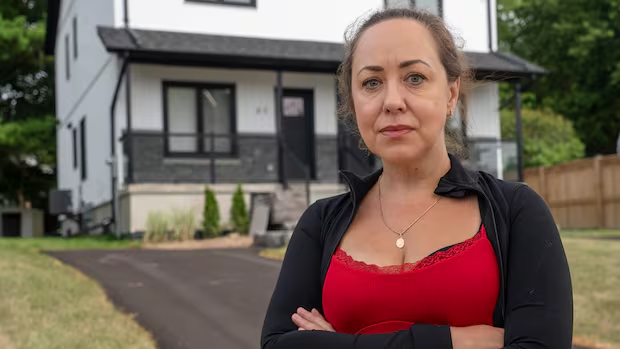
The fire that destroyed Antonina Gladkova’s property at the beginning of 2024 was just the beginning of years of frustration and financial stress that’s cost her tens of thousands of dollars and left her wanting to warn other homeowners about what’s in their mortgage agreements when it comes to insurance claims.
But the fire “was just the first nightmare,” she said. “It became worse.”
At first, Gladkova says she was relieved with the smooth process of dealing with her insurance company, which covered the full cost to rebuild her half of the semi-detached house in Georgetown, Ont.
But, her mortgage provider didn’t dole out the insurance payments on pace with her contractor’s invoices, and now she says she and her boyfriend are out tens of thousands of dollars and on the hook for a private mortgage they had to get to cover the shortfalls and keep construction going amid costly delays.
“We were absolutely outraged,” she said.
While it’s routine for insurance payments to be released in installments through a homeowner’s mortgage lender, legal experts say situations like Gladkova’s are becoming more common. That’s why she’s warning others about her experience in hopes of preventing it from happening again.
“The whole system doesn’t work. And that’s why I want people to know … be prepared,” she said.
‘A chicken and egg situation’
In February 2024, a fire broke out in the neighbouring half of Gladkova’s semi-detached property. Her neighbour tragically died in the fire, which spread to her half, completely destroying it. Gladkova, who originally lived in the home, had been renting it out for several years after she moved in with her boyfriend.
Just over a year after the fire, the insurance payment to rebuild the home was approved at just over $508,000. Because they had a mortgage, the lender, Simplii Financial, was responsible for releasing the funds.
The couple’s contractor required the first payment of $101,600, but Simplii only released $25,000, according to bank statements reviewed by CBC News.
After the couple brought up the issue, Simplii, which is part of CIBC, released another $25,000 as part of what they called a “one-time exception.” But the couple was still 50 per cent short.
 A fire broke out on the other side of Antonina Gladkova’s semi-detached house in Georgetown, Ont., in February 2024. It spread to Gladkova’s half of the property, completely destroying both homes. (Mehrdad Nazarahari/CBC)
Gladkova says the inital process was for the bank to release funds based on invoices from the builder and confirmation of completed work. But that would require the contractor, who she says was chosen by the insurance company, to finance the work upfront.
“You cannot build without the money. So it’s like a chicken and egg situation,” Gladkova said.
The couple filed a formal complaint with Simplii, requesting that the bank release an additional $51,600 so they could pay the invoice in full and keep construction going. The bank declined.
Gladkova says they didn’t have enough money to pay the difference, so they got a private mortgage with a 10 per cent interest rate.
After the formal complaint, documents show Simplii changed its process to provide funds based on progress reports of the work that was completed. For example, if 20 per cent of the work was completed, Simplii would have provided 20 per cent of the total insurance payment.
But, emails between Gladkova and Simplii show the bank began making the calculation on the first insurance cheque rather than the total insurance payout, which Gladkova says resulted in the couple consistently being about 35 per cent short on paying the contractor.
 Antonina Gladkova’s property was completely destroyed in the fire and her insurance company paid to rebuild the house. (Submitted by Antonina Gladkova)
Simplii did eventually release all of the money, including through another additional exception payment this past April to cover a shortfall for the third construction invoice.
The rebuild was completed this past June, about six months behind schedule, according to the construction contract.
Gladkova says the couple has paid around $15,000 in interest on the private mortgage and counting, plus thousands to set up the private mortgage and legal costs.
There’s still an outstanding balance of about $19,000 owed to the contractor as a result of delays because the couple didn’t have funds to pay him on time, Gladkova says.
She says that because of the private mortgage and the insurance payouts not keeping pace, the amount they owed “accumulated and skyrocketed in no time.”
Simplii’s response
In a statement, Simplii spokesperson Kira Smylie says the company empathizes with clients managing property damage and that “wherever possible, we work with our clients to provide flexibility, and we did so in this case.”
Smylie also said Simplii’s mortgage terms allow the bank to determine how insurance proceeds are applied.
“Before finalizing the payment terms with a contractor, clients should confirm the payment schedule with us so they can make informed decisions,” she said.
Gladkova says she wants to warn others about how vague some mortgage agreements are written. She says that had the bank told them they would be responsible for any shortfalls, the couple would have made other arrangements.
How to protect yourself
Standard mortgage provisions require insurance money be paid to the lender, which will then release the money on a schedule, because the lender has an interest in the property and wants to ensure the funds are used to rebuild it, according to real estate and home insurance lawyers.
Fy Virani, the founder of Virani Law, which specializes in home insurance claims, says situations like Gladkova’s that result in payment schedules not alligning are occurring more often. He says that’s because lenders are exerting tighter control over insurance payouts since there are now more total loss claims from fires and floods.
 Fy Virani, a home insurance claim lawyer and the the founder of Virani Law, says he’s seeing the issue of insurance payment schedules not aligning with contractor invoices more frequently. (Submitted by Fy Virani)
“We’re running into more and more total losses as a result of fires and floods,” he said. “So the result becomes this communication gap between these entities that aren’t used to being on the same page.”
Virani says in order to prevent this, property owners should establish clear and open communication with lenders, contractors and insurance companies to ensure all parties are on the same page and that payment schedules align before construction begins.
“It’s very hard to fix once money is already moving,” he said.
Filing complaints
At the end of 2025, Gladkova filed a complaint with the Ombudsman for Banking Services and Investments (OBSI), which is an independent and impartial Canadian organization that helps resolve disputes between banks, investment firms and customers.
Gladkova wanted Simplii to compensate them for the interest on the private mortgage and $4,000 in fees that came along with it.
She says the OBSI completed its investigation last June and found that while Simplii is not responsible for the extra costs incurred, and was not bound by the agreement the couple reached with the contractor, the bank did cause extraordinary distress and inconvenience by not explaining to the couple that they may need additional financing to complete the project.
The OBSI recommended that Simplii give the couple $500 in compensation, which the couple did not accept.
“It was a slap in the face,” Gladkova said.
In a statement, the OBSI said its complaint resolution process is confidential and cannot comment on an individual complaint.
Gladkova has since filed a complaint with the Financial Consumer Agency of Canada, which supervises federal external complaint bodies, including banks and the OBSI. She hopes to see changes to mortgage agreements so banks will release insurance payments directly to contractors.
“Hopefully, this can be fixed,” she said. “No one should experience this as it was life changing.”