
Listen to this article
Estimated 5 minutes
The audio version of this article is generated by AI-based technology. Mispronunciations can occur. We are working with our partners to continually review and improve the results.
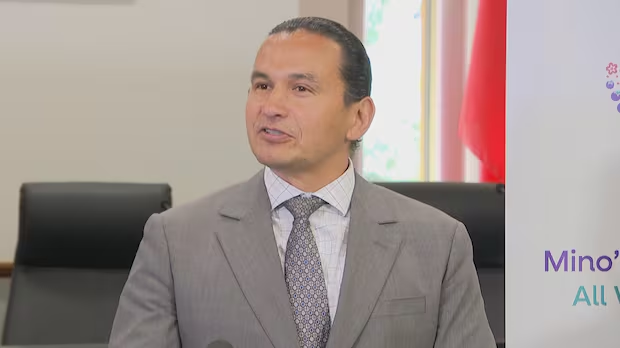
Conversations with Mark Carney amid an escalating trade war with the U.S. have been focused on the long haul, with the prime minister telling premiers to prepare economic programs that are “a bridge past the Trump administration,” says Wab Kinew.
“I can tell you that the conversation with the prime minister has been to prepare for two-plus years,” the Manitoba premier said in response to reporters’ questions Tuesday at an unrelated news conference in Winkler, Man.
“At some point, the American people will see how damaging this presidency is to their cost of living,” said Kinew.
U.S. President Donald Trump “plays like he’s in it for the little person, but he only cares about the elites,” he said. “And the sooner Americans — the voting public of America — realizes, the better off the whole world will be.
“So please, connect the dots.”
Kinew’s comments came after the federal government announced it is rolling out $7.5 billion to help workers and businesses withstand the new 50 per cent tariffs being imposed on $27.6 billion of Canadian goods.
WATCH | Premiers told to ‘bridge past’ Trump administration, Kinew says:
Premiers told to ‘bridge past’ Trump administration: Kinew
Manitoba Premier Wab Kinew says the premiers, in conversation with Prime Minister Mark Carney, have been told to prepare economic programs for the ‘two-plus years’ U.S. President Donald Trump has left in office.
The federal response, which came days after trade talks collapsed between Ottawa and Washington, also includes a plan to match the U.S. tariffs dollar for dollar by tariffing $27.6 billion of comparable U.S. goods starting Sept. 8.
Kinew said premiers across the country are reaching out to their American counterparts at the state level, making the case that trade with Canada is good for the U.S. — and their voters.
Kinew said he thinks if Trump “continues on the path that he’s on now, there’s definitely going to be some change in American politics” after the country’s upcoming midterm elections.
“Our issue is with the Trump administration’s tariffs. Our issue is not with the American people. American people are still our friends, they’re still our family members in many cases. And we want to continue building those relationships,” Kinew said.
While he’s proud of Canada’s response in tariff talks with the U.S., which he said has shown the rest of the world “that you don’t have to take a knee, you don’t have to bow down,” Kinew said “we wouldn’t be Canadians if we weren’t still willing to sit down and hash out some disagreements.”
“But we don’t want to compromise our values along the way, so it’s a bit of a balancing act,” he said.
“It’s always the hope that we’re going to be able to sort through these things. Maybe the president just has to take an L [a loss] in the midterms before he sees the writing on the wall.”
Manitoba response expected in coming days
Kinew said the economic impact of the Trump administration’s tariffs is expected to be “very jagged” in Manitoba and across Canada, but he’s been encouraged by the measures the federal government has announced so far in response.
He said his government is studying the federal government’s counter-tariffs and support measures, and expects to share another update about its own tariff response later this week.
Kinew said the federal government’s response balances support for businesses and workers, echoing an approach that came up at a meeting of the Manitoba government’s U.S. trade council he attended on Monday.
“You’ll probably see us moving in a similar way as the province of Manitoba,” said Kinew, who was in Winkler on Tuesday as part of a funding announcement for transitional housing.
“Absolutely, we have to keep the corporate sector moving along. But if there are the impacts on the actual workers and the people on the front lines, we have to make sure that we don’t leave those folks behind either.”
Winkler Mayor Henry Siemens said Tuesday while the uncertainty of the ongoing trade war has been difficult and concerning for the southern Manitoba city’s manufacturing sector, people he’s spoken to have been “fairly uniformly supportive of working with our federal government to try to find a solution.”
“The biggest piece is the uncertainty. If we knew what the tariff was going to be, we could deal with that, we could find ways to make that work or to shift gears, or any number of different things that come out of that,” Siemens said.
“But I would say overall, [people are] very supportive of the government for working towards a solution, continuing to work towards a solution — and not signing a bad deal.”