
Open this photo in gallery:
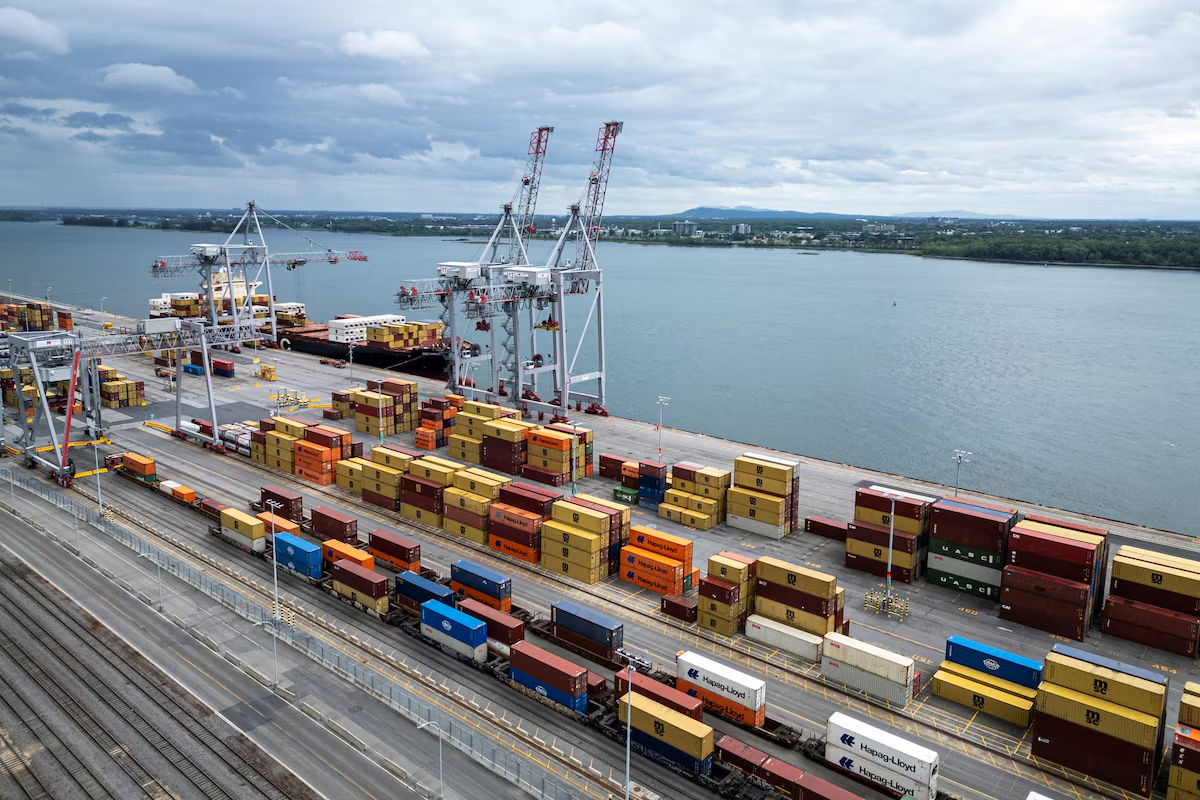
Shipping containers are seen in the Port of Montreal in Montreal on Sunday. Prime Minister Mark Carney announced retaliatory tariffs on the U.S. on Saturday, after walking away from a “bad deal” on trade in a deepening rift between the longtime allies.ANDREJ IVANOV/AFP/Getty Images
The federal government is expected this week to lay out its tariff-relief plan for businesses hurt by the latest round of U.S. levies on Canadian imports, as provinces brace for the financial impact of a protracted trade battle.
One day after walking away from negotiations with U.S. President Donald Trump’s administration, Prime Minister Mark Carney on Saturday signalled that he was prepared to help businesses withstand a lengthy trade war.
“We will support these businesses for as long as it takes,” Mr. Carney said.
“In other words, beyond the life of this U.S. administration.”
Ottawa rejected last-minute U.S. demand to drop Cancon requirements for streamers
Mr. Carney said that the government will provide more details on tariff relief for businesses this week. He hinted that Ottawa will largely lean on the Crown-owned Business Development Bank of Canada (BDC), which the federal government has tapped to deliver previous tariff-relief programs.
On Monday, the Prime Minister is scheduled to announce “investments to defend our waters and strengthen our trade routes,” at a news conference with Premier Christine Fréchette in Lévis, Que.
Mr. Trump’s threatened 50-per-cent tariffs on US$20-billion worth of goods sold to American customers each year took effect at 12:01 a.m. on Saturday. Both countries have blamed each other for the negotiations falling apart.
Mr. Carney has promised dollar-for-dollar retaliatory tariffs on American imports beginning after Labour Day. University of Calgary economics professor Trevor Tombe said in an interview that he estimates those tariffs would generate roughly $1-billion in additional monthly tax revenue for Ottawa.
“That’s a lot that they then can use to support individuals and businesses through this moment,” Prof. Tombe said.
The U.S. tariffs have targeted sectors primarily housed in Canada’s most populous provinces: Ontario, Quebec and British Columbia.
Over the weekend, Canadian premiers attempted to present a united front behind Mr. Carney’s decision to walk away from U.S. trade negotiations, but some expressed caution over responding with retaliatory tariffs.
Any new financial relief will add to billions of dollars already provided by the federal government to tariff-hit Canadian businesses. In May, Ottawa announced a $1.5-billion program primarily to help businesses affected by tariffs on metal imports.
Premiers present united front behind Carney, but divisions emerge on next steps
That program saw the BDC extend no-interest and low-interest loans to industries that manufacture and export products containing steel, aluminum or copper.
Mr. Carney said the BDC and regional development agencies “will be the focal points for a limited number of easy-to-use but very effective programs.”
“Part of what we’re seeing is what the potential future limits are to the American market.”
The Department of Finance pointed to Mr. Carney’s weekend comments when asked for more details on the forthcoming supports.
Randall Bartlett, deputy chief economist at Desjardins Group, said in an interview that those programs could cost upward of $1-billion, depending on uptake, but nowhere close to the income-support and business-relief programs created during the COVID-19 pandemic.
“The federal government has sufficient fiscal room to implement programs easily within the hundreds of millions, if not push billion-dollar-plus, in terms of money in the window,” Mr. Bartlett said.
The new tariffs will take a heavy toll on certain provinces while others, such as Alberta and Saskatchewan, remain somewhat immune from Mr. Trump’s levies, Mr. Bartlett said.
Previous U.S. tariffs have already weighed heavily on provincial finances. Ontario Premier Doug Ford’s government in March cited a sluggish economy hampered by tariffs when it tabled a $13.8-billion shortfall for the current fiscal year, and B.C. partly blamed its record $13.3-billion deficit projection on trade turbulence.
Mr. Ford said on Saturday that the trade war “will be painful” and that the government will support the steel and auto sectors. He did not provide details. His office said he will speak to media on Monday in Hamilton.
B.C Premier David Eby told reporters on Saturday that his government will work with Ottawa to deliver support for businesses affected by tariffs.
“There is no question that there will be economic pain associated with this. There already is. But it is necessary to stand up to a bully,” Mr. Eby said.
Trump revives annexation comments as governors warn tariffs on Canada will harm Americans
Mr. Bartlett said the new tariffs will hit Quebec the hardest. He said its effective tariff rate could reach roughly 10 per cent, up from about 6.5 per cent.
Ms. Fréchette, the Quebec Premier, has endorsed the Prime Minister’s decision to walk away from U.S. proposals, such as removing bilingual labelling regulations. On Saturday, she wrote on social media that her government will be ready to “intervene where the impacts will be the most significant” and urged Mr. Carney to help her province’s businesses and workers.
Alberta, meanwhile, has to date been the province least exposed to U.S. levies, with an estimated 1- to 2-per-cent effective tariff rate, according to is fiscal plan published in February. Premier Danielle Smith on Saturday said that only about 3 per cent of Alberta’s exports to the U.S. are exposed to the most-recent tariffs.
Separately, a multibillion-dollar chunk of Alberta’s $9.4-billion projected deficit could have already been wiped out by high oil prices caused, in part, by Mr. Trump’s continuing war with Iran and the subsequent closing of the Strait of Hormuz.
Ms. Smith on Saturday cautioned against Canada applying retaliatory tariffs but said she supports Mr. Carney withdrawing from negotiations. Next door, Saskatchewan Premier Scott Moe, whose province is also mostly shielded from the U.S. tariffs, said on Saturday that he supported dollar-for-dollar retaliatory levies on U.S. products.
Ms. Smith did not directly say whether Alberta will create its own support program for businesses.
Despite Alberta’s minimal exposure to export tariffs, the trade war will have indirect effects that could still lead to significant job losses in the province, said the University of Calgary’s Prof. Tombe.
“It takes a long time to manifest itself and be visible, perhaps on the order of months, but Alberta’s not spared just because it’s not as directly affected,” he said.